The Pulse
GPT-6 Astra Drives a Corolla; Claude and Grok Fall Short
Three Axiom engineers tested GPT-6 Astra, Claude Fable 5.1 and Grok behind the controls of a Toyota Corolla. Astra completed a simple parking-lot course, while Claude and Grok managed only part of it.
AI.info Team · Written with AI ·
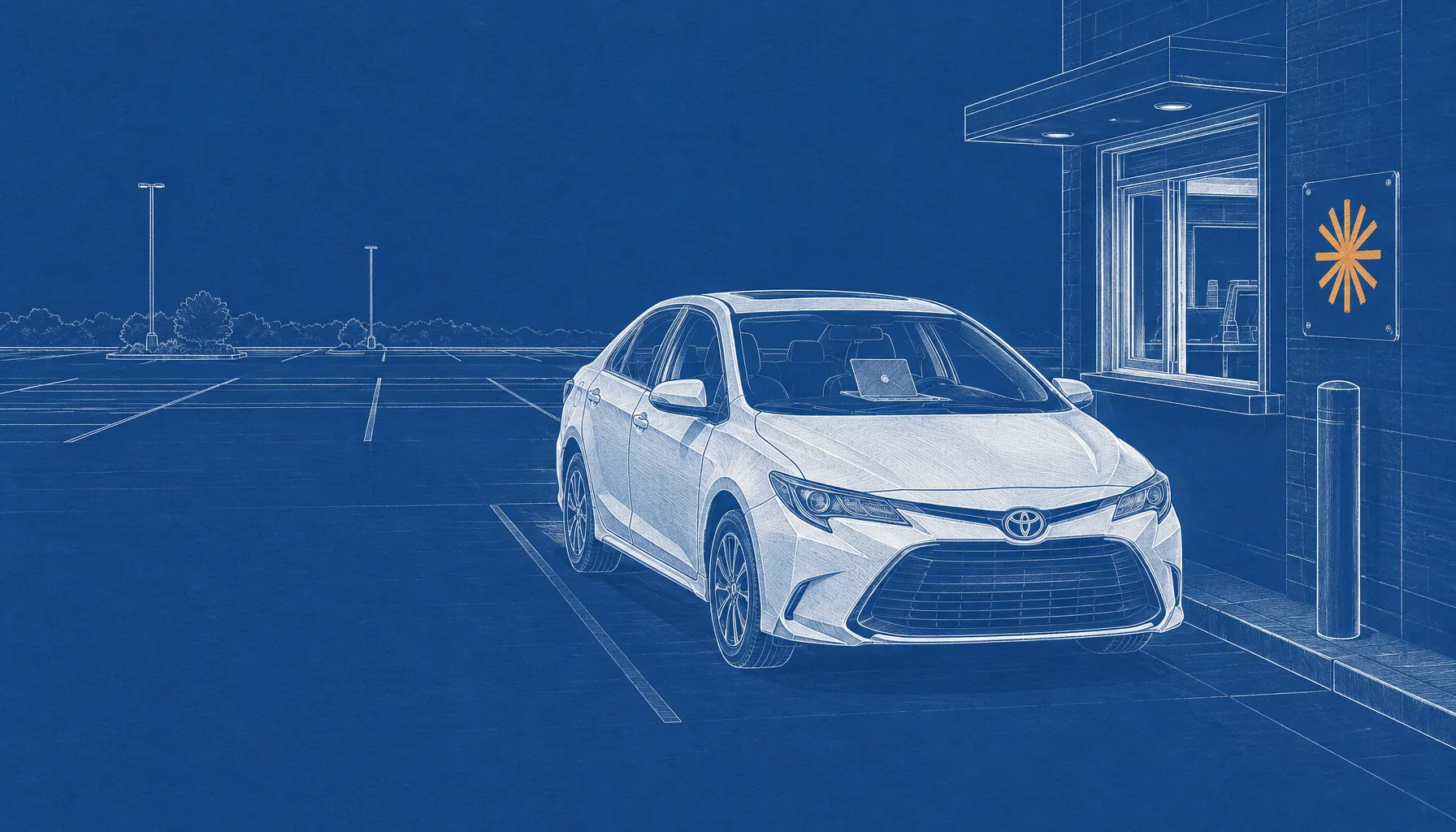
In a WIRED story published on October 7, three engineers described using OpenAI’s GPT-6 Astra to steer a 2024 Toyota Corolla through an In-N-Out drive-through near the Bay Area. A laptop connected the model to windshield-mounted cameras and the car’s power steering; a safety driver kept a foot poised over the brake. Astra moved the car to the takeout window, where the engineers collected lunch.
A drive-through test, not a driverless car
The experiment came from Aditya Ramabadran, Simon Mahns and Tobias Gessler, AI engineers at startup Axiom. They ran the project outside their work, WIRED reported, after wondering whether models that could build complex 3D simulations might also manage real-world navigation. The car was not operating without a human safeguard: the safety driver could intervene if the model went wrong.
That distinction matters. The test did not show that a general-purpose chatbot could replace a self-driving system built and trained specifically for roads. It showed that a model designed to handle text and images could, with cameras and steering connected, make enough decisions to move a car through one limited route.
Astra finished the course; Claude and Grok did not
The engineers also evaluated the models on DrivingBench, a benchmark they built around a simple course in a parking lot. GPT-6 Astra was the only model to complete it, and did so slowly. Anthropic’s Claude Fable 5.1 covered 45 percent of the course; Grok covered 11 percent.
Those results put the fast-food outing in perspective: a successful trip to a drive-through is not evidence of reliable driving across varied roads, traffic or hazards. The benchmark suggests the models remain far from passing even a simple driving test. The trial also depended on a safety driver, rather than testing whether a car could safely operate without human intervention.
Prompting helped models move beyond refusal
The team first tried SpaceXAI’s Grok, then tested newer models from OpenAI and Anthropic. At first, the systems refused to control the vehicles, returning responses such as, “I can help interpret road images, but I can’t issue motion commands to a physical car.” The engineers found that careful prompting could get them to go further.
That does not establish that the companies trained these models to drive. The engineers told WIRED they suspected the capability arose from training aimed at spatial reasoning, rather than from specific driving instruction. Mahns described it as a possible “emergent capability” from increasing multimodal training, which can include images, video and 3D models.
Real-world control raises a different safety question
The project’s significance lies less in the lunchtime destination than in the connection between model output and a moving vehicle. A model can make mistakes while interpreting a scene or choosing an action; when its output reaches steering, those errors can have physical consequences. WIRED reported that nothing alarming happened on the drive, but the engineers acknowledged the stakes of putting a general-purpose model in control of a fast-moving car.
Ramabadran said the models appeared to learn from errors while operating the vehicle: “The models really did seem to be adjusting or in-context learning based on their mistakes and learning how to better navigate the controls,” he told WIRED. That observation describes the team’s impression during the test, not proof of a dependable driving skill. For now, the clearest result is the benchmark split: Astra completed the parking-lot course, Claude reached 45 percent, and Grok reached 11 percent.