The Pulse
Meta Shows 102.4T Switches for Gigawatt-Scale AI Clusters
Meta detailed IcePack liquid-cooled network racks and IceCube 102.4-Tbps switches at the October 12, 2026, OCP Global Summit. The company also introduced a multiplane GPU fabric and open-source networking software while working with partner
AI.info Team · Written with AI ·
Meta is pushing for common, open networking standards even as its AI clusters depend on a mix of switch chips, network fabrics and cloud-provider systems. At the October 12, 2026, Open Compute Project Global Summit, the company detailed a 102.4-terabit-per-second switch platform and a new multiplane fabric, alongside open-source transport software and standards work with industry partners.
The hardware aims to connect denser AI clusters while managing the heat and complexity that come with higher bandwidth. But Meta’s own account also describes the challenge behind the pitch: cloud networks vary in topology, congestion behavior and transport, so making them operate as one system requires shared testing and engineering across vendors.
IcePack pairs liquid cooling with 102.4T switches
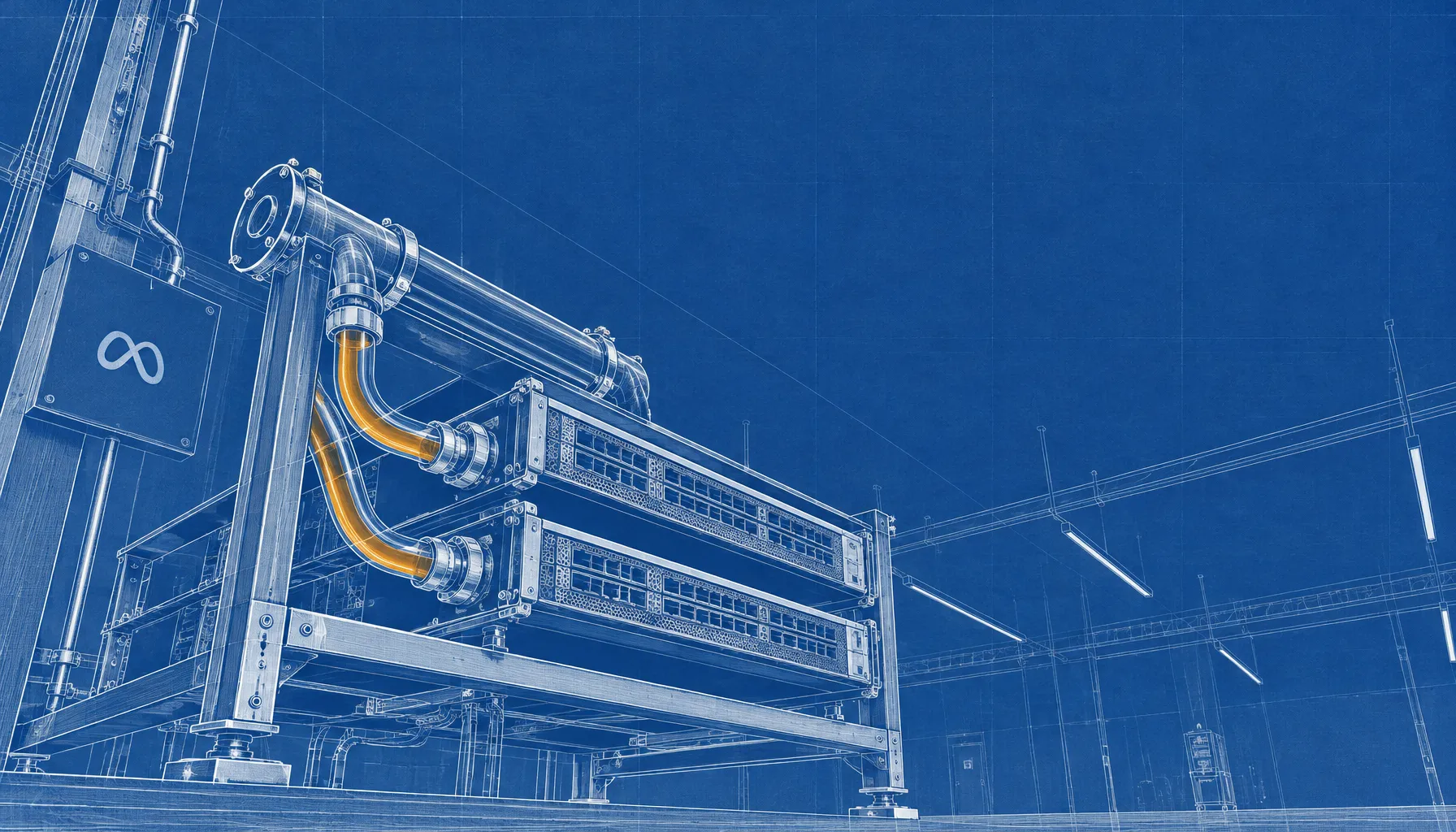
Meta’s IcePack is its first liquid-cooled network rack, built to the OCP ORV3-HPRv1 rack standard. It houses IceCube switch blades, each offering 102.4 Tbps of non-blocking capacity through 128 800-gigabit-per-second ports. Meta says that is twice the bandwidth of its 51.2T platforms.
IceCube comes in two versions: one built around Broadcom’s Tomahawk 6C switch ASIC and another using NVIDIA’s Spectrum-6 Switch ASIC. Both run Meta’s open-source FBOSS network operating system and use OCP’s Switch Abstraction Interface. Meta says the rack and switches are designed for higher power density and thermal efficiency as AI clusters expand toward gigawatt scale.
The design makes cooling part of the network platform rather than a separate data-center concern. It also pairs a common software stack with chips from two suppliers, a practical test of Meta’s push to make switching platforms more interchangeable.
Eight network planes replace a switch tier
Meta’s Flattened Planar Fabric, or FPF, changes how GPUs connect to the network. Each GPU links to eight separate switches through independent 100G connections, one for each network plane. Meta says the arrangement replaces the three-tier Clos design used in its earlier fabric with a two-tier design, reducing network hops, latency and infrastructure cost.
FPF also moves packet distribution closer to the accelerator: the network interface card spreads traffic across all eight planes in hardware. Its control plane spans hosts as well as switches, allowing hosts to steer traffic away from a failed plane. Meta says it developed the fabric with NVIDIA, drawing on NVIDIA Spectrum-X Multiplane technology, and is sharing lessons with cloud partners.
That partnership does not make cloud networking uniform by itself. Meta says providers differ in fabric topology, buffer depth, congestion control and even whether they use Ethernet with RoCE or InfiniBand. Its proposed response is a shared performance-validation suite that tests point-to-point and collective workloads from tens to more than a thousand GPUs before a cluster is handed over.
Open standards address the gaps between systems
Meta is also introducing Tahan, an Ethernet-based scale-up switch for its MTIA 300 training accelerators. Built on Broadcom’s 51.2-Tbps Tomahawk 5 ASIC, Tahan provides 64 800G ports; four switches connect 16 accelerators in a non-blocking topology. Meta says it uses the same RoCE transport as its scale-out network, bringing both fabrics under FBOSS.
A next-generation design would use 102.4-Tbps Broadcom Tomahawk 6C silicon. Meta previews eight 216-by-400G switches connecting 72 accelerators in a rack, with a future version planned to use OCP’s Ethernet for Scale-Up Networking, or ESUN, as its data plane. ESUN 1.0 has been released, Meta says, while work on version 1.1 is underway.
“The principle we keep applying is that heterogeneity is manageable but standardization is what makes it affordable,” write members of Meta’s Network Infrastructure team. The line captures the problem Meta’s standards efforts are meant to address: each difference between providers and hardware platforms adds testing and integration work.
OSPA and MetaRoCE broaden the open stack
Meta, Microsoft and Alibaba are co-leading the Open Switch Platform Architecture initiative at OCP. OSPA targets the switch platform layer beneath data-plane software, defining common interfaces for power sequencing, thermal controls, device inventory, management ports, firmware updates and diagnostics. Meta says the first specification has been submitted to OCP; the post does not describe it as an approved standard.
Meta also announced open-source implementations of MetaRoCE, its RDMA transport protocol for AI networks over Ethernet. The company says the software provides congestion control and reliability mechanisms for distributed training traffic. Alongside FBOSS and the OSPA and ESUN work, the release puts software, hardware interfaces and network behavior on the same agenda—while leaving adoption to the vendors and operators who must make those components work together.