The Pulse
Black Forest Labs Releases 7B FLUX 3 Action Robotics Models
Black Forest Labs’ FLUX 3 Action is a 7B open-weights model that predicts robot actions and future frames, with a 42.92% score on RoboLab-120.
AI.info Team ·
A 7B model posts a 42.92% RoboLab score
Black Forest Labs says its new 7-billion-parameter FLUX 3 Action model achieved a 42.92% success rate on RoboLab-120, placing first among the policies listed on the benchmark when the company published its release on September 23, 2026. The next model in the table, OASIS WAM, scored 39.0%; NVIDIA’s 16-billion-parameter Cosmos3-Nano-Policy scored 36.8%. The figures come from RoboLab’s simulation benchmark, not a measure of success across real-world robot deployments.
The company has released model weights for a general action-model base and two robot-specific policies, for the SO-101 arm and systems compatible with the DROID-trained Franka setup. The collection also includes shared encoders and optimization variants. Black Forest Labs describes the release as open-weight, rather than presenting it as unrestricted open-source software.
One sequence predicts motion and video
FLUX 3 Action takes camera frames, a robot’s current state and a text instruction, then predicts actions alongside future video frames. Black Forest Labs says the 7B diffusion transformer jointly denoises the action and video tokens; a frozen video encoder processes frames, while a frozen Qwen3-VL-4B encoder handles instructions. At runtime, the system can return 32 actions and, optionally, 32 decoded frames. The controller can execute some actions, take a fresh observation and plan again.
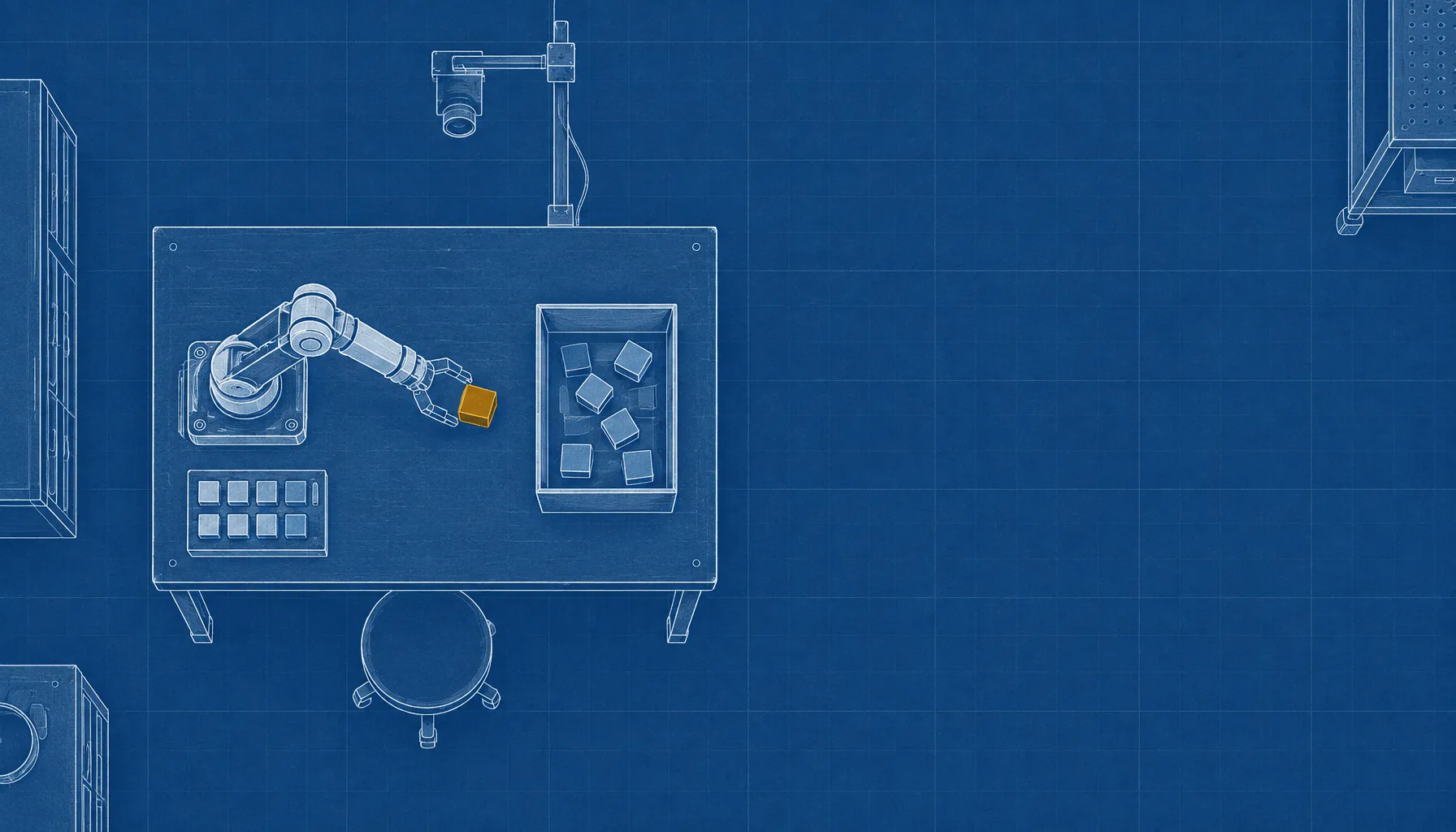
The release is designed for adaptation through LeRobot, the robotics software framework. Black Forest Labs says the SO-101 demonstration policy used about 200 teleoperated episodes covering related pick-and-place tasks. Its release post shows examples involving objects and containers not seen in training, but those demonstrations do not establish general reliability across robots, tasks or operating conditions.
Simulation results are not deployment guarantees
The RoboLab-120 table lists FLUX 3 Action at 42.92%, followed by OASIS WAM at 39.0%. The score is a useful point of comparison within that benchmark, but it does not mean the policy completes 42.92% of tasks in an arbitrary factory or home. The release post also describes training policies for two simple video games and an indoor drone in NVIDIA Isaac Sim; the company says the simulated flights were a fine-tuning set, not part of the model’s original training.
That range suggests the model is intended as a base for visual control beyond a single arm. Researchers and developers can inspect the weights, training recipe and game examples, while the robot-specific checkpoints offer starting points for adapting behavior to supported setups. Whether those results transfer to varied physical environments will require evaluation outside the benchmark and the demonstrations published with the release.
“Open weights” comes with license conditions
The weights are distributed under Black Forest Labs’ FLUX Kommunity License v1.0. The release identifies the license but does not detail its terms on the page.
That distinction matters for teams considering the models for deployed robot systems: access to downloadable weights does not by itself establish that every organization may use them in production. The launch gives developers a concrete set of checkpoints and an adaptation path; the benchmark score, hardware demonstrations and license define what the release has established—and what adopters still need to verify for their own systems.