The Pulse
Google Puts Gemini 4 Argon Into Robotics Workflows
Google presents Gemini 4 Argon in robotics examples spanning robot control, simulation and physical-task analysis. The demonstrations report specific results, but rely on defined robot setups, simulation tools and task-specific workflows.
AI.info Team · Written with AI ·
Google says Gemini 4 Argon can help robots handle tasks from simulation building to physical manipulation. But the examples the company published on October 13 depend on carefully specified robot interfaces and simulation software, rather than showing Argon operating as a self-contained robot controller.
“Using pure reasoning, Argon scores 87%, outperforming every other frontier model.”
Kanishka Rao, principal software engineer at Google, writes on the Google Developers Blog.
Rao’s post presents Argon as a general-purpose model for the robotics lifecycle and says it leads the Embodied Reasoning Question Answer (ERQA) benchmark. The score is Google’s claim; the announcement does not give an Argon-specific breakdown or describe the evaluation method in detail.
From camera feeds to robot commands
Google’s demonstrations span four areas: robot control, converting real-world scenes into simulations, interpreting physical activity in video, and improving robot actions through simulation and hardware trials. The variety is the point: Argon is positioned not as a specialized motion model, but as a reasoning model that can write code and work with visual and spatial information.
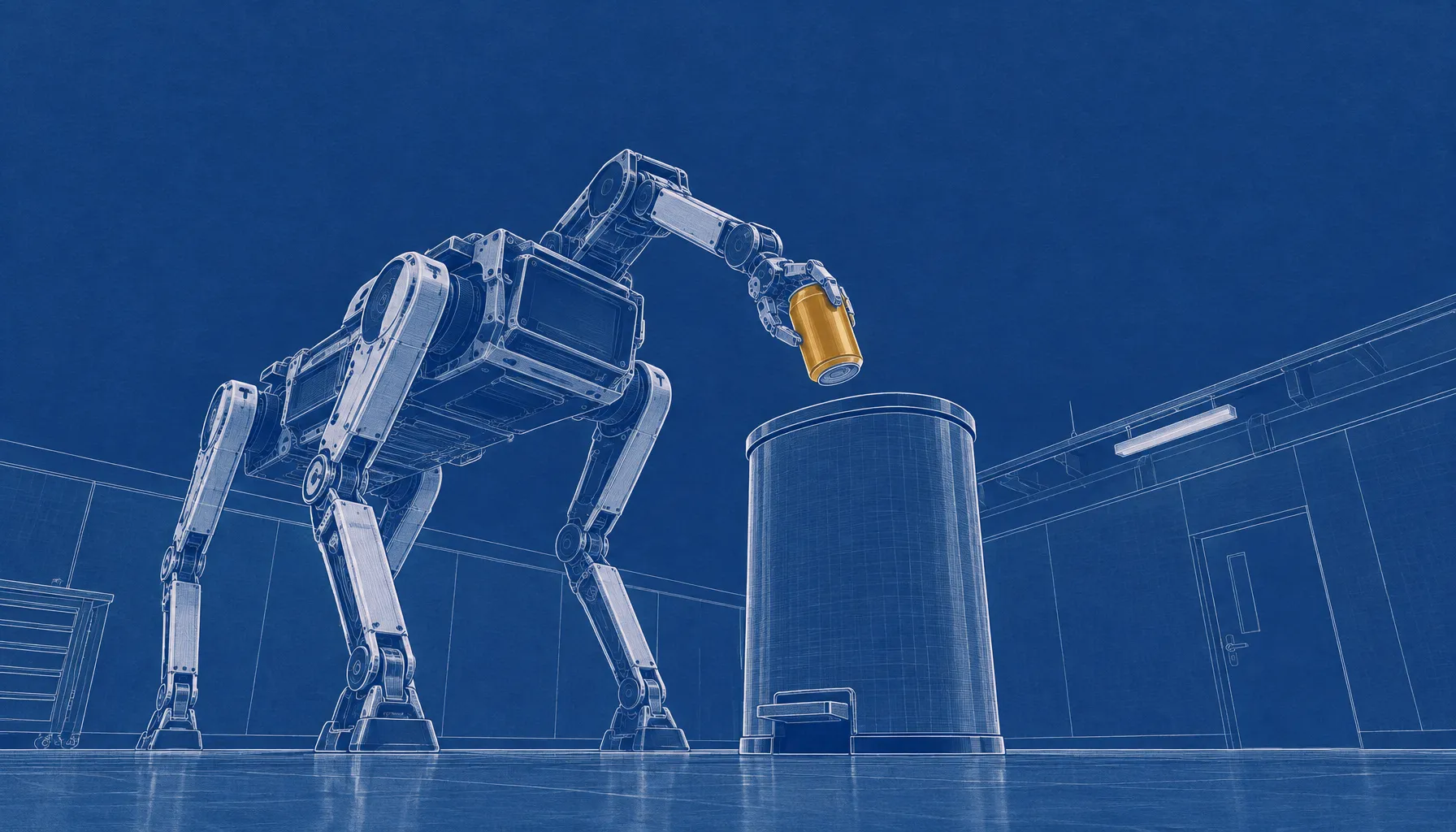
In one example, Argon guides a Boston Dynamics Spot quadruped with a six-degree-of-freedom arm through a foot-pedal-bin task. It builds a MuJoCo digital twin to practice the movement, then checks camera views to verify the robot’s foot placement on the pedal and its hand alignment over the bin. Another example has Argon reposition a fallen mug and place a napkin inside it, using calibrated camera coordinates and a supplied set of movement commands.
Those details also show what the demonstrations require around the model. The mug task provides a visual coordinate system, motion primitives and a feedback loop; the Spot example uses a robot-specific skill and a physics simulator. Google describes the scenarios as representative prompts, not as a general-purpose controller that can be connected to any robot without additional engineering.
Simulation results come with a hardware claim
Google says Argon can turn a single tabletop image into a calibrated MuJoCo environment, generate more than 4,500 randomized simulation episodes, and use them to improve a vision-language-action model. For one evaluation, the company reports that real-robot success rose from 56% to 75%, while task completion time fell from 35 seconds to 24 seconds.
The evaluation prompt specifies a bimanual workspace with two 7-DoF Franka FR3 arms, parallel-jaw grippers and four RGB cameras. Google presents the figures as an example of simulation-driven improvement, so they should not be read as a general measure of Argon’s performance across robots or tasks.
Google’s ERQA link leads to a public benchmark repository describing 400 multimodal, multiple-choice questions about spatial reasoning and real-world scenarios. That tests embodied reasoning in question-answer form; it is distinct from measuring how reliably a robot completes physical tasks. The announcement’s 87% benchmark result and its hardware example therefore speak to different capabilities.
The API is not a live robot interface
Developers can use the model ID gemini-4-argon through the paid Gemini API tier in AI Studio. Google’s API documentation lists text, image, video, audio and PDF inputs, with text output, and says the Live API is unsupported. The demonstrations nevertheless use iterative model feedback; a builder must supply the machinery that collects observations, sends them to the model and safely translates responses into robot actions.
Google’s October 13 post makes a broad case for Argon across robot development; its concrete examples show how much that promise still depends on simulation, calibrated sensors and task-specific control software.