The Pulse
Intrinsic Open-Sources Core Robotics Software Under Apache 2.0
Intrinsic announced Intrinsic Core, an open-source set of ROS-compatible capabilities for building industrial robotics applications, along with the Open Machine Tending Solution, a reference design for CNC machine tending.
AI.info Team ·
Intrinsic is opening core parts of its robotics platform under the Apache 2.0 license. The company announced Intrinsic Core on September 22, 2026, describing it as an open-source set of ROS-compatible capabilities for building industrial robotics applications.
The release was announced at ROSCon 2026 in Toronto and is intended to help developers build robotic applications without coding every capability or piece of infrastructure from scratch. Intrinsic says Core is available through GitHub and can be used with the Open Robotics Suite.
Intrinsic opens foundational robotics capabilities
Intrinsic Core combines ready-to-use capabilities and services for building AI-enabled robotics applications. The company says the components can be combined to create adaptive solutions for manufacturing and other industrial uses, while remaining compatible with the ROS ecosystem.
Released under a permissive Apache 2.0 license, Intrinsic Core includes a pre-configured software environment that runs on local hardware. It also includes a hardware-agnostic real-time control framework, asset models and a native digital twin. Intrinsic says developers can use the software for open research projects or private, on-premises production lines.
The open release is designed to work with Intrinsic’s other offerings. Applications built with Core can connect to enterprise services that include advanced AI models, the Intrinsic Flowstate development environment and industrial cloud services. Intrinsic says the approach is intended to provide more paths from prototype to production without requiring code rewrites when developers adopt those offerings.
Seven capabilities focus on industrial integration
Intrinsic Control is a hardware-agnostic, real-time control framework that provides sensor-based control. It allows a robot to adapt its behavior during a trajectory as conditions change and is designed to support different robot arms, grippers and sensors without requiring developers to rewrite drivers.
Pose estimation uses NVIDIA FoundationPose to provide six-degree-of-freedom estimates for three-dimensional parts. Intrinsic says the capability can help robots detect and handle parts dynamically, reducing the need for rigid physical fixtures.
Motion planning generates paths while avoiding collisions, replacing the need to program robots manually joint by joint. Grasp planning uses real-time sensor feedback to adapt different grippers to a part’s location and orientation.
The release also includes simulation services powered by Gazebo. These services let developers test and troubleshoot robotic applications as they build them, including application logic, state machines and workcell behavior. Camera calibration automates the process of aligning a robot’s camera and configuring its vision system.
Intrinsic-ROS drivers provide pre-configured, ROS-compatible drivers for supported robots, grippers and three-dimensional cameras. Intrinsic says the connection between sensor calibration and controls helps sensors and robots work together more quickly during application development.
Open Machine Tending Solution provides a reference design
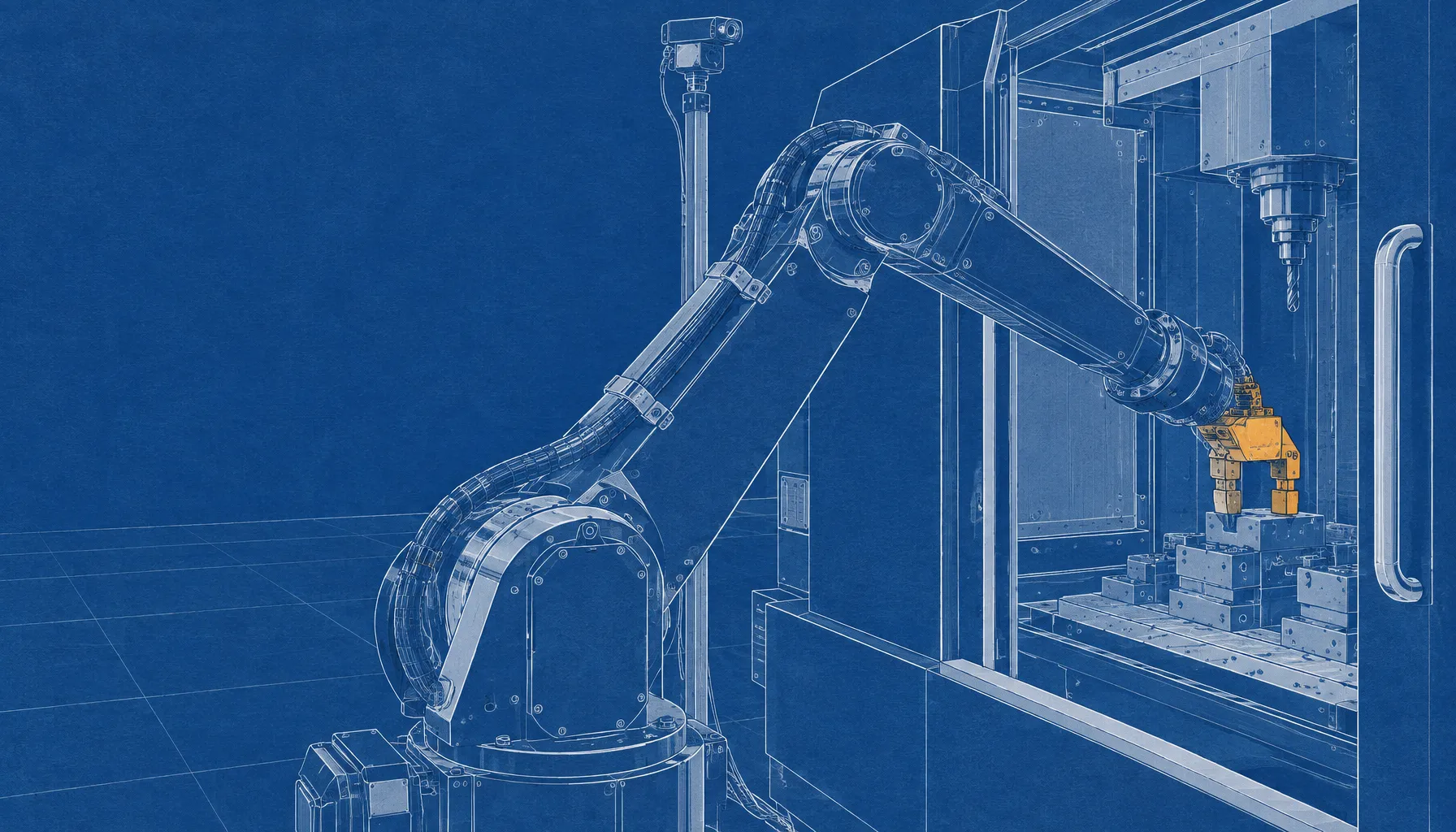
Alongside Intrinsic Core, the company released the Open Machine Tending Solution, or OMTS. The solution runs on Intrinsic Core and the Open Robotics Suite and serves as a reference design for an industrial CNC machine-tending application.
OMTS is intended to give developers and integrators a starting point for a real-world machine-shop use case. Intrinsic says the design can be customized for different assets, including hardware from FANUC and Universal Robots, as well as foundation models such as NVIDIA FoundationPose.
The company describes OMTS as the first in a planned series of open reference solutions. It says machine-tending systems could assist operators and automate lower-value tasks for fabricators and machine shops, many of which have limited access to automation.
Release follows interest from robotics developers
Intrinsic connected the release to the first AI for Industry Challenge, which focused on electronics assembly. The company said the challenge drew more than 5,000 developers and roboticists from 115 countries.
Intrinsic said the response demonstrated interest in using open-source tools, ROS, Intrinsic capabilities and artificial intelligence to address difficult manufacturing problems. Through Intrinsic Core, the company is making foundational capabilities available to developers who want to build similar industrial applications.
Intrinsic acknowledged that using Core still requires basic proficiency in robotics. The company invited developers to build with the project alongside the ROS community and others working on open robotics innovation.