The Pulse
Runway releases open weights for Praxis-1 robot control model
Runway has made Praxis-1 available under the Apache 2.0 license, including weights and code for adapting the robot control model. The company reports results from simulated and physical-robot tests, while noting difficulties with similar-looking objects and multistep instructions.
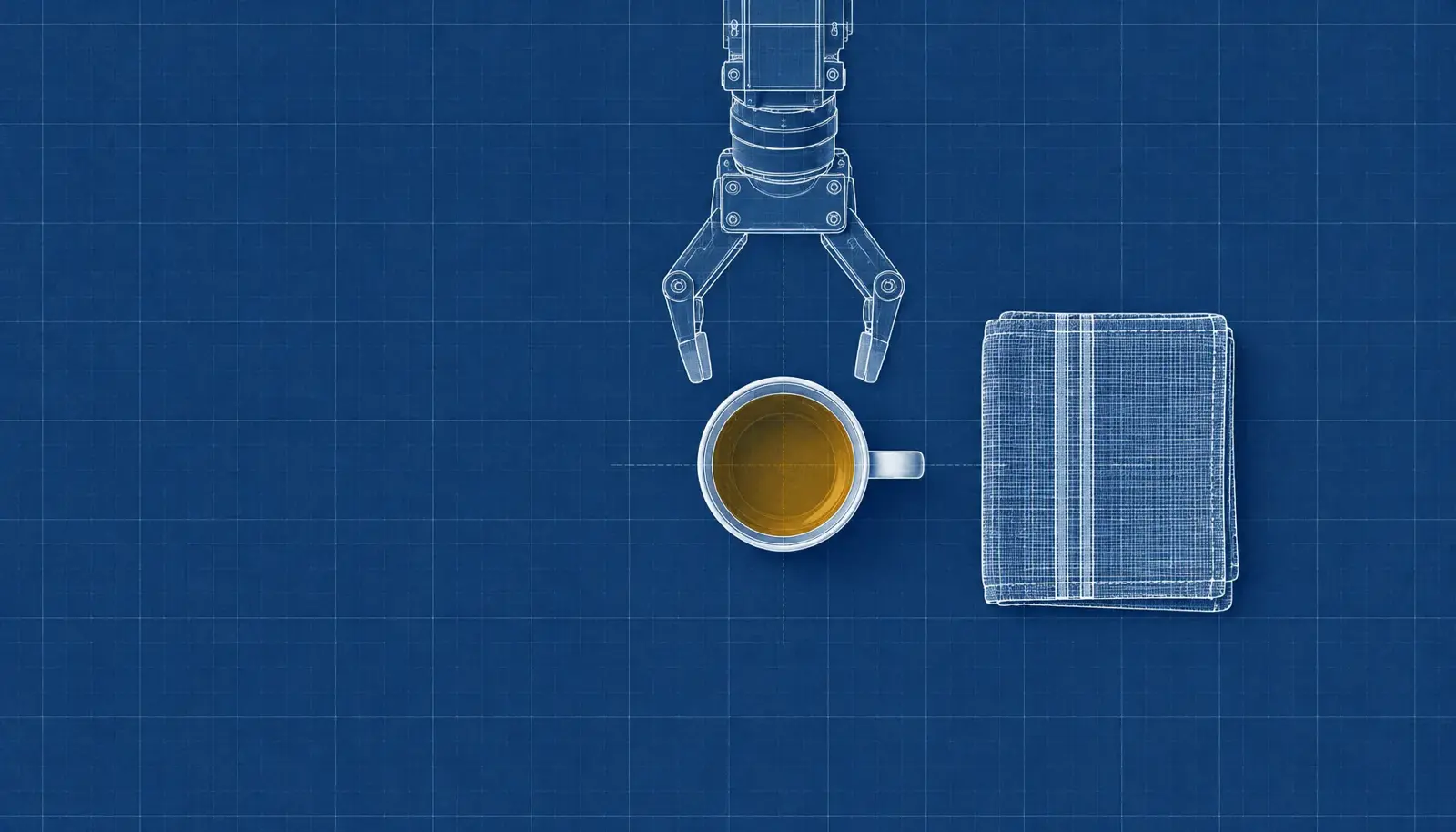
Runway has released the weights for Praxis-1, a robot control model built on its video pretraining, under the Apache 2.0 license. The release also includes inference and fine-tuning code for researchers and developers, including commercial users.
Runway introduced Praxis-1 in September as its first world action model. The company says launch partners Noble Machines, Standard Bots and Ultra have been running it on their own hardware, including a legged humanoid, an industrial arm and a dual-arm warehouse robot.
From video to movement
Praxis-1 is a 27-billion-parameter mixture-of-experts diffusion transformer that predicts video and actions together. Its video backbone forecasts what a scene will look like next, while a separate action expert reads the video features to determine movement.
On each call, the model takes an instruction, recent camera frames and the robot’s current pose. It returns predicted video alongside 1.6 seconds of actions, expressed as 24 action rows at 15 Hz; the robot then executes the actions and sends back camera frames for the next call.
Training proceeds through four stages, beginning with general video and moving through footage of hands and robots before introducing action targets. The final stage fine-tunes the model for a target robot, while retaining video prediction in the training objective.
Results in simulation and on an arm
In a simulated benchmark, Runway says Praxis-1 fine-tuned on the DROID dataset completed 555 of 1,200 episodes, a 46.2% success rate. RoboLab-120 consists of 120 tabletop tasks for a DROID-style arm, with 10 trials per task; FLUX 3 Action scored 42.9% on the leaderboard.
The company describes Praxis-1 as the highest-scoring world action model and open-source robot foundation model on that leaderboard at publication. The report says four entries scored higher overall, including two agents that directly use frontier models rather than trained policies.
Runway also tested the model on a physical Franka FR3 arm operated by Positronic, using FLUX 3 Action’s published single-item tasks. It reports that Praxis-1 succeeded in 88 of 100 episodes, compared with 80 for FLUX 3 Action, across 10 tasks run on the same rig.
In a separate simulation of Google’s RT-1 robot, Runway says a fine-tuned version reached 80.0% average success across four tasks, compared with 52.4% for the original RT-1 policy. The evaluation used SimplerEnv’s visual-matching grid, with 864 episodes.
Downloads and limitations
The release is available on GitHub and Hugging Face, with native LeRobot support, and in vLLM-Omni; hosted inference is available through Reactor. Runway is releasing three checkpoints: versions fine-tuned on DROID and the bimanual YAM robot, plus the base mid-trained model.
The technical report says the most common failure on a real robot is reaching for an object that resembles the intended target. It also says vague instructions are harder for the policy, while chaining several steps from a single prompt remains difficult; multistep tasks work when each step receives its own instruction.