The Pulse
NEURA Robotics Unveils Neuron AI for Robots That See, Feel and Remember
NEURA Robotics introduced Neuron AI, a physical-AI model that combines vision, touch, audio, robot state, language and memory. The company says it trained the model across five robot embodiments and plans an 11-minute laundry-handling demon
AI.info Team · Written with AI ·
NEURA Robotics introduced Neuron AI on October 14, describing it as a foundation model for robots that combines 3D vision, touch, audio, robot state, language and memory. The company says its Perception-Language-Action architecture connects sensory inputs with a robot’s past actions, so it can use information cameras miss and keep track of objects after they leave view. NEURA says the model was developed and trained in Metzingen, Germany.
Neuron AI combines sight with touch and sound
NEURA’s announcement focuses on tasks where visual input alone may not confirm what has happened. A robot opening a lock, for instance, could use touch and sound to determine whether the mechanism actually opened; a welding robot could assess a seam partly by listening to the process. The company says Neuron AI aligns sensory inputs over time rather than processing each sensor as an isolated stream.
Memory is another stated part of the design. NEURA says the model is adapted to retain context about objects that move out of view and about the consequences of a robot’s actions. The announcement does not provide independent test results, performance benchmarks or a commercial release schedule for the model.
“An intelligent robot needs a brain that brings its senses together and remembers what happened,”
David Reger, Founder and CEO of NEURA Robotics
Three sources of training data, five robot embodiments
NEURA says it trains Neuron AI with real-world robot data collected in its NEURA Gyms, simulated variations generated through its Data Amplifier and simulation stack, and demonstrations recorded by people wearing sensor-equipped data suits. The real-world data includes synchronized vision, touch, force, audio and movement information. The company says the combined training approach supports a shared model foundation across five of its robot embodiments, which use different grippers and hands.
After training and benchmarking in the NEURA Gyms, customers can deploy and update capabilities across fleets through the Neuraverse platform. NEURA says customers can fine-tune the model for their own tasks and keep those skills private. Customers who choose to share skills or deployment data can contribute to the broader ecosystem and future model development, the company says.
An 11-minute laundry sequence is the public test
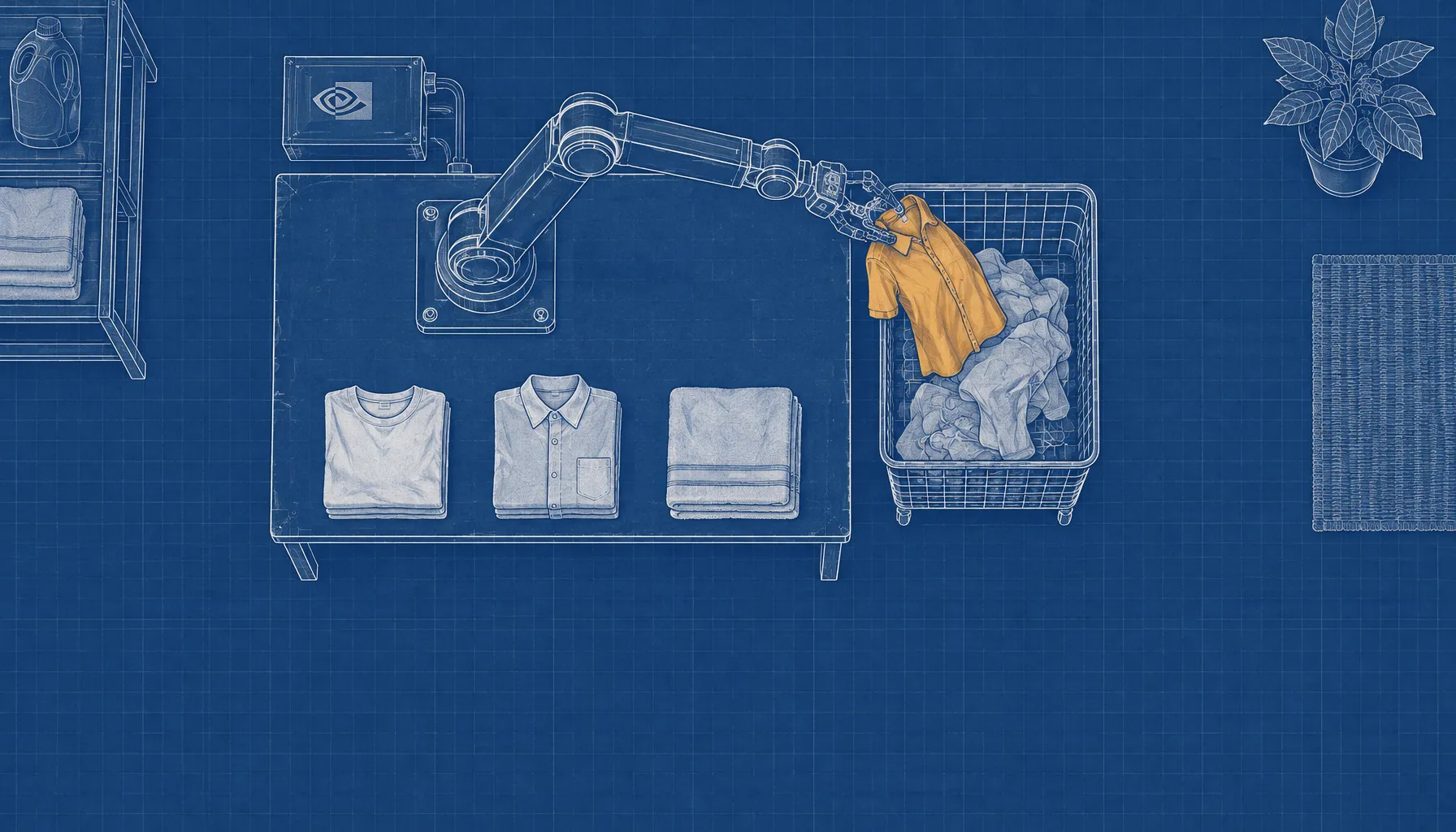
NEURA plans to demonstrate the current version of Neuron AI at NVIDIA GTC Berlin 2026, scheduled for October 20–22 at Station-Berlin. The company says its 4NE1 humanoid will perform an 11-minute sequence that includes sorting laundry, loading and reopening a washing machine, unloading it, and transferring garments to a dryer without human intervention. The demonstration is intended to show task coordination and the ability to carry context from one step to the next, not just isolated movements.
NEURA says data partnerships with industrial companies including Schaeffler and Bosch complement training in its own facilities. The release describes the model’s architecture, data sources and planned demonstration, but does not publish an evaluation dataset or quantitative measure of task reliability. Its public showing in Berlin is the next specified chance to see the system perform a multi-step physical task.