The Pulse
AstroForge puts its Solo AI system in command of a space probe
AstroForge is preparing to fly Solo, an in-house transformer-based control system, on spacecraft designed for deep-space missions. The company says the system could diagnose and correct anomalies without waiting for instructions from Earth.
AI.info Team ·
AstroForge wants its spacecraft to solve problems before Earth can respond
AstroForge is preparing to put an artificial intelligence system in command of a spacecraft, replacing some ground-based intervention with onboard decision-making. The startup’s Solo system is a transformer-based control stack designed to identify faults, connect symptoms across spacecraft systems and attempt corrective actions without waiting for a flight controller.
The plan addresses a problem AstroForge encountered directly. Its Odin spacecraft launched into deep space in 2025, but the company struggled to communicate with it and ultimately failed to regain control. Deep-space missions depend on a small number of powerful antennas and limited communication windows, leaving little time to respond when a vehicle develops a fault.
“Would that have been recoverable with all the data on the spacecraft? I don’t know, but I can tell you nothing onboard tried it, and I would love something onboard to try if the spacecraft is unrecoverable at launch,” Matthew Gialich, AstroForge’s co-founder and CEO, told TechCrunch.
Solo combines conventional controls with a transformer model
AstroForge is not handing every spacecraft function to a general-purpose chatbot. Armand Awad, the company’s head of flight software, said Solo combines traditional control algorithms with models trained on test data for individual subsystems, including power generation and navigation. An upper intelligence layer draws on data from about 2,500 spacecraft sensors.
The proposed system is narrow by design. Gialich described it as “a constrained autonomy at a very low sensor input,” rather than a general system capable of operating any spacecraft. That distinction matters because conventional spacecraft autonomy still relies heavily on deterministic control software, in part because neural networks can behave unpredictably in conditions that were not represented in their training data.
AstroForge’s example is a chain of small failures that could become serious if left unattended. Solo might detect that the spacecraft has lost its position estimate, associate a power irregularity with a malfunctioning star tracker and restart the affected hardware. Awad described the likely intervention simply: “probably turning it on and off in this case.”
DeepSpace-2 will test Solo before full autonomy
The company’s third spacecraft, DeepSpace-2, is scheduled to carry Solo in “shadow mode.” In that configuration, the system will observe spacecraft operations and generate recommendations while AstroForge’s engineers retain control. The test is intended to expose failures and measure the system’s performance before the company gives it authority over a later mission.
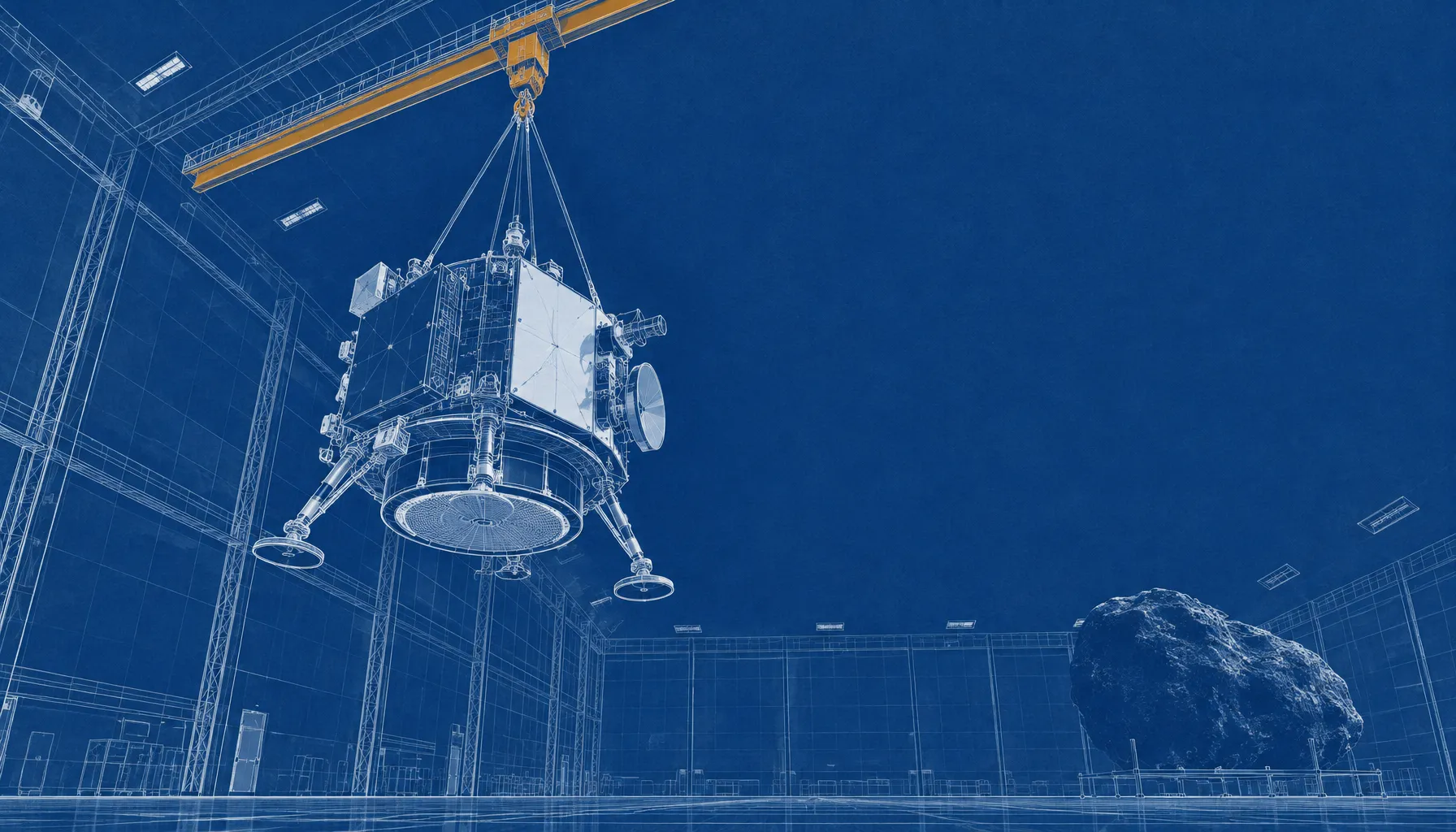
AstroForge has described DeepSpace-2 as a roughly 200-kilogram interplanetary vehicle built to travel millions of kilometers and rendezvous with a near-Earth asteroid. Earlier company material says the spacecraft will use a high-resolution monochrome camera to study the asteroid’s shape, structure and possible mineral composition. TechCrunch reports that DeepSpace-2 is expected to launch alongside Intuitive Machines’ third lunar mission by the end of 2026.
The immediate objective is not asteroid mining. DeepSpace-2 is a technology and reconnaissance mission, while Solo’s first fully autonomous flight is planned for 2027 on the first rocket launched by Stoke Space. That NASA-backed mission is expected to gather scientific data about the Sun.
AstroForge weighs software against a $200 million ground network
Gialich framed the decision as an economic tradeoff. Building a dedicated ground network with five dishes around the world, he said, would cost around $200 million before operating expenses. AstroForge is instead testing whether software can reduce the amount of infrastructure needed to keep a spacecraft alive and productive.
“The trade for me is: Do I go build my own ground network, which is going to cost [around] $200 million to put up five dishes around the world and then do operations on it, or do I try to remove it with a model?” Gialich said.
The choice also reflects the company’s history. Founded in 2022 and backed by $56 million in venture funding, AstroForge has launched two prototype spacecraft. Both suffered anomalies that kept them from achieving most of their mission objectives, according to TechCrunch. The startup is now treating onboard autonomy as a response to operational limits, not simply as a research project.
The most radical version would remove the radio
AstroForge’s proposed Autonomy-1 mission could push the idea beyond an automated backup system. Gialich told TechCrunch that he currently does not plan to install radios capable of receiving commands from Earth on that spacecraft, a decision that would force Solo to operate independently after launch.
“We have to go all in right now. The team’s probably going to talk me into it by the time we fly it. But right now, I’m telling them no radios,” Gialich said.
That plan is not final, and the shadow-mode test on DeepSpace-2 will come first. For AstroForge, the concrete measure of success will be whether Solo can respond correctly to real spacecraft conditions without turning a software experiment into another lost vehicle.