Research
You Don't Need Prompt Engineering Anymore: The Prompting Inversion
Overview Research area: Prompt engineering and LLM reasoning evaluation, specifically Chain-of-Thought (CoT) prompting, constrained/rule-based prompting, and how prompting effectiveness changes across
- arXiv
- 2510.22251
- Published
- 2025-10-25
- Authors
- Imran Khan
AI summary
Overview
Research area: Prompt engineering and LLM reasoning evaluation, specifically Chain-of-Thought (CoT) prompting, constrained/rule-based prompting, and how prompting effectiveness changes across model capability tiers.
Technical level: Intermediate. The experimental design and error taxonomy are easy to follow; some familiarity with CoT prompting and benchmark evaluation helps.
Scope (one sentence): The paper compares three prompting strategies (Zero Shot, standard CoT "Scaffolding," and a constrained "Sculpting" prompt) across three OpenAI model generations on the GSM8K math benchmark, documenting a reversal in which the constrained prompt helps a mid-tier model but hurts a more advanced one.
A note on completeness: the provided paper content is truncated mid-sentence in Section 6.2.2, so the conclusion, limitations, and Appendix A (full prompt texts) are not available in this content. Section 6.2.2 was discussing prompt engineering possibly being a transitional practice.
What This Paper Is About
The paper asks whether adding more rules and constraints to a prompt always makes a language model reason better. Using the GSM8K grade-school math word-problem benchmark, the author tests a heavily constrained "Sculpting" prompt against a simple step-by-step Chain-of-Thought prompt and a no-instruction baseline across gpt-4o-mini, gpt-4o, and gpt-5. The goal is to show that the value of a prompt is not absolute but depends on how capable the model already is.
Key Contributions
-
Empirical documentation of the "Prompting Inversion." The paper reports that the same constrained prompt that beat standard CoT on gpt-4o (97% vs. 93% on a 100-problem sample) underperformed it on gpt-5 (94.00% vs. 96.36% on the full 1,317-problem benchmark).
-
A proposed "Sculpting" prompting method. A constrained variant of CoT combining identity priming ("You are a pure mathematical reasoning engine"), negative constraints (no outside common sense or real-world knowledge), positive requirements (step-by-step arithmetic and a "Final Answer:" prefix), and an information constraint (use only problem-given numbers and relationships).
-
A qualitative error taxonomy across model generations. Hand-coded error categories (arithmetic error, semantic misparse, irrelevant knowledge, hyper-literalism, over-constraint, inference rejection) on the 100-problem sample, with worked case studies from named GSM8K items.
-
A "Guardrail-to-Handcuff" explanation and a capability-dependent crossover hypothesis. The constraints that prevent common-sense deviations in mid-tier models are argued to induce hyper-literalism, inference rejection, and incomplete solutions in advanced models.
Main Findings
-
Phase 2 baseline (gpt-4o-mini, 100 problems): Zero Shot 86.0% (86 correct, 14 incorrect), Scaffolding 91.0% (91/9), Sculpting 93.0% (93/7). Sculpting improved over Zero Shot by +7.0%.
-
Phase 3 (gpt-4o, 100 problems): Zero Shot 88.0% (88/12), Scaffolding 93.0% (93/7), Sculpting 97.0% (97/3). Sculpting's lead over Scaffolding was 4 percentage points, and its gain over Zero Shot grew to +9.0%.
-
Phase 4 inversion (gpt-5, 100 problems): Zero Shot 97.0% (97/3), Scaffolding 99.0% (99/1), Sculpting 97.0% (97/3). gpt-5's Zero Shot score matched gpt-4o's best prompted score, and Sculpting provided no benefit over Zero Shot.
-
Phase 5 full-benchmark confirmation (gpt-5, 1,317 problems): Zero Shot 94.00% (1238 correct, 79 incorrect), Scaffolding 96.36% (1269/48), Sculpting 94.00% (1238/79). Sculpting underperformed Scaffolding by 2.36 percentage points, and matched Zero Shot exactly.
-
Cross-model trend (100-problem sample): Zero Shot rose 86.0% to 88.0% to 97.0% across the three models; Scaffolding rose 91.0% to 93.0% to 99.0%; Sculpting followed an inverted-U at 93.0%, 97.0%, 97.0%. Sculpting's delta vs. Zero Shot was +7.0%, +9.0%, and 0.0%.
-
Guardrail effect on gpt-4o (gpt-4o, 100-problem sample): Sculpting's total errors were 3 versus 7 for Scaffolding. Sculpting eliminated semantic misparse (3 to 0) and irrelevant knowledge (2 to 0) errors, while incurring one hyper-literalism error and one over-constraint error. The paper attributes this to constraints blocking plausible but incorrect common-sense reasoning.
-
Handcuff effect on gpt-5 (gpt-5, 100-problem sample): Sculpting's total errors were 3 versus 1 for Scaffolding. Sculpting introduced 2 hyper-literalism errors and 1 over-constraint error while eliminating nothing; Scaffolding's single error was an inference rejection.
-
Error types shift with capability: The paper states gpt-4o struggles with semantic understanding and irrelevant knowledge, while gpt-5 struggles with constraint-induced rigidity.
-
Crossover hypothesis: Low-capability models (gpt-4o-mini) benefit moderately from constraints, mid-capability models (gpt-4o) benefit maximally, and high-capability models (gpt-5) are harmed by them, implying future optimal prompts trend toward simplicity.
Methodology in Plain English
-
Benchmark: GSM8K, described in the paper as 1,319 grade-school math word problems with multi-step solutions and a final numeric answer in
#### [Number]format. The author's parser successfully extracted answers for 1,317 of the 1,319 problems; the two with non-standard formats were excluded, forming the full evaluation set. -
Three prompts: Zero Shot gives the raw question only; Scaffolding appends standard CoT instruction ("Let's think step-by-step to solve this" plus a request for reasoning then a clear final answer); Sculpting adds the four-rule constrained prompt described above.
-
Answer checking: A hierarchical extractor searches first for a "Final Answer:" tag, then for LaTeX
\boxed{}, then falls back to the last number in the response. Answers are normalized by removing commas, converting to float, and comparing with a tolerance of epsilon = 0.01. The paper reports a parsing success rate above 99%. -
Sampling: Temperature = 0 (deterministic), with each model-prompt-problem combination queried exactly once. Because of this, confidence intervals cannot be computed, which the author acknowledges.
-
Phased plan to manage cost: Phase 1 smoke test (10 problems, gpt-4o-mini, which exposed a bug in the naive last-number extractor that misparsed roughly 15% of cases); Phase 2 baseline (100 problems, gpt-4o-mini); Phase 3 hypothesis H1 (100 problems, gpt-4o); Phase 4 hypothesis H2 (100 problems, gpt-5, where the inversion appeared); Phase 5 full validation (1,317 problems, gpt-5).
-
Models: gpt-4o-mini-2024-07-18, gpt-4o-2024-08-06, and gpt-5-preview-2024-10-01, described as three capability tiers.
-
Error analysis: All errors from the 100-problem sample were manually reviewed; the author identified the diverging reasoning step, categorized the error type, and compared patterns across prompts.
Why This Matters
Impact on research. The paper argues against the assumption that more structured prompting is universally better, and instead frames prompt quality as relative to model capability. It claims that prompt libraries and best practices should be versioned by capability, that prompt evaluation should run on the target model rather than a proxy, and that transfer assumptions across capability gaps are invalid. It also hypothesizes an alignment-related mechanism: because reinforcement learning from human feedback optimizes models toward natural, conversational instructions, formal rigid prompts may represent a distributional shift.
Real-world applications (bullets):
-
Model migration planning: Teams upgrading from a model like gpt-4o to a more capable successor would need to re-test elaborate prompt templates, since a template tuned on the older model can lose accuracy on the newer one (94.00% vs. 96.36% in this study).
-
Prompt library maintenance: Organizations maintaining separate prompt sets per model generation, or a single unified set, can weigh the trade-off the paper outlines (model-specific optimization, unified approach, or adaptive prompting).
-
Cost-aware reasoning pipelines: The reported heuristic uses validation accuracy thresholds: below 90% suggests constrained prompting, above 95% suggests simple prompting, otherwise test both.
-
Evaluation and QA tooling: The hierarchical answer-extraction protocol and error taxonomy suggest reusable infrastructure for scoring deterministic LLM runs on math-style benchmarks.
Industry relevance. The practical guidance is that elaborate prompt scaffolding is most valuable in the middle of the capability range, and that simpler prompts may suffice or perform better as models improve. Because each configuration was run once at temperature 0, the paper cannot report confidence intervals, so organizations should validate these patterns on their own tasks and models.
Future Directions
-
Test the inversion beyond GSM8K and beyond OpenAI models. The study uses one math benchmark and three models from a single family; whether the pattern holds for other tasks, domains, and model providers is not reported.
-
Move from single deterministic runs to repeated sampling. Because each model-prompt-problem combination was queried exactly once, confidence intervals could not be computed, and the author notes the inversion was confirmed on the full 1,317-problem set instead.
-
Develop and validate adaptive prompting. The paper proposes choosing constrained versus simple prompts based on measured validation accuracy thresholds (below 90%, above 95%, otherwise test both) but does not report an implementation or evaluation of such a system.
-
Investigate the proposed RLHF/alignment mechanism. The distributional-shift explanation for why rigid prompts hurt advanced models is stated as a hypothesis, not tested experimentally.
-
Re-test with newer generations. The paper frames prompting effectiveness as co-evolving with model capability, which implies ongoing re-evaluation as each new model tier is released.
Target Audience
Practitioners and researchers who design prompts for LLM deployments, especially those maintaining prompt libraries across multiple model versions or planning upgrades. It is also relevant to evaluation engineers building answer-extraction and error-analysis pipelines, and to researchers studying Chain-of-Thought, constrained prompting, and capability scaling. Readers looking for statistical rigor should note the single deterministic run per configuration and the 100-problem samples for gpt-4o-mini and gpt-4o, with full-benchmark validation reported only for gpt-5.
Authors’ abstract
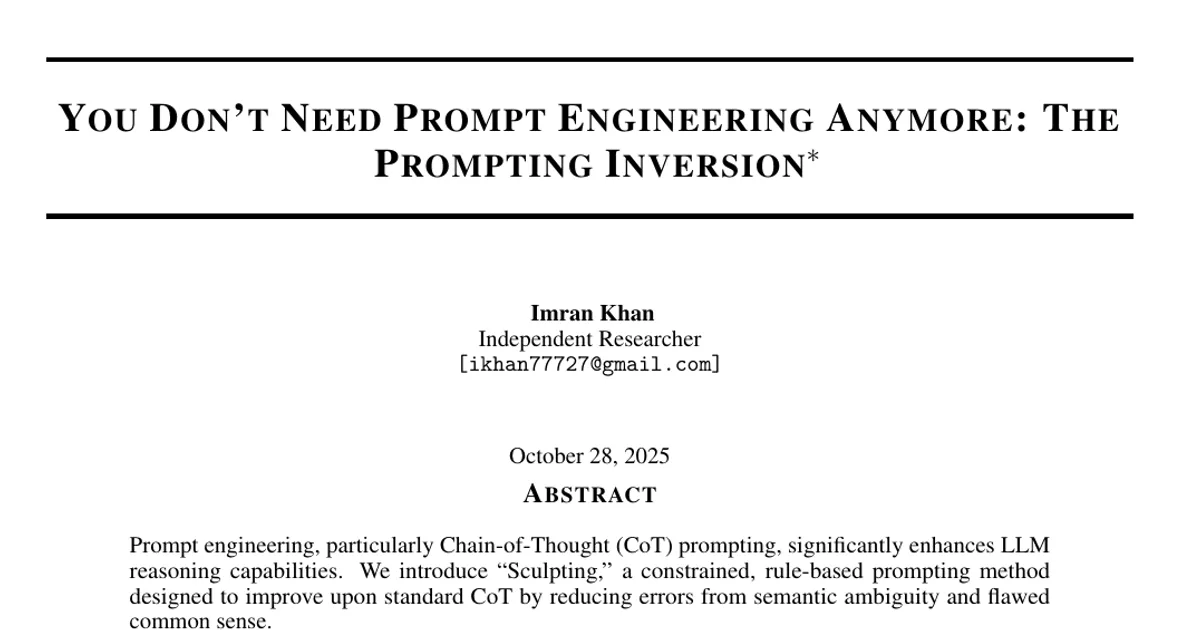
Prompt engineering, particularly Chain-of-Thought (CoT) prompting, significantly enhances LLM reasoning capabilities. We introduce "Sculpting," a constrained, rule-based prompting method designed to improve upon standard CoT by reducing errors from semantic ambiguity and flawed common sense. We evaluate three prompting strategies (Zero Shot, standard CoT, and Sculpting) across three OpenAI model generations (gpt-4o-mini, gpt-4o, gpt-5) using the GSM8K mathematical reasoning benchmark (1,317 problems). Our findings reveal a "Prompting Inversion": Sculpting provides advantages on gpt-4o (97% vs. 93% for standard CoT), but becomes detrimental on gpt-5 (94.00% vs. 96.36% for CoT on full benchmark). We trace this to a "Guardrail-to-Handcuff" transition where constraints preventing common-sense errors in mid-tier models induce hyper-literalism in advanced models. Our detailed error analysis demonstrates that optimal prompting strategies must co-evolve with model capabilities, suggesting simpler prompts for more capable models.