Research
XR Design Framework for Early Childhood Education
Overview Research area: Human-Computer Interaction (cs.HC), specifically extended reality (XR) — augmented reality (AR), virtual reality (VR), and mixed reality (MR) — used in early childhood educatio
- arXiv
- 2601.18979
- Published
- 2026-01-26
- Authors
- Supriya Khadka, Sanchari Das
AI summary
Overview
- Research area: Human-Computer Interaction (cs.HC), specifically extended reality (XR) — augmented reality (AR), virtual reality (VR), and mixed reality (MR) — used in early childhood education (ECE), with attention to privacy and child safety.
- Technical level: Beginner-Friendly. The paper is conceptual and review-based; its only formal notation is a single interaction function, and the bulk of the work is a structured literature analysis with visual matrices.
- Scope (one sentence): The paper proposes the Augmented Human Development (AHD) framework and grounds it in a Systematization of Knowledge (SoK) of 111 peer-reviewed studies of children aged 3–8 to show where XR research attention is misaligned with real-world risk.
What This Paper Is About
XR tools are engaging for young children, but systems calibrated for adults can overload or disorient a child whose cognitive, motor, and sensory abilities are still developing rapidly. The authors argue that no structured framework exists linking XR system properties to cognitive load and access inequity, so they build one — the AHD framework — and then test it against the published literature. Their goal is to identify which risks are genuinely studied and which are being ignored.
Key Contributions
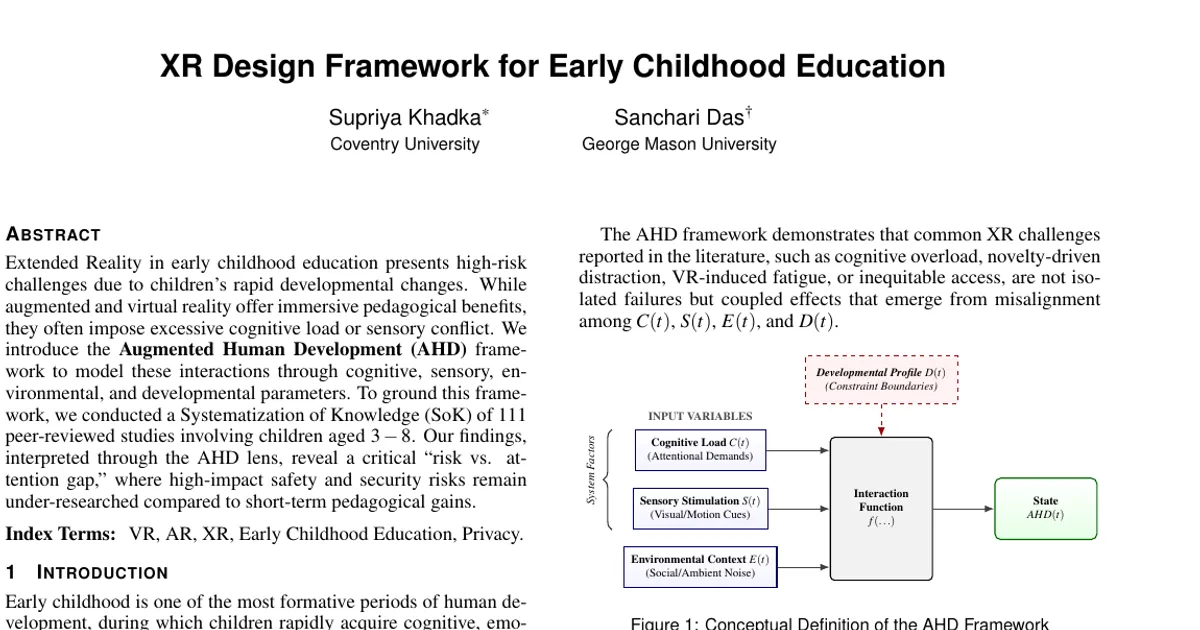
- The Augmented Human Development (AHD) framework, which models a child-system interaction at any moment t as AHD(t) = f(C(t), S(t), E(t), D(t)), where the four parameters are Cognitive Load, Sensory Stimulation, Environmental Context, and Developmental Profile.
- A Systematization of Knowledge (SoK) of 111 peer-reviewed studies (2010–2025) involving children aged 3–8, filtered from 2,198 records across eight databases.
- A scoring scheme that separates academic attention from real-world risk: studies were scored on a 0–2 scale (0 = not addressed, 1 = mentioned, 2 = substantively discussed) across seven dimensions, with Scholarly Attention defined as the mean score per dimension, and an independently calculated Real-World Risk score (Likelihood × Impact) on a 1–9 scale informed by external standards such as NIST and WHO.
- The "risk vs. attention gap" — a Risk vs. Attention Matrix that plots the seven dimensions and identifies blind spots where high risk meets low scholarly attention.
Main Findings
- AHD reframes failures as coupled effects: cognitive overload, novelty-driven distraction, VR-induced fatigue, and inequitable access are presented not as isolated failures but as effects emerging from misalignment among C(t), S(t), E(t), and D(t).
- Technology distribution is skewed: among the 111 studies, AR dominates at 73%, followed by VR at 20% and MR at 4.5%. Deployments relied mostly on mobile and tablet-based systems (63%), with head-mounted displays at 9.9% and specialized custom setups at 13.5%.
- Bio-technical mismatches drive handheld AR failure: monocular camera sensing in handheld AR demands a stability that exceeds the fine motor control of children aged 3 to 8, producing visual jitter, frequent tracking loss, and interaction breakdowns.
- Immersive VR fails on hardware and anthropometric fit: standard head-mounted displays do not account for early childhood cranial dimensions, leading to optical misalignment, occlusion, and musculoskeletal strain, plus neuro-vestibular conflict when visual motion cues diverge from vestibular signals, increasing cybersickness risk.
- Positive outcomes may be short-term: 107 of the 111 studies report positive learning outcomes, but the authors argue many reflect novelty rather than sustained conceptual understanding. Elevated sensory stimulation can produce a "cognitive tunnel" where children attend to interface mechanics instead of instructional content.
- Text-based instructions exclude pre-literate users and force continuous adult mediation; limited teacher readiness compounds these problems.
- Data security is the clearest blind spot: it receives the least scholarly attention (0.14) while carrying the maximum risk score (9).
- Disability access is similarly neglected (Attention: 0.52), suggesting systems are optimized for neurotypical users rather than developmental variability.
- Privacy and low-resource access are high-risk but underexamined technically: both have risk scores of 9, with attention scores of 1.04 and 0.92 respectively. The paper notes privacy is often treated as a procedural matter handled through parental consent rather than through technical safeguards such as data minimization and on-device processing.
- Pedagogy and technical challenges get the most research focus (Attention: 1.56 and 0.96), but correspond to comparatively lower risk levels (4 and 2) because effects such as novelty-driven distraction tend to be transient.
- Health falls in the "ignored" quadrant: risk score 4 with attention of 0.81, indicating the field prioritizes cognitive engagement while under-addressing physiological constraints and sensory thresholds.
Methodology in Plain English
The authors first built a conceptual model describing a child's XR experience as the interaction of four things: how much thinking and attention the system demands, how much visual and motion stimulation it delivers, the classroom and social setting including teacher mediation, and the child's own developmental profile of age, motor ability, and sensory thresholds. They then searched eight databases (ACM Digital Library, IEEE Xplore, Scopus, ERIC, ProQuest, Taylor & Francis, Wiley Online Library, and EBSCOhost) and narrowed 2,198 records down to 111 peer-reviewed studies from 2010 to 2025 involving children aged 3–8. For each study they extracted metadata, participant information, and feasibility details, and scored it on a 0–2 scale across seven dimensions: Pedagogy, Privacy, Data Security, Medical/Health, Technical, Disability Access, and Low-Resource Access. The mean score per dimension became the "Scholarly Attention" measure. Separately, they assigned each dimension a Real-World Risk score by multiplying likelihood by impact on a 1–9 scale, drawing on external standards from bodies such as NIST and WHO. Plotting attention against risk produced the matrix that exposes the gap.
Why This Matters
- Impact on research: The paper supplies a shared vocabulary and a diagnostic scaffold for a field that has largely measured XR success through short-term learning gains. By separating scholarly attention from real-world risk, it makes under-researched high-risk areas visible rather than implicitly treating research volume as a proxy for importance.
- Real-world applications:
- Designing AR/VR classroom tools with interaction vocabularies suited to pre-literate children and limited fine motor control, rather than text-heavy interfaces requiring constant adult help.
- Sizing and fitting head-mounted displays for early childhood cranial dimensions, and designing to reduce neuro-vestibular conflict and cybersickness.
- Building data minimization and on-device processing into educational XR platforms rather than relying only on parental consent procedures.
- Extending accessibility design to children with disabilities and to low-resource settings where low-cost devices are the realistic option.
- Industry relevance: Educational technology developers, hardware makers, and school procurement teams all receive concrete criteria — ergonomics, sensing reliability, privacy engineering, accessibility, and cost — against which to evaluate whether a product is developmentally appropriate, not merely engaging.
Future Directions
- Technical safeguards for privacy and security: the paper identifies that privacy is often handled as a procedural consent issue, leaving open how data minimization and on-device processing would be implemented in children's educational XR.
- Designing for developmental variability: with disability access at 0.52 attention, it remains an open question how systems should accommodate special needs rather than optimizing sensing and interaction for neurotypical users.
- Ergonomics and health research: health sits in the ignored quadrant (risk 4, attention 0.81), raising the unresolved question of how to characterize and mitigate physiological strain, cybersickness, and sensory thresholds for children aged 3–8.
- Distinguishing novelty from durable learning: since 107 of 111 studies report positive outcomes but the authors question whether these persist, the field needs methods that measure sustained conceptual understanding rather than immediate engagement.
Target Audience
This paper benefits HCI and child-computer interaction researchers, XR designers and developers building educational products, early childhood educators and curriculum specialists, and policy or procurement staff evaluating classroom technology. It is also accessible to readers new to the area, since the argument rests on a clear four-parameter model and a visual risk matrix rather than advanced technical machinery.
Authors’ abstract
Extended Reality in early childhood education presents high-risk challenges due to children's rapid developmental changes. While augmented and virtual reality offer immersive pedagogical benefits, they often impose excessive cognitive load or sensory conflict. We introduce the Augmented Human Development (AHD) framework to model these interactions through cognitive, sensory, environmental, and developmental parameters. To ground this framework, we conducted a Systematization of Knowledge (SoK) of 111 peer-reviewed studies involving children aged 3 - 8. Our findings, interpreted through the AHD lens, reveal a critical "risk vs. attention gap," where high-impact safety and security risks remain under-researched compared to short-term pedagogical gains.