Research
WorldPlay2: Extending Real-Time Interactive World Models in Control and Horizon
Overview Research area: Computer Vision — generative video world models, specifically real-time interactive world models built on diffusion/flow-matching video generators. Technical level: Advanced. T
- arXiv
- 2609.35560
- Published
- 2026-09-28
- Authors
- Haiyu Zhang, Wenqiang Sun, Tengfei Wang, Junta Wu, Jun Zhang, Yunhong Wang, Yu Qiao, Chunchao Guo
AI summary
Overview
Research area: Computer Vision — generative video world models, specifically real-time interactive world models built on diffusion/flow-matching video generators.
Technical level: Advanced. The paper assumes familiarity with autoregressive video diffusion, distribution-matching distillation, teacher-student training, and memory compression.
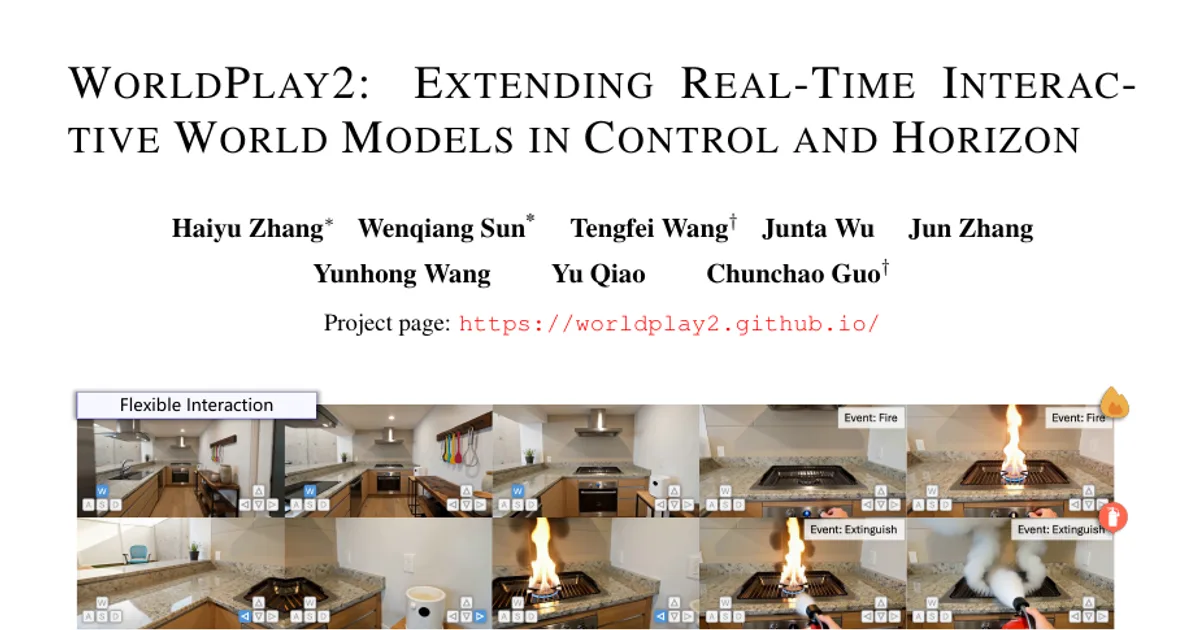
Scope: WorldPlay2 is a single interactive world model that combines a factorized control interface, compressed memory tokens, and a stable distillation scheme ("Stable Forcing") to deliver real-time, controllable, long-horizon video generation.
What This Paper Is About
Interactive world models must respond in real time to user controls while keeping a consistent world state over long rollouts. Two obstacles stand in the way: heterogeneous control signals (precise camera/character motion versus high-level semantic events) are hard to combine without entangling appearance, identity, and events, and long-context modeling plus few-step distillation make stable long-horizon training computationally prohibitive. WorldPlay2 addresses both by co-designing a factorized control interface with compressed memory and a stable distillation framework.
Key Contributions
-
Factorized hybrid control interface. Control is split into frame-aligned action control (continuous camera pitch and yaw, discrete longitudinal and lateral movement, camera perspective, and a special jump action) and structured semantic control, which is a structured caption partitioned into three decoupled fields: scene, character, and event. This explicitly disentangles scene appearance, character identity, and dynamic semantic events.
-
Distillation-oriented compressed memory. A learnable history compressor encodes history into compact memory tokens shared by the autoregressive student and the bidirectional teacher. The representation combines sink tokens, compressed memory tokens produced by a dual-branch (coarse plus fine residual) compressor, and adjacent temporal tokens. The paper reports this reduces sequence length by a factor of approximately l·s² = 32, where l = 2 is temporal downsampling and s = 4 is spatial downsampling.
-
Stable Forcing. A long-horizon distillation framework with three parts: few-step initialization that extends PDD to the memory-augmented autoregressive student, full-rollout replay that decouples the rollout phase from gradient backpropagation by caching a random intermediate denoising timestep per chunk, and efficient clip-wise score evaluation in which a long rollout of B clips is scored clip by clip conditioned on compact memory tokens.
-
RevisitBench. A new evaluation benchmark of 200 revisit trajectories, curated from WBench and self-collected validation sets, following the protocol in Sun et al. (2026), used to measure long-horizon geometric consistency under loop-closure trajectories. An additional 145 held-out samples from WBench and the interactive event dataset are used to test responsiveness to interactive events, scored by a VLM (Seed, 2025) acting as an automated evaluator.
Main Findings
-
Best overall average on WBench. WorldPlay2 (full) reaches an average score of 83.1, surpassing the previous state-of-the-art baseline Alaya-Evoke-Turbo (82.0) by 1.1 points. Full numbers for WorldPlay2: Quality 81.8, Setting 81.5, Interaction 88.3, Consistency 90.0, Physical 74.0.
-
Large margin on long-horizon geometric consistency (RevisitBench). WorldPlay2 records PSNR 19.71, SSIM 0.613, LPIPS 0.318, and MEt3R 0.105, compared with, for example, WorldPlay at PSNR 17.05, SSIM 0.553, LPIPS 0.416, MEt3R 0.179, and AlayaWorld at PSNR 13.61, SSIM 0.399, LPIPS 0.569, MEt3R 0.244.
-
Stable Forcing drives the gains. Without Stable Forcing, the model scores an average of 79.0 on WBench, PSNR 16.52, SSIM 0.535, LPIPS 0.439, and MEt3R 0.215 — below the full model's 83.1, 19.71, 0.613, 0.318, and 0.105.
-
Dominant interactive-event responsiveness. On the interactive-event evaluation (Average / Environment and Object change / Complex Interaction), WorldPlay2 scores 74.7 / 79.2 / 70.1. The next best, Lingbot-World-V2, scores 52.5 / 61.5 / 43.4, and AlayaWorld scores 39.4 / 48.3 / 30.5.
-
Compressed memory keeps quality at lower cost. At the same sequence lengths, compressed memory substantially reduces both GPU memory consumption and iteration time relative to a full-context baseline, and achieves long-horizon geometric consistency comparable to the full-context counterpart when trained on 96 latents.
-
Full-context distillation is slower and does not scale. Distilling with the full-context teacher requires substantially longer wall-clock time (261s vs. 167s per iteration) than the compressed-memory approach, and extending the full-context teacher to longer-horizon distillation (e.g., 320 latents) triggers out-of-memory issues.
-
Ablations confirm control design. Removing the interactive event dataset limits responsiveness to semantic events, while adding even a small fraction of interactive data unlocks those capabilities. Omitting structured semantic control causes the model to conflate foreground characters with background scenes and degrades navigation controllability. Removing full-rollout replay causes progressive quality degradation and eventually mode collapse with ground artifacts; PDD initialization mitigates blurry outputs and grid-like artifacts.
-
Real-time deployment. The model generates at 16 FPS on 8 H20 GPUs, using computation graph fusion, low-bit quantization, KV caching, and a lightweight VAE.
Methodology in Plain English
The team starts from a base video diffusion model and trains it in stages. First, they train on a spatial navigation dataset to learn navigation controls. Then they add a memory compressor using a two-stage training regime from Zhang et al. (2026a) to improve long-horizon geometric consistency. Next, they convert the bidirectional model into a chunk-wise autoregressive model through teacher forcing, and give it a few-step capability via PDD initialization. Finally, they apply distribution-matching distillation to produce the deployed world model.
To handle controls, they split every control signal into two parts: a low-level action vector (continuous camera pitch/yaw plus discrete movement choices, embedded separately and combined, then injected before the feed-forward network in each Transformer block) and a structured caption with three separate fields for scene, character, and event.
To handle long horizons, instead of keeping all past frames at full resolution, they compress history into a short sequence of memory tokens using a dual-branch compressor — a coarse branch that patchifies low-resolution, low-frame-rate latents and a fine branch that downsamples full-resolution latents for residual detail. Because both the student and the teacher use this same compact memory, the teacher can score the student's rollout one clip at a time rather than over the entire rollout.
To make distillation stable, they first warm-start the student with PDD so its few-step output distribution is close to the teacher's, then run distribution-matching distillation with full-rollout replay: during the forward rollout every chunk is sampled fully in few steps, and only a randomly recorded intermediate denoising step is replayed with gradients afterward.
Why This Matters
Research impact. The paper argues that prior interactive world models treat memory design and distillation as separate concerns, and rely on retrieval, sparse attention, or explicit 3D representations for long-horizon consistency — each with failure modes the paper attributes to camera pose drift, fixed context windows, memory decay, or metric scale ambiguity across chunks. WorldPlay2's co-design shows that a compact memory shared between teacher and student can simultaneously reduce training cost and make long-horizon distillation tractable, and that initialization matters for keeping few-step autoregressive rollouts stable.
Real-world applications (as framed by the paper):
- Interactive entertainment and gameplay: navigating and steering characters through generated environments in real time.
- Embodied intelligence: world models as scalable data generators and policy evaluators for embodied agents.
- Spatial computing: general-purpose simulators users can explore, interact with, and reshape.
- Content creation and storytelling: multi-turn interactive control for coherent narrative generation.
Industry relevance. Real-time generation at 16 FPS on 8 H20 GPUs, combined with training that scales more efficiently than full-context distillation, points toward deployable interactive simulation rather than offline video synthesis. The paper explicitly frames WorldPlay2 as designed with scalability at its core, scaling efficiently as compute budgets and data volume grow.
Future Directions
- Character drift. The authors report that characters remain prone to gradual visual and semantic drift and occasionally fail to preserve strict identity consistency during long rollouts.
- Infinite-horizon generation. Scaling the framework to unbounded generation while maintaining stability and long-term geometric consistency without error accumulation is described as an open challenge and one of the most fundamental frontiers in interactive world modeling.
- Longer-horizon distillation scaling. Since full-context teachers hit out-of-memory at 320 latents while the compressed-memory approach scales, further extending horizon length with this design is a natural next step.
- Integrating programmatic 3D generation. The appendix notes that recent coding agents can synthesize spatially coherent 3D environments via programmatic generation, and suggests integrating such intelligence into generative world models as a promising frontier.
Target Audience
Researchers and engineers working on video generation, world models, and interactive simulation — particularly those interested in autoregressive diffusion distillation, memory compression for long-context generation, or controllable generative environments. The paper is most useful to readers already comfortable with diffusion/flow-matching training, teacher-student distillation, and Transformer-based video architectures; it is not an introductory read. Practitioners building embodied-agent simulators or real-time interactive media systems will find the deployment details (16 FPS on 8 H20 GPUs) and the RevisitBench evaluation protocol directly relevant.
Authors’ abstract
Interactive world models require responding in real time to versatile controls and maintaining long-horizon consistency. However, modeling heterogeneous controls remains difficult, while explosive contexts and unstable distillation impede achieving both long-horizon consistency and real-time responsiveness. In this paper, we present WorldPlay2, an interactive world model that couples a factorized hybrid control interface with a co-design of compressed memory and stable distillation. 1) Our factorized hybrid control interface integrates frame-aligned action control with structured semantic control that explicitly disentangles scene appearance, character identity, and dynamic semantic events, thereby facilitating effective control learning. 2) To achieve efficient long-horizon modeling, we compress historical contexts into compact memory tokens shared by the autoregressive student and the bidirectional teacher. This design enables clip-wise, memory-conditioned score evaluation instead of jointly processing an entire long rollout, substantially reducing distillation overhead. 3) We further propose Stable Forcing, which initializes the autoregressive student via a few-step strategy and leverages full-rollout replay to preserve the quality of long-horizon rollouts, ensuring robust and stable distillation. Extensive experiments demonstrate the strong generalizability of our model and its superior performance compared to existing methods.