Research
WorldLine: Action-Driven Visual Simulation for Robotic Manipulation
Overview Research area: Robotics / robot learning — specifically action-conditioned video generation used as a "visual simulator" for manipulation policies. Technical level: Intermediate. The paper as
- arXiv
- 2609.38059
- Published
- 2026-09-29
- Authors
- Shenghe Zheng, Wenbo Li, Jiyao Zhang, Bin Xia, Haoyang Huang, Nan Duan, Jiaya Jia
AI summary
Overview
- Research area: Robotics / robot learning — specifically action-conditioned video generation used as a "visual simulator" for manipulation policies.
- Technical level: Intermediate. The paper assumes familiarity with diffusion/flow-matching video models, robot kinematics (end-effector pose, Rot6D), and standard robotics evaluation metrics, though its core ideas are explained in accessible terms.
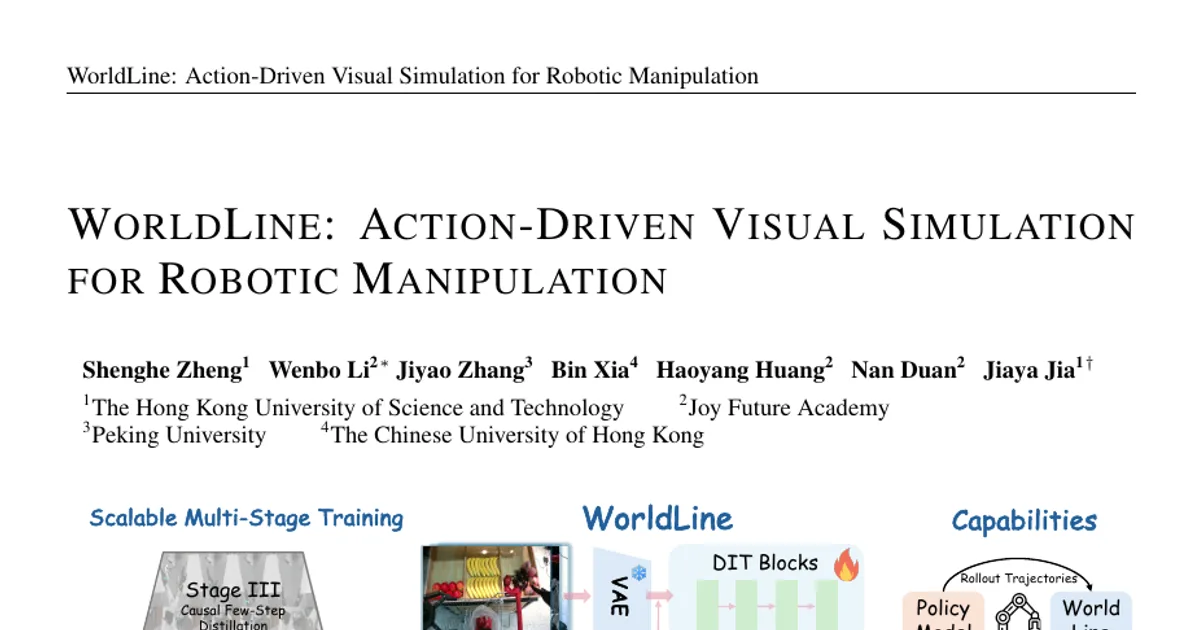
- Scope: The paper presents WorldLine, a three-stage action-driven video simulator that learns manipulation dynamics from large-scale action-free robot video and grounds heterogeneous robot controls through an image-space action representation, and evaluates it on action-conditioned video prediction, policy evaluation, and best-of-N planning.
What This Paper Is About
Robot learning is bottlenecked by the cost of collecting real-world experience and testing candidate behaviors physically. Existing video generation models can predict what happens next, but they tend to prioritize looking realistic over actually following commanded robot actions, and action-conditioned simulators are usually trained on scarce, embodiment-specific data that cannot be shared across robots with incompatible control interfaces. WorldLine's goal is a scalable visual simulator that both follows actions faithfully and models coherent robot–object interactions across many embodiments.
Key Contributions
- Scalable cross-embodiment learning. A decoupled framework that first learns transferable robot–object dynamics from large-scale action-free videos, then grounds heterogeneous robot controls through a geometry-preserving image-space interface rather than forcing incompatible control spaces into a shared vector.
- Interaction-oriented modeling. Synchronized multi-view observations, failure-enriched trajectories (approximately 200 hours of failure data), and relational regularization using a frozen V-JEPA2 teacher, plus a robot-focused few-step distillation that enables efficient causal rollout while preserving action-critical motion.
- Broad empirical validation. Evaluation across three settings — action-conditioned video generation (in-domain AgiBotWorld and out-of-domain DROID), policy evaluation (RoboTwin and AgiBot), and best-of-N trajectory selection (RoboTwin) — showing generalization to unseen environments and embodiments.
- A data pipeline at a scale the paper reports as larger than prior action-conditioned robot video models, using more than 10,000 hours of action-free video, 2,500 hours of action data, more than ten embodiments, and more than 3,500 tasks.
Main Findings
- Failure-trajectory prediction: On failed trajectories, WorldLine improves robot-mask IoU by 0.1626 over the strongest baseline, and leads all four reported metrics (PSNR, SSIM, LPIPS, robot IoU) on AgiBotWorld failure trajectories.
- Successful-trajectory prediction: On successful AgiBotWorld trajectories, WorldLine ranks first in SSIM (0.7931), LPIPS (0.1695), and robot IoU (0.6539), and second in PSNR (18.67).
- Out-of-domain generalization: On DROID, which is excluded from WorldLine training, adaptation, and checkpoint selection, WorldLine achieves the highest robot IoU (0.2739), exceeding the best prior result by 0.0690, with near-best visual quality. Its causal variant achieves the best DROID LPIPS (0.2705).
- Policy evaluation accuracy: WorldLine reaches 74% mean trajectory-success classification accuracy across RoboTwin and AgiBot (Qwen3VL-8B classifier, averaged over five generation seeds), one percentage point above the strongest baseline at 73%; causal WorldLine and GE-Sim-V2 also score 73%, Masked Visual Actions 72%, and OpenDW-0.5 71%.
- Embodied planning gains: Without RoboTwin training or adaptation, selecting among policy-generated candidates using WorldLine rollouts and a Qwen3VL-8B selector improves task success at N = 32 by 19.1 percentage points for π0.5 and 21.4 percentage points for LingBot-VLA over direct policy execution. In the ablation table the full model reaches 78.0±1.4% success (+19.1%) for π0.5 and 62.4±3.6% (+21.4%) for LingBot-VLA.
- Cross-policy effect: At N = 32, selection benefits both policies and narrows their direct-execution success gap from 17.9 to 15.6 percentage points, suggesting the simulator improves action selection across policy proposals rather than one policy's distribution.
- Causal acceleration: Causal distillation reduces sampling from 35 to four steps, cutting 129-frame generation from 90 to 21 seconds and per-frame latency from 0.698 to 0.163 seconds, a 4.3x speedup, while preserving the main robot–object evolution.
- Action representation matters: Replacing image-space action maps with FiLM-injected native action vectors drops robot IoU on AgiBotWorld from 0.5622 to 0.3639 and on DROID from 0.2739 to 0.1171, and lowers planning success to 67.2±2.3% (+8.3%) for π0.5 and 53.2±3.3% (+12.2%) for LingBot-VLA.
- Data composition matters: Under matched total training compute, removing action-free data degrades visual quality and planning (AgiBotWorld LPIPS worsens from 0.1804 to 0.2924; RoboTwin π0.5 gain falls from +19.1% to +14.3%). Head-view-only data reduces robot-mask overlap (AgiBotWorld robot IoU 0.5622 to 0.4348). Success-only trajectories barely change π0.5 performance but lower LingBot-VLA success by 10.6 points of gain (from +21.4% to +10.6%).
- Regularization effect is nuanced: Removing relational regularization worsens visual quality and robot-mask IoU (AgiBotWorld LPIPS 0.1804 to 0.2477; robot IoU 0.5622 to 0.4593) but has little effect on planning success under fixed-candidate evaluation.
- Acceleration changes which cues survive: The paper argues few-step rollouts remain useful when outcomes are visually distinguishable but are less reliable when selection depends on finer differences; whether reallocating saved runtime to more candidates offsets ranking errors is left open.
Methodology in Plain English
WorldLine separates two things that prior work trains together: how robots and objects move, and how specific control signals drive that motion.
Stage I — Dynamics pretraining. The model starts from a pretrained Cosmos3-Nano video model and is adapted on more than 10,000 hours of robot video drawn from six collections (including AgiBotWorld, RoboCOIN, the RoboMIND series, and Galaxea), spanning more than ten embodiments and over 3,500 tasks. It is conditioned only on the initial frame and task text and trained with a standard flow-matching objective. Although some source datasets contain states or actions, these are never fed to the model in this stage, so training is "action-free."
Stage II — Action grounding. The model is initialized from Stage I, task-text conditioning is removed, and a new action branch (zero-initialized to preserve the prior) is trained on over 2,000 hours of action-labeled trajectories across more than ten embodiments. Rather than feeding native action vectors, the authors use robot kinematics to project the commanded end-effector pose into each camera view, then paint a Gaussian heatmap (fixed bandwidth of 10 pixels on the 384×512 reference canvas) encoding projected position, depth, Rot6D orientation, and gripper state — a nine-channel action map rendered at video latent resolution (for a 480×640 input, shape 9 × Tℓ × 30 × 40). A lightweight Conv3D residual branch and patchification add these tokens to the video-latent embeddings so action and video tokens share spatial and temporal coordinates. Multi-view training uses synchronized head, left-wrist, and right-wrist streams (trajectories missing a required wrist view are excluded), and roughly 200 hours of failure trajectories are included as ordinary action–video pairs without outcome labels. Intermediate DiT features are additionally regularized against a frozen V-JEPA2 teacher by matching pairwise cosine-similarity relations between consecutive frames within a view and between synchronized frames across views.
Stage III — Causal distillation. The Stage-II model generates whole trajectories through iterative ODE sampling, which prevents online updates. It is distilled into a block-autoregressive student that accepts new controls each block and generates in four denoising steps, where a block spans four latent frames (16 RGB frames). A robot-focused objective weights reconstruction and temporal-motion losses by a latent-resolution robot mask, so few-step distillation does not overemphasize static backgrounds. The result runs mask-free at inference.
Evaluation. Action-conditioned generation is measured with PSNR, SSIM, LPIPS, and head-view robot-mask IoU (segmenting both robot masks with SAM 3, using projected end-effector location only for initialization), averaged over five runs. Policy evaluation has Qwen3VL-8B classify rollout videos as success/failure. Planning samples N ∈ {2, 4, 8, 16, 24, 32} candidate trajectories from π0.5 and LingBot-VLA on 10 RoboTwin tasks with five scenes each, scores them with Qwen3VL-8B, and executes the highest-scoring one over five independently sampled banks. An in-domain AgiBotWorld split is scene-disjoint from training; DROID is used only for out-of-distribution evaluation.
Why This Matters
Impact on research. The paper argues that coupling dynamics learning to action supervision limits how much simulation quality can scale, and shows an alternative: learn dynamics from abundant action-free video, then ground controls through a shared geometry-preserving interface. If it holds, this reframes visual simulation as a data-scaling problem rather than an embodiment-specific data-collection problem, and gives the field a concrete recipe for evaluating policies and ranking candidate actions without physical execution.
Real-world applications:
- Offline policy evaluation: screening candidate robot policies against predicted rollouts before spending hardware time.
- Best-of-N action selection at deployment, where a policy proposes several trajectories and the simulator picks the one most likely to succeed.
- Cross-embodiment development, since a single model is conditioned on more than ten embodiments and generalizes to unseen single-arm DROID settings.
- Faster iteration on manipulation tasks that are expensive or unsafe to attempt repeatedly, using failure-enriched training to represent unsuccessful outcomes.
Industry relevance. The reported 4.3x latency reduction (90 to 21 seconds for 129 frames, 0.698 to 0.163 seconds per frame) is what makes simulator-in-the-loop selection practical rather than a research demonstration. The paper's gains of 19.1 and 21.4 percentage points at N = 32 for two different policies, achieved without RoboTwin training or adaptation, are directly relevant to teams deploying VLA-style policies that need a cheap way to choose among sampled actions.
Future Directions
- Extending WorldLine to rare manipulation patterns, deformable objects, diverse cameras, and longer action-conditioned horizons, to test whether image-space action grounding and cross-embodiment dynamics remain reliable under greater variation.
- Using WorldLine as a reinforcement learning environment for training robot policies, and as a test-time scaling tool that allocates more candidate rollouts to difficult tasks.
- Better uncertainty estimation and closed-loop replanning, so planners can identify unreliable predictions and allocate computation efficiently.
- Testing whether improved simulated outcomes translate into more reliable real-robot behavior, and — as the paper explicitly poses as open — whether spending the runtime saved by few-step distillation on evaluating more candidates can offset ranking errors.
Target Audience
Robotics and embodied-AI researchers working on policy evaluation, planning, or world models; video-generation researchers interested in action conditioning and distillation; and engineers building manipulation systems who need a way to predict action outcomes before physical execution. Readers who want implementation specifics will find them distributed across appendices on data construction, model initialization, action-map construction, and distillation settings.
Authors’ abstract
Real-world robot learning is constrained by the cost of collecting experience and evaluating candidate behaviors. Video generation models offer a scalable foundation for visual simulators that predict action outcomes before physical execution. Yet they often favor visual plausibility over accurate action following and coherent robot--object dynamics, while action-conditioned simulators depend on scarce, embodiment-specific data that are difficult to share across incompatible control spaces. We introduce WorldLine, an action-driven visual simulator that decouples transferable dynamics learning from heterogeneous action grounding. WorldLine learns manipulation dynamics from more than 10,000 hours of action-free robot videos and grounds them using over 2,000 hours of action trajectories across more than ten embodiments. An image-space action representation provides a shared control interface across embodiments, while multi-view and failure-enriched training with relational regularization improves interaction-sensitive prediction. Robot-focused few-step distillation enables efficient causal rollout while preserving action-critical motion. Across held-out and out-of-domain settings, WorldLine maintains strong visual quality and robot-motion agreement; on failed trajectories, it improves robot-mask IoU by 0.1626 over the strongest baseline. It predicts trajectory success with 74% mean accuracy across RoboTwin and AgiBot, one percentage point above the strongest baseline. Without RoboTwin training or adaptation, its rollouts improve task success by up to 21.4 percentage points over direct policy execution. Together, these capabilities make WorldLine a scalable and efficient visual simulator for policy evaluation and embodied planning. More results are available at \href{https://zhengsh123.github.io/WorldLine/}{project page}.