Research
WorldCrafter: Consistent Video World Model with Implicit 3D-aware Memory
Overview Research area: Computer vision / generative video — specifically video world models that generate camera-controllable, interactive scene exploration. Technical level: Advanced. The paper assu
- arXiv
- 2609.24984
- Published
- 2026-09-21
- Authors
- Wangbo Yu, Kunhao Liu, Wenbo Hu, Shenghai Yuan, Chaoran Feng, Haiyang Zhou, Yukun Huang, Yiran Wang, Wang Zhao, Yingmin Luo, Ying Shan
AI summary
Overview
- Research area: Computer vision / generative video — specifically video world models that generate camera-controllable, interactive scene exploration.
- Technical level: Advanced. The paper assumes familiarity with latent video diffusion, Diffusion Transformers (DiTs), flow matching, autoregressive chunk-wise generation, camera-pose conditioning, and distillation.
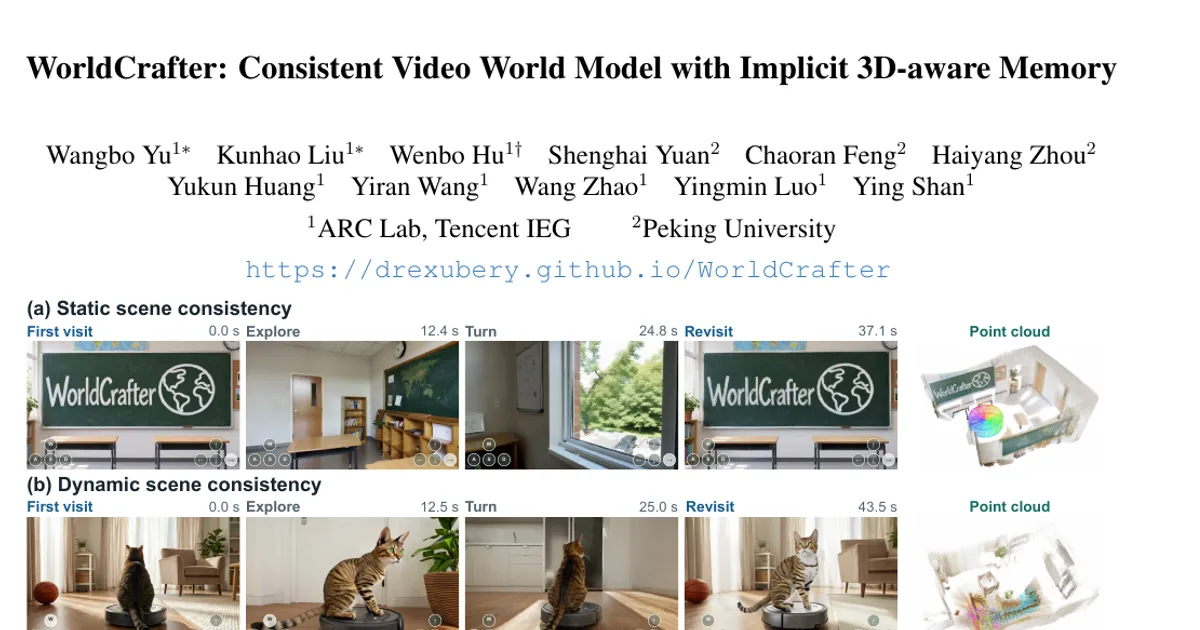
- Scope (one sentence): WorldCrafter introduces an implicit, 3D-aware memory that compresses historical video latents into a fixed set of camera-queryable tokens, letting a video world model stay consistent when a user revisits locations over minute-scale exploration.
What This Paper Is About
Video world models let users "move" through a generated scene by controlling the camera, but they forget what they have already shown: revisit a place later or from a new angle and the content often changes. The paper's goal is a memory mechanism that preserves scene appearance and structure across long, closed-loop camera trajectories without the cost of attending to all past frames or the fragility of explicit 3D reconstruction. WorldCrafter does this by learning to compress history into a compact 3D-aware representation and reading it out as a fixed number of tokens conditioned on the camera viewpoint the user is about to visit.
Key Contributions
- An implicit 3D-aware memory mechanism for video world models. A learned memory encoder maps history latent frames into a compact representation that preserves spatial-temporal context, enabling efficient memory writing and readout inside a fixed token budget — with no explicit depth-based correspondences.
- Integration into camera-controllable autoregressive video generation. The memory conditions the video DiT directly through self-attention alongside recent temporal context and camera poses, yielding leading revisit consistency — reported as a 47.6% improvement relative to the strongest baseline — and camera-control accuracy, supported by controlled ablations.
- A real-time interactive system via few-step distillation. Pyramid denoising distillation produces WorldCrafter-fast, which supports streaming inference while maintaining visual quality throughout minute-scale exploration, reaching 16 fps on a 4-GPU machine.
- A long-horizon benchmark and evaluation protocol covering memory, camera-control accuracy, and visual quality across 145 images, 83 dynamic object-centric scenes, and 62 static scenes, with 5 metric camera trajectories each (725 videos per method, trajectories spanning 528–1,648 frames).
Main Findings
- Revisit consistency improves substantially. On long-horizon revisit metrics averaged over 725 generated videos, WorldCrafter records MEt3R 0.166, LPIPS 0.255, PSNR 18.016, and SSIM 0.517, versus the next-best baseline Lyra 2.0 at MEt3R 0.334, LPIPS 0.487, PSNR 14.050, and SSIM 0.390. WorldCrafter-fast is best on all four: MEt3R 0.129, LPIPS 0.186, PSNR 20.868, SSIM 0.616.
- Camera control is the most accurate among the compared models. WorldCrafter achieves the lowest error on all three camera metrics (RotErr 13.536, TransErr 1.475, CamMC 1.546), with Lyra 2.0 second (16.145 / 1.538 / 1.624) and WorldCrafter-fast third (18.251 / 1.638 / 1.737). The weakest reported baseline, DreamX-World, scores 54.116 / 2.759 / 3.138.
- Visual quality is preserved, not traded away. On VBench in custom-input mode over 725 videos, the models are best in 5 of the 8 dimensions. WorldCrafter obtains the highest overall score, 81.910; WorldCrafter-fast achieves the best Temporal Flickering score, 96.444. The highest Aesthetic Quality among compared methods belongs to SANA-WM (63.467), and LingBot-World 2 and Matrix-Game 3.5 both report Dynamic Degree of 100.000.
- Implicit 3D-aware memory beats context memory. Replacing learned memory tokens with 4 retrieved history latent frames (context memory) degrades everything: MEt3R 0.382, LPIPS 0.497, PSNR 13.907, SSIM 0.315, RotErr 26.522, TransErr 2.083, CamMC 2.150. The advantage grows with longer revisit intervals, as shown in the LPIPS-versus-interval curve.
- Joint training of memory and generator matters. Freezing the memory encoder while training the readout, DiT, and camera branch drops performance to MEt3R 0.227, LPIPS 0.305, PSNR 16.873, SSIM 0.472, RotErr 15.428, TransErr 1.793, CamMC 1.886; joint optimization reaches lower revisit error earlier in training and keeps that advantage.
- Pose-guided readout beats pose-free readout. Under the same inputs and token budget, pose-free readout yields MEt3R 0.251, LPIPS 0.333, PSNR 16.486, SSIM 0.467, RotErr 18.307, TransErr 1.701, CamMC 1.828 — worse on memory and camera control than the full model.
- Max-coverage history retrieval beats similarity ranking. Pairwise FoV similarity ranking, with the same 9-frame encoder input and the same DiT token budget, gives MEt3R 0.213, LPIPS 0.296, PSNR 17.125, SSIM 0.485, RotErr 14.657, TransErr 1.579, CamMC 1.664, versus the full model's 0.166 / 0.255 / 18.016 / 0.517 and 13.536 / 1.475 / 1.546.
- Memory processing is far cheaper than depth-based spatial memory. At 640 × 384 with a 9-latent-frame chunk and 4 history frames for warping, depth estimation and alignment takes 0.409 s and batched warping 0.937 s, totaling 1.346 s per chunk; WorldCrafter's encoding takes 0.049 s and readout 0.013 s, totaling 0.062 s — a 21.7× reduction.
Methodology in Plain English
The system extends a chunk-wise autoregressive video generator: instead of generating one fixed clip, it produces the video in sequential chunks and feeds each finished chunk back into the history archive. The standard recipe would let the model attend to a short window of recent frames, which is not enough to remember a place seen a minute ago.
WorldCrafter adds a second stream of information. A memory encoder takes a limited number of history latent frames (9 in training) together with their camera poses and writes them into a compact representation. This encoder is initialized from LagerNVS, a multi-view scene representation model that was trained to reconstruct novel views — so it already carries a learned bias toward preserving both geometry and appearance, unlike geometry-estimation models that prioritize geometry. The shallow image-processing layers of that encoder are discarded and replaced with a patch embedding layer so it can consume VAE latents directly.
Because the representation grows with the number of input frames, the input is capped. At inference the latest frame is always kept, and the remaining slots are filled greedily with frames whose combined field of view best covers the region the upcoming camera trajectory will visit.
A readout module then turns that representation into a fixed number of memory tokens — matching the token count of 4 full frames — which are concatenated with the recent-context frames and the noisy current chunk and processed as one sequence by the DiT. The readout is queried with poses sampled from the upcoming trajectory, so the limited token budget is spent on information relevant to where the user is going. Camera control is handled by a PRoPE-style relative-pose transformation, implemented as the parallel camera-attention branch of UCPE with a zero-initialized projection, and applied only to the noisy chunk, not to memory or recent context.
Training proceeds in four stages: adapting Helios-base to the modified inference window on 760,000 OSP videos (5,000 iterations, 32 GPUs, batch 32); adding camera control with the backbone frozen on 40,000 filtered OSP videos and 6,000 DL3DV videos (32 GPUs, batch 128); warming up the memory encoder on 9 latent frames over DL3DV and the filtered OSP subset (5,000 iterations, 16 GPUs, batch 16); and finally jointly training the readout module, memory encoder, video DiT, and camera branch — 8,000 iterations on DL3DV plus the filtered OSP subset, then 1,000 more iterations adding MIND synthetic videos to improve dynamic subject modeling. Camera poses come from Depth Anything 3 and captions from Qwen2.5-VL.
For speed, distribution matching distillation with a coarse-to-fine pyramid (3 spatial resolutions, 2 denoising steps each) reduces sampling steps. Two distilled models are trained with different data mixtures: a low-noise model that keeps natural appearance and runs the last denoising step, and a high-noise model that retains subject-following ability and runs all preceding steps.
Why This Matters
The paper targets a specific failure mode of interactive generative video — forgetting — and shows it can be addressed with a compact learned memory rather than with full-history attention or explicit reconstruction. The evaluation protocol, spanning static and dynamic scenes, closed-loop revisits, camera-control accuracy, and per-chunk memory latency, gives the field a way to compare memory designs on equal footing.
Real-world applications:
- Interactive entertainment and virtual worlds. Users could explore a generated game-like environment with a camera, leave a location, and return to find it unchanged — the revisit behavior this paper measures.
- Virtual production and pre-visualization. Filmmakers could scout a scene from a text description, move the virtual camera freely, and shoot multiple angles of a consistent set, including from text prompts alone.
- Robotics and embodied-agent simulation. A world model that keeps a stable scene across viewpoints could supply rollout data for navigation and manipulation policies, where spatial consistency is required for training to transfer.
- Virtual tours, real estate, and simulation authoring. A single input image or text prompt can seed a minute-scale walkthrough with controlled camera motion, reducing the need for captured footage.
Industry relevance: the work comes from Peking University and ARC Lab, Tencent IEG, and it is explicitly engineered for deployment — fixed encoder input size, fixed DiT memory-token budget, 16 fps on a 4-GPU machine, and memory processing roughly 21.7× cheaper than the depth-estimation-and-warping pipeline used by spatial-memory competitors. That combination of consistency and per-chunk cost is what separates a demo from a serving system.
Future Directions
- Autoregressive streaming memory. The authors propose a memory encoder that incrementally folds each newly generated chunk into the memory state, rather than re-encoding history at every chunk — the source of the extra latency they identify.
- Robustness on hard trajectories. The paper states that consistency can still break down along particularly complex or extended trajectories; what causes those failures, and whether more history slots or a different retrieval criterion would fix them, is left open.
- Motion versus memory in dynamic scenes. Explicit spatial memories overconstrain dynamics, and implicit geometry-oriented memories under-serve appearance. WorldCrafter balances this by training on synthetic MIND videos for one stage; how far that balance extends to complex moving subjects is not established.
- Whether the design transfers. The encoder is initialized from LagerNVS and the DiT from Helios-base, and the memory is trained on DL3DV, OSP, and MIND. How much the mechanism depends on those specific pretrained backbones — and whether it ports to other video generators — is not reported.
Target Audience
Researchers and engineers working on video diffusion, world models, and interactive generative systems will get the most from this paper, particularly those interested in long-horizon memory, camera conditioning, and inference efficiency. It is also relevant to practitioners building streaming or real-time video generation products, and to readers who want a concrete comparison framework for context, spatial, and implicit memory designs. The paper is not beginner-friendly: it presumes working knowledge of diffusion transformers, flow matching, autoregressive rollout, and the camera-parameter conventions used by prior systems.
Authors’ abstract
Video world models enable interactive exploration of dynamic environments, yet struggle to respect prior observations over long horizons and across viewpoints. We present WorldCrafter, a video world model that learns a camera-queryable implicit 3D-aware memory for this purpose. The key insight is to let the requested viewpoint shape how multi-view evidence is compressed into the video generator's limited token budget. Trained jointly with the video generator, a memory encoder and pose-conditioned readout module integrate historical observations into a fixed set of target view-specific tokens before denoising, without explicit depth-based correspondences. By combining this memory with recent temporal context and few-step distillation, WorldCrafter enables streaming scene exploration from a single input image or text prompt. Experiments across static and dynamic scenes show substantial gains in long-horizon consistency and camera-control accuracy while preserving visual quality during minute-scale exploration.