Research
World Observer: Joint Actor-Observer Generation for Persistent World Modeling
World Observer: Joint Actor-Observer Generation for Persistent World Modeling Overview Research area: Computer Vision — generative video world models, specifically persistent world-state maintenance b
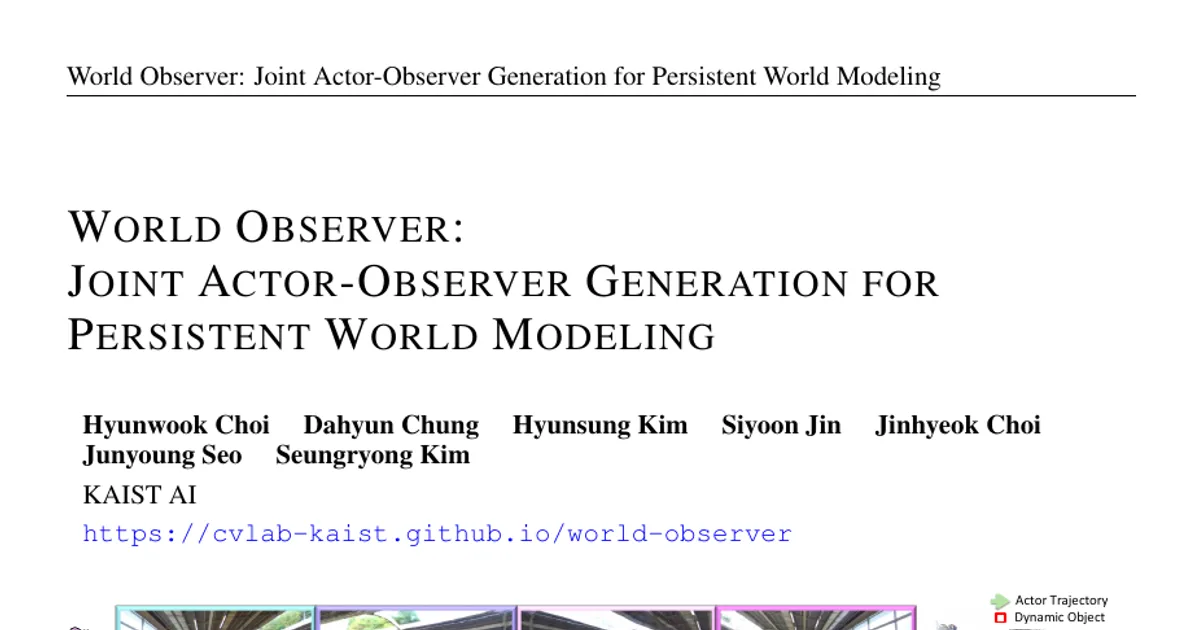
- arXiv
- 2610.02162
- Published
- 2026-10-01
- Authors
- Hyunwook Choi, Dahyun Chung, Hyunsung Kim, Siyoon Jin, Jinhyeok Choi, Junyoung Seo, Seungryong Kim
AI summary
World Observer: Joint Actor-Observer Generation for Persistent World ModelingOverview
Research area: Computer Vision — generative video world models, specifically persistent world-state maintenance beyond an agent's field of view.
Technical level: Advanced. The paper assumes familiarity with video diffusion transformers, latent space autoencoders, flow matching, positional embeddings (RoPE), and 3D geometry (panoramic warping, Plücker ray maps, metric depth).
Scope: The paper proposes a joint actor-observer video generation framework that keeps out-of-view regions of a world explicitly represented and evolving, together with new world-space metrics and benchmarks for measuring out-of-view dynamics.
What This Paper Is About
Existing video world models are actor-centric: they simulate an environment only from what the agent currently sees, so once an object leaves the view the model has no direct evidence of how it changed. The authors identify four resulting failure modes — frame-locked, lost, frozen, and impostor states — all of which stem from tying world-state maintenance to the actor's observation. The goal is to keep regions of interest continuously observable regardless of where the actor looks, by decoupling "observing" from "acting."
Key Contributions
-
World Observer, a framework that decouples acting from observing by jointly generating a perspective actor (the agent-centric view) alongside one or more panoramic observers that keep regions beyond the actor's view represented and evolving.
-
Flexible observer placement. Because observers are not tied to the actor, they can be positioned alongside the actor, at fixed independent viewpoints, or extended to multiple observers (N > 1) for broader coverage and for steering out-of-view evolution via control signals.
-
Two grounding mechanisms: panoramic warping from a shared initial panorama with metric-scale depth for explicit actor-observer geometric correspondence, and an Observer Sink of high-resolution perspective references to restore fine appearance when a region re-enters the actor view.
-
New evaluation protocol: world-space metrics OOV-D_gt (agreement with ground-truth dynamics), OOV-D_self (self-consistency through the out-of-view interval), and OOV-F (frequency of valid leave-and-return cases), plus a benchmark spanning real and synthetic scenes.
Main Findings
-
Out-of-view dynamics improve substantially. World Observer (Single) reaches OOV-F 0.492 / 0.580, OOV-D_gt 0.426 / 0.531, and OOV-D_self 0.408 / 0.526 (Real-OOV-Bench / Synthetic-OOV-Bench), the strongest OOV-D scores in the comparison table.
-
Multi-observer further raises coverage. World Observer (Multi) reaches OOV-F 0.722 on Synthetic-OOV-Bench, with OOV-D_gt 0.528 and OOV-D_self 0.457. It is evaluated only on Synthetic-OOV-Bench, as multi-observer conditions are scarce in the real world.
-
Visual and temporal fidelity remain competitive. World Observer (Single) reports FID 29.30 / 19.65 and FVD 291.7 / 196.2; World Observer (Multi) reports FID 16.06 and FVD 147.0 on the synthetic benchmark.
-
Camera control and 3D adherence hold up. World Observer (Single) reports RotErr 0.125 / 0.022, TransErr 0.372 / 0.029, mPSNR 18.574 / 18.893, and mLPIPS 0.278 / 0.276. Multi reports RotErr 0.014, TransErr 0.022, mPSNR 20.357, and mLPIPS 0.240 on the synthetic benchmark.
-
Failure signatures are visible in the metrics. Low OOV-F indicates frame-locked or lost objects; high OOV-F with low OOV-D_gt and OOV-D_self indicates frozen or incoherent motion; high OOV-D_gt with lower OOV-D_self indicates impostor dynamics that follow the prompt but depart from the object's own trajectory.
-
Joint generation matters (ablation). The raymap-only Backbone has unstable camera control (RotErr 0.595) and the lowest OOV scores (OOV-F 0.070). Removing the observer yields high OOV-F (0.674) but low OOV-D_gt (0.387) and OOV-D_self (0.430) — an impostor tendency. Removing the actor yields strong OOV scores but weak camera control (Img.Q 0.433) and fidelity.
-
The Observer Sink matters (ablation). Removing it lowers OOV-D_self to 0.470 and also degrades 3D adherence (mPSNR 18.221, mLPIPS 0.303), FID (20.33), and FVD (214.0) relative to World Observer (Single).
-
Demonstrated capabilities. Qualitative results show state memory, observer-prompted control of off-screen events, autoregressive long-horizon rollouts, and multi-observer tracking of occluded regions.
Methodology in Plain English
The system fine-tunes Cosmos-Predict2.5, a 2B-parameter video Diffusion Transformer (28 blocks, 16 attention heads, hidden dimension 2048), operating in a 16-channel latent space from a 3D VAE with 4× temporal and 8× spatial compression.
-
Two jointly generated streams. The actor stream renders the agent's local view; the observer stream is a 360° panoramic video. Both are concatenated into one sequence and processed by a shared DiT with learnable view embeddings. Matched actor and observer latents are given identical positions on the RoPE temporal axis so attention can exchange information across corresponding timesteps — this is what lets a re-entering object attend to the observer region holding its out-of-view state.
-
Separate prompts, shared world. The actor prompt describes events inside the local view; the observer prompt describes events across the surrounding world, including regions the actor does not see. This gives the observer two roles: it acts as memory and as control.
-
Geometry grounding by warping. The initial panorama is unprojected with metric-scale depth (Depth Anything 3) and re-rendered into each stream's trajectory, producing warped videos that are concatenated channel-wise with noisy latents and a binary validity mask. A 6-channel Plücker raymap encodes each stream's viewpoint.
-
Decoupled resolution. The observer is generated at 640×320 while the actor is rendered at 1280×704, since the observer only needs to maintain coarse structure, object locations, motion, and visibility changes. Roughly a quarter of the actor's tokens come from each observer.
-
Observer Sink. Four perspective views are cropped from the high-resolution initial panorama, each 90° apart in yaw, encoded to latents, and appended to the sequence as fixed references (not denoised) with an offset of Δ_os = 50 and a positional stride δ_os. This supplies fine appearance the distorted panorama cannot.
-
Multi-observer. For N > 1, each observer gets its own stream and a learned observer-specific embedding; the actor's geometric source is the initial panorama whose observer pose is nearest the current actor position. Because the first observer takes index 0, the multi-observer model reduces exactly to the single-observer model, enabling warm-start training.
-
Training. Flow matching with a shared timestep; teacher forcing throughout with Gaussian noise (scale 0.1) injected into conditioning history frames with 50% probability. History is H = 2 latents (5 frames of the preceding chunk). Data mix is 60% real panoramic video and 40% synthetic CARLA video; multi-observer training uses synthetic data only. Classifier-free guidance dropout zeroes text captions with 20% probability and Observer Sink tokens with 20% probability.
-
Data scale. 138K clips sampled from 23K real videos and 72K clips from 12K synthetic videos, with T = 77 frames per clip (T = 77 = 1 + 4×19, yielding L = 20 latents per stream). Single-observer training runs 12K iterations at batch size 16; multi-observer adds 6K iterations at total batch size 8 with N = 2 observers. Training uses AdamW at learning rate 4.8e-5 on 8 NVIDIA H100 GPUs.
-
Evaluation. Held-out benchmarks of 100 real and 100 synthetic sequences (200 total) at T = 77 frames, each with a back-and-forth camera rotation and one or more objects undergoing out-of-view motion. All evaluation is within a single chunk, so failures cannot be attributed to limited context or missing retrieval.
Why This Matters
Impact on research. The paper reframes persistence in world models as an observability problem rather than a memory problem. Instead of inferring unseen evolution from past observations, generative priors, or explicit state extrapolation, it keeps the relevant regions directly observable. It also argues that existing out-of-view benchmarks (STEVO-Bench, WRBench, MemoBench) leave judgment to a VLM rating naturalness, which cannot verify where an object actually moved while unobserved — motivating explicit world-space metrics.
Real-world applications (the three explicitly named in the paper, plus one implied by the data):
- Embodied navigation — an agent reasoning about world state beyond its current observation.
- Interactive simulation — environments where off-screen events must continue coherently.
- Long-horizon planning — tasks where the agent must account for what happened while it was not looking.
- Driving and outdoor autonomy — the synthetic data is rendered in the CARLA driving simulator, indicating relevance to settings where objects routinely pass out of a vehicle's field of view.
Industry relevance. The model builds on an existing open backbone (Cosmos-Predict2.5, 2B) rather than training from scratch, and the decoupled low-resolution observer design keeps the joint token budget tractable as observers are added — an engineering trade-off directly relevant to deploying persistent world models at scale.
Future Directions
-
Scaling multi-observer setups. The paper trains and evaluates multi-observer generation only with N = 2 observers on synthetic data; how performance scales with more observers and larger coverage, and at what token cost, is left open.
-
Closing the real-world multi-observer gap. Synchronized multi-observer recordings are described as difficult to obtain in the real world, which is why multi-observer results are reported only on Synthetic-OOV-Bench. Real-world capture setups or sim-to-real transfer would be a natural extension.
-
Understanding residual failure modes. The OOV-D_gt / OOV-D_self split distinguishes frozen from impostor dynamics; whether a model can be driven to raise both simultaneously in longer out-of-view intervals is an open question.
-
Limitations and broader impact. The paper lists an Appendix E.1 Limitations and Appendix E.2 Societal Impact section, but their content is not included in the provided material, so the specific limitations acknowledged by the authors are not reported here.
Target Audience
Researchers and graduate students working on video generation, world models, embodied AI, and interactive simulation who need to track object state across out-of-view intervals. It is most useful to readers already comfortable with diffusion transformers and 3D geometry pipelines; practitioners building navigation, driving, or planning systems on top of video world models will benefit from the benchmark and metrics even if they skip the modeling details. Readers looking for an accessible introduction to world models would find the technical level steep.
Authors’ abstract
How can a world model continuously observe regions beyond the actor's current view? Video world models simulate how an environment evolves from an agent's actions, yet remain actor-centric. Once an object leaves the actor's view, they lose direct evidence of its evolution, often failing to preserve its state and dynamics upon re-entry. To address this, we introduce World Observer, which decouples observing from acting by jointly generating a perspective actor for the agent-centric view with one or more panoramic observers that watch selected world regions. This allows objects that leave the actor's view to remain visually evolving in an observer, so their updated states are reflected when they re-enter. We ground the actor and observers by warping from a shared panoramic source for explicit geometric correspondence, and introduce an Observer Sink of high-resolution perspective references to restore fine appearance upon re-entry. Since the observers are decoupled from the actor, they can be placed freely across the scene, extended to multiple locations for broader coverage, and driven by control signals to steer out-of-view evolution. To evaluate out-of-view evolution, we further introduce world-space metrics and a benchmark spanning real and synthetic scenes. World Observer substantially improves out-of-view dynamics while remaining competitive in visual fidelity, camera control, and 3D adherence.