Research
What Makes a Good Unmasking Policy? A Controlled Study of Learned Unmasking in Diffusion Language Models
Overview Research area: Efficient inference for masked diffusion language models (dLLMs), specifically the design of learned "unmasking policies" that decide which token positions to commit at each de
- arXiv
- 2610.31576
- Published
- 2026-10-22
- Authors
- Jinya Sakurai, Xun Xu, Jaehong Yoon
AI summary
Overview
Research area: Efficient inference for masked diffusion language models (dLLMs), specifically the design of learned "unmasking policies" that decide which token positions to commit at each denoising step.
Technical level: Advanced — the paper assumes familiarity with discrete diffusion, decoding schedules, and lightweight supervised policy networks, though its central arguments are stated in terms of accuracy-versus-compute trade-offs.
Scope: A controlled ablation study of what makes a learned unmasking policy good — covering supervision targets, training states, policy inputs, and per-step overhead — culminating in a single 856K-parameter policy called OnTrack evaluated on LLaDA-8B-Instruct and Dream-7B-Instruct.
What This Paper Is About
Masked diffusion language models generate text by iteratively filling in masked positions, and they can commit several tokens per step in parallel. The rule deciding which tokens to commit (the unmasking policy) strongly controls the speed–accuracy trade-off, and recent work trains small policies to make this decision. The problem is that published policies differ along several axes at once — what counts as a "safe" commitment label, which decoding states they learn from, what they observe, and how big they are — so it has been impossible to tell which design choices actually matter. The paper's goal is to disentangle these choices one at a time, then combine the winning ones into a single policy.
Key Contributions
-
A distillation framing of supervised unmasking policies. The authors recast existing methods as distilling a fixed decoding procedure: a teacher derived from reference trajectories labels which positions may be committed, and the policy imitates it. This framing separates the labeling rule, the training states, and the policy's inputs as independently testable design axes.
-
Trajectory contraction, a new commitment target. Instead of labeling any prediction that matches the final output as committable ("terminal agreement"), the proposed target accepts a commitment only when it lands exactly on a later state of the reference trajectory. This is evaluated in a 2×2 design crossed with the choice of reference-trajectory versus teacher-induced training states.
-
A systematic comparison of policy inputs and a measured overhead analysis. Confidence, top-two probability margin, backbone hidden states, and confidence-plus-hidden-states are compared with architecture held fixed. Separately, per-step latency is profiled across prompt lengths and caching settings to establish how much NFE reduction is needed to pay for the policy.
-
OnTrack, an 856K-parameter policy (about 0.01% of the backbone). Trained with trajectory-contraction targets on reference trajectories using confidence and hidden states as input, it achieves the best accuracy–NFE frontier and highest throughput on GSM8K, is competitive at moderate accuracy targets on MATH-500 and HumanEval, and largely transfers to Dream-7B-Instruct.
Main Findings
-
Terminal agreement is too permissive at low NFE. 28.7% of terminal-agreement positive labels violate trajectory contraction — they are correct tokens whose early commitment would leave the reference trajectory — and 56.0% of reference states contain at least one such violation. The rate is consistent across datasets (28.5% on GSM8K, 29.1% on MATH).
-
Contraction improves the frontier, mostly at low NFE. Replacing terminal agreement with trajectory contraction improves the accuracy–NFE frontier under both training-state constructions. On GSM8K this change accounts for most of the gain; at the highest accuracy targets, terminal agreement can be more accurate.
-
Reference trajectories help out of domain. On MBPP, reference-trajectory supervision reaches the 98% target with 48.6 NFE versus 64.8 for teacher-induced trajectories. Teacher-induced trajectories retain only 34% (contraction) and 25% (terminal agreement) of reference states, which may explain the weaker transfer.
-
Hidden states are weak alone but complement confidence. Hidden states alone require substantially more NFEs to reach the same accuracy. Combining confidence with hidden states reaches the 98% and 95% targets with the fewest NFE on both GSM8K and MBPP — for example, 42.1 versus 52.9 NFE for confidence alone at the 98% target on GSM8K. At the 90% target, confidence alone is comparable on GSM8K and slightly more efficient on MBPP. Adding the top-two probability margin yields no consistent gain.
-
Policy overhead is small up to 7.5M parameters. On LLaDA-8B-Instruct, policies up to 7.5M parameters add a nearly constant cost of about 1.5 ms per step — at most 10% across all tested prompt lengths and caching settings — so roughly a 10% NFE reduction suffices to break even. A 300M policy, with up to 39% overhead, needs about 28% fewer NFEs.
-
Prefix caching changes the picture but not the break-even. Prefix caching reduces backbone latency by 73% at 2048 prompt tokens but only 5% at 128 tokens; the break-even threshold for policies up to 7.5M parameters stays around 10%.
-
Main results on LLaDA-8B-Instruct. OnTrack gives the best accuracy–NFE frontier on GSM8K and reaches 98% of the reference accuracy with the fewest NFE; it attains the highest TPS on GSM8K at every accuracy target, and on MATH-500 and HumanEval at moderate targets. On MATH-500 its accuracy saturates just below the 98% target where EB-Sampler and Fast-dLLM exceed the reference at larger NFE. On HumanEval it reaches the 90% target with the fewest NFE but Fast-dLLM is more efficient at 95%, and only Fast-dLLM and EB-Sampler reach 98%. On MBPP it reaches the 95% and 98% targets with the fewest NFE, while Learn2PD and Fast-dLLM are more efficient at 90%. Paired-bootstrap confidence intervals show the GSM8K NFE gains exceed evaluation noise against all baselines except EB-Sampler at the 98% target.
-
Caching sensitivity. Prefix caching reduces OnTrack's accuracy by up to about two percentage points, while confidence-based baselines are essentially unaffected. The drop persists even at one token per step, so it concerns which tokens are committed rather than how many. With zero-shot prompts under caching, Fast-dLLM overtakes OnTrack at the 98% target, though OnTrack remains fastest at 95%.
-
Transfer holds, with limits. On Dream-7B-Instruct (790K-parameter policy, 3584-dimensional hidden states), the advantage is largely preserved: best frontier on HumanEval, 98% of reference on MATH-500 with the fewest NFE, fewest NFE at the 95% target on GSM8K but saturation slightly below the reference. Trained at L=256 and evaluated at L=128 and L=512 without retraining, the policy stays best or comparable up to 95% of reference accuracy, but when a length shift is combined with the domain shift to code it falls behind Fast-dLLM and EB-Sampler.
Methodology in Plain English
The authors treat an existing decoding procedure as a teacher and a small neural network as its student. They first run Fast-dLLM (confidence threshold 0.9) on training prompts drawn from a mixture of GSM8K and MATH to record "reference trajectories" — the exact sequence of partially masked states the decoder passes through. Every masked position at every state then gets a binary label saying whether it may be committed.
Two labeling rules are compared. Terminal agreement says yes if the current prediction matches the token the decoder eventually produced. Trajectory contraction is stricter: a set of positions is labeled committable only if filling them all at once reproduces a state the reference trajectory actually visits later, and the label marks the furthest such jump. Two ways of choosing training states are crossed with this: keeping every reference state, or generating states by following the teacher's own decisions (which skips states).
For inputs, the policy is given token confidence, the backbone's hidden representation, the top-two probability margin, or confidence plus hidden states; the network architecture is held fixed so only the input varies. The policy is a single DiT-style transformer block with width 128 and 2 attention heads, with confidence and hidden states projected into a shared space and added; the backbone stays frozen and training minimizes binary cross-entropy over eligible positions.
Because NFE counts only backbone evaluations, the authors also profile wall-clock latency per decoding step with and without policies of 331K, 856K, 7.5M, and 300M parameters, across prompt lengths of 128, 512, 1024, and 2048 tokens with and without prefix caching. That yields a break-even NFE threshold, which they then check against measured end-to-end tokens per second. Baselines are Fast-dLLM, EB-Sampler, and Learn2PD (official checkpoint); LUP and TraceLock are excluded because no trained checkpoints are publicly available.
Why This Matters
Impact on research. The paper turns a crowded design space into a set of separable questions and reports which axes actually move the accuracy–compute frontier. The finding that "correct final token" is an overly permissive supervision signal challenges a labeling rule shared by prior work, and the overhead analysis gives the field a concrete threshold (roughly 10% NFE reduction for policies up to 7.5M parameters) for when a learned policy is worth deploying at all.
Real-world applications.
- Latency-sensitive code assistants, where out-of-domain transfer to HumanEval and MBPP is directly relevant.
- Step-by-step mathematical reasoning services, the in-domain setting for GSM8K and MATH-500.
- Cost- and energy-constrained serving of diffusion language models, since the backbone is frozen and only a small policy is added.
- Deployment scenarios with long prompts and prefix caching, where the paper explicitly measures whether NFE savings survive.
Industry relevance. The policy is a plug-in: it modifies no backbone weights, adds about 0.01% of the backbone's parameters, and converts directly into throughput. That makes it attractive for inference providers who want faster decoding without retraining an 8B-parameter model, provided they operate at moderate rather than maximal accuracy targets.
Future Directions
-
Multi-domain, multi-length training. The policy is trained only on mathematical reasoning data at a single generation length (L=256) with fixed block length; the authors name training across domains and lengths as the natural remedy for the failure when length and domain shift occur together.
-
Closing the high-accuracy gap. Accuracy saturates slightly below the reference on MATH-500 with LLaDA and GSM8K with Dream even at conservative thresholds, while training-free methods reach the reference at larger NFE. The authors suggest supervision covering more conservative commitment behavior.
-
Robustness to approximate inference. The roughly two-point accuracy drop under prefix caching — attributed to the policy consuming hidden representations that caching perturbs — is left open, and matters because caching is exactly what makes serving cheap.
-
Broadening the controlled comparison. LUP and TraceLock could not be included for lack of public checkpoints; adding them, and extending the same one-axis-at-a-time protocol to reinforcement-learning-trained policies, would test whether the findings hold beyond supervised distillation.
Target Audience
Researchers and engineers working on efficient inference for diffusion language models, especially those building or deploying decoding schedulers; practitioners who need to decide whether a learned unmasking policy will pay for itself in throughput; and graduate students looking for a template of how to run a clean, single-factor ablation over a crowded design space. Readers without background in discrete diffusion will find the framing accessible but will need the appendix for architectural and training details.
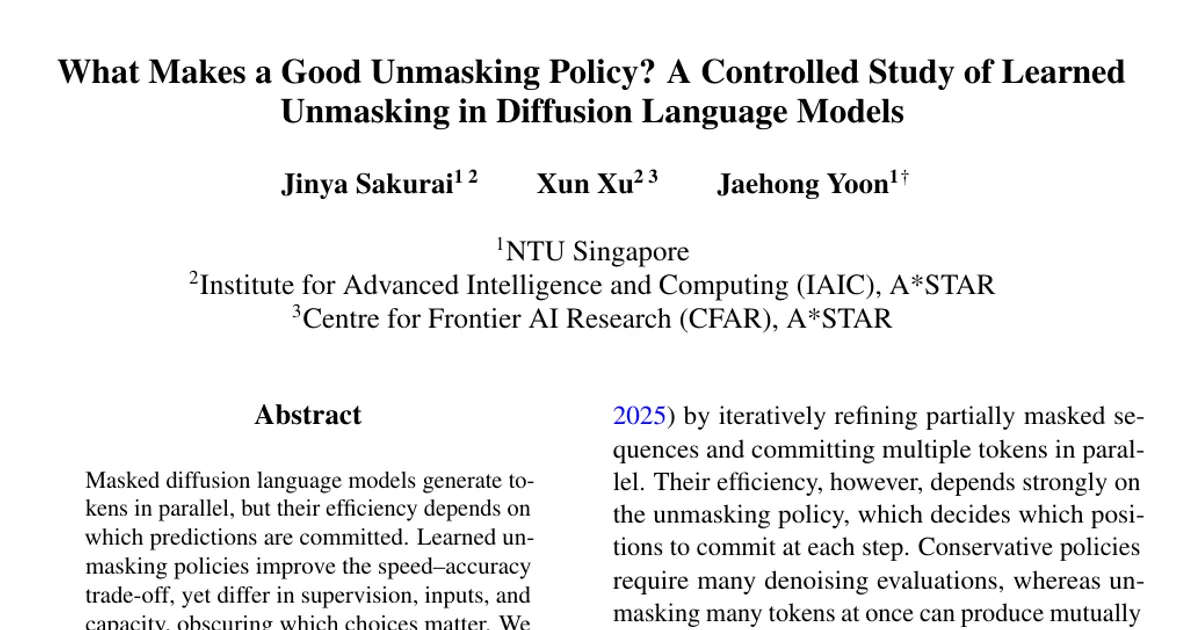
Authors’ abstract
Masked diffusion language models generate tokens in parallel, but their efficiency depends on which predictions are committed. Learned unmasking policies improve the speed--accuracy trade-off, yet differ in supervision, inputs, and capacity, obscuring which choices matter. We view supervised policies as distilling a decoding procedure through a teacher and examine independently what the teacher labels as committable, on which states the policy imitates it, what the policy observes, and how much the number of function evaluations (NFE) must decrease to offset policy overhead. We find that labeling predictions matching the final output is overly permissive at low NFE, and hidden states are weak alone but can complement confidence. About a 10% NFE reduction suffices to offset policy overhead for policies up to 7.5M parameters across tested settings. We therefore train a policy on trajectory-contraction targets, which accept only commitments staying on a reference trajectory, using confidence and hidden states. On LLaDA-8B-Instruct, the resulting 856K-parameter policy achieves the best accuracy--NFE frontier and highest throughput on GSM8K, is competitive at moderate targets on MATH-500 and HumanEval, and largely transfers to Dream-7B-Instruct.