Research
WebWorld: The Browser as a World Model for Self-Improving Web Code
Overview Research area: Natural Language Processing, specifically vision-language-model (VLM) driven generation and self-improvement of web code, with verification grounded in browser execution. Techn
- arXiv
- 2608.30530
- Published
- 2026-08-31
- Authors
- Jiajun Wu, Jian Yang, Yaxin Du, Wei Zhang, Haowen Wang, Junhang Cheng, Yuxuan Zhang, Tuney Zheng, Xianglong Liu, Ming Zhou
AI summary
Overview
Research area: Natural Language Processing, specifically vision-language-model (VLM) driven generation and self-improvement of web code, with verification grounded in browser execution.
Technical level: Advanced. The paper assumes familiarity with VLMs, supervised fine-tuning (SFT), agentic self-improvement loops, and benchmark-based evaluation of code generation.
Scope: The paper proposes WebWorld, an interface that treats the browser as a deterministic "world model" for web code and uses it as an unfoolable counterparty that decides which model-generated repairs become training supervision.
What This Paper Is About
Self-improvement loops for web code have a structural flaw: the VLM that proposes a repair is also the VLM that judges it, and under that judge, whether a page looks plausible is a weak stand-in for whether it actually works. The paper's goal is to replace that self-referential judgment with the browser itself — a deterministic, executable simulator of how an HTML artifact behaves under user actions, which the authors describe as a world model for web code in all but name. WebWorld is the interface that lets a VLM interact with this browser-as-world-model autonomously and, crucially, decides which of those interactions are allowed to become training data.
Key Contributions
-
A reframing of the browser as a world model. The authors argue the browser is a deterministic, executable simulator of HTML behavior under user actions, and therefore the natural counterparty a VLM cannot fool — unlike the VLM's own visual judgment.
-
The WebWorld interface. Each round, the VLM emits a critique; a planner compiles that critique into a typed interaction contract; the browser re-executes the candidate artifact against it.
-
Browser-issued acceptance certificates as a quality ratchet. The browser issues a certificate only when both target progress and preservation of every previously verified capability hold. Certified transitions accumulate into a ratchet, and that ratchet is the only thing the SFT export ever sees.
-
Empirical evidence that admission, not just scale, drives the gain. Under matched training, WebWorld-27B improves on Raw-27B by 5.3 points on HTMLBench-400 and 14.9 points on MiniAppBench-Val, reaching the level of systems such as Kimi-K2.6 and GPT-5.4 on interactive HTML generation; equal-size ablations show that removing the certificate nearly eliminates the lift at 9B.
Main Findings
-
The self-judging loop has a structural flaw. Because the proposing model is the judging model, visual plausibility becomes a poor proxy for whether the page actually works.
-
The browser is an unfoolable counterparty. Being deterministic and executable, it cannot be persuaded by appearance; it is described as a world model for web code in all but name.
-
Acceptance requires both progress and preservation. A certificate is issued only when the candidate advances the target and retains every previously verified capability, which the paper frames as a quality ratchet.
-
Only certified transitions are used for training. The SFT export sees nothing but certified transitions, so the supervision signal is gated by browser verification rather than by model opinion.
-
Measured gains over a matched baseline. WebWorld-27B improves Raw-27B by 5.3 points on HTMLBench-400 and 14.9 points on MiniAppBench-Val under matched training, and reaches the level of strong frontier systems such as Kimi-K2.6 and GPT-5.4 on interactive HTML generation.
-
The certificate is the source of the gain, per an equal-size ablation. Without the certificate, the matched 9B lift nearly disappears — indicating that browser-backed admission, rather than model size alone, carries the improvement.
-
Details not available in the abstract. The abstract does not report benchmark composition, dataset sizes, training compute, the precise definition of the typed interaction contract, or the number of interaction rounds; those specifics are not in the text summarized here.
Methodology in Plain English
The approach replaces a model's opinion of its own work with an execution test.
- A VLM looks at the current web artifact and produces a critique — a statement of what is wrong or what should improve.
- A planner translates that critique into a typed interaction contract: a structured, machine-checkable description of the interactions and outcomes the artifact is expected to satisfy.
- The browser re-executes the candidate artifact against that contract. This is the key step: the browser is deterministic and executable, so it cannot be talked into approving something that does not work.
- The browser issues an acceptance certificate only if two conditions hold at once — the change makes the target progress, and none of the capabilities already verified in earlier rounds are lost.
- Certified transitions pile up into a ratchet. That ratchet, and nothing else, is exported for supervised fine-tuning.
The evaluation strategy is a matched comparison: the same training setup is used for a WebWorld model and a "raw" baseline, so any difference can be attributed to the WebWorld admission mechanism. An equal-size ablation at 9B tests the same question at smaller scale by removing the certificate.
Why This Matters
Impact on research. The paper targets a known failure mode of self-improving loops — a model grading itself on a proxy (visual plausibility) that is weakly correlated with the real objective. Substituting a deterministic external executor as the arbiter, and restricting training data to transitions that survive that arbitration, is a template that could transfer to other domains where a cheap, unfoolable checker exists. It also reframes an ordinary tool (the browser) as an environment model, blurring the line between "world model" and "test harness."
Real-world applications:
- Automated front-end prototyping. Tools that generate or repair web pages could validate changes against real interaction contracts instead of screenshots, reducing silently broken output.
- Regression safety in UI code assistants. The preservation requirement — every previously verified capability must still hold — maps directly onto the practical worry that an AI "fix" breaks something that used to work.
- Functional QA of generated pages. Certificates provide an execution-backed record of what a page has been shown to do, which could feed quality gates in deployment pipelines.
- Agentic coding workflows. An agent that can autonomously probe a page in a browser and only keep changes that survive probing is a more reliable collaborator than one that judges its own diffs.
Industry relevance. Interactive web and app generation is a high-demand capability for developer tooling and low-code platforms. A method that improves measured interactive HTML generation to the level of frontier systems — and, per the ablation, does so through verification rather than only scale — speaks to teams that need reliability, not just fluency, from code-generating models.
Future Directions
- Does the certificate mechanism transfer beyond web code? Any domain with a deterministic executable checker (simulators, test suites, formal tools) is a candidate, but the paper does not test this.
- What happens at larger model sizes and longer horizons? The ablation is reported at 9B and the headline comparison at 27B; how the certificate's contribution scales further, and whether the ratchet accumulates indefinitely without stalling, remains open.
- How expensive is the loop in practice? Repeated browser re-execution and typed-contract compilation have a cost, and the abstract gives no accounting of rounds, wall-clock, or token budget.
- How robust and general is the typed interaction contract? The abstract does not describe how contracts are specified or how well they cover emergent user actions, accessibility behavior, or unusual UI patterns.
- Do the benchmark results hold under broader evaluation? The abstract reports HTMLBench-400 and MiniAppBench-Val and a comparison to named frontier systems; independent replication and evaluation on other interactive benchmarks and human functional-correctness judgments are natural next steps.
Target Audience
Researchers and engineers working on code-generating agents, self-improving or self-training pipelines, and VLM grounding; practitioners building AI-assisted front-end development or low-code tooling; and anyone studying verification-based supervision, reward design, or the failure modes of models that evaluate their own output.
Authors’ abstract
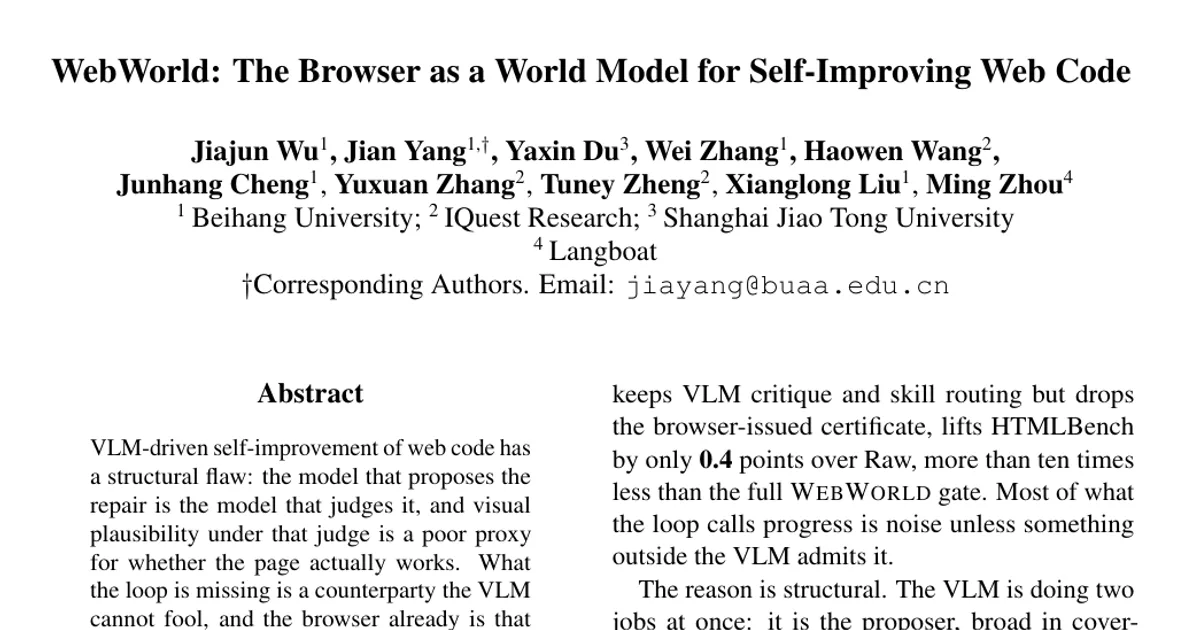
VLM-driven self-improvement of web code has a structural flaw: the model that proposes the repair is the model that judges it, and visual plausibility under that judge is a poor proxy for whether the page actually works. What the loop is missing is a counterparty the VLM cannot fool, and the browser already is that counterparty: a deterministic, executable simulator of how an HTML artifact behaves under user actions, and in everything but name a world model for web code. We present WebWorld, the interface that lets a VLM prior interact with this browser-as-world-model autonomously and decides which interactions become supervision. Each round, the VLM emits a critique that the planner compiles into a typed interaction contract; the browser re-executes the candidate and issues an acceptance certificate only when both target progress and preservation of every previously verified capability hold; certified transitions accumulate as a quality ratchet that is the only thing the SFT export ever sees. Under matched training, WebWorld-27B improves Raw-27B by 5.3 points on HTMLBench-400 and 14.9 points on MiniAppBench-Val, and reaches the level of strong frontier systems such as Kimi-K2.6 and GPT-5.4 on interactive HTML generation. Equal-size ablations show that browser-backed admission carries the gain: without the certificate, the matched 9B lift nearly disappears.