Research
WebChain: A Large-Scale Human-Annotated Dataset of Real-World Web Interaction Traces
Overview Research area: Artificial Intelligence / GUI and web agents; large-scale multimodal interaction datasets and Vision-Language-Action (VLA) model training. Technical level: Intermediate. The pa
- arXiv
- 2603.05295
- Published
- 2026-03-05
- Authors
- Sicheng Fan, Rui Wan, Yifei Leng, Gaoning Liang, Li Ling, Yanyi Shang, Dehan Kong
AI summary
Overview
- Research area: Artificial Intelligence / GUI and web agents; large-scale multimodal interaction datasets and Vision-Language-Action (VLA) model training.
- Technical level: Intermediate. The paper is readable without deep RL background, but familiarity with supervised fine-tuning, reinforcement learning (RLVR), Vision-Language Models, and web benchmarks helps.
- Scope: WebChain is a fully open-source, human-annotated dataset of 31,725 real-website interaction trajectories (317,993 steps across 428 domains), released together with a construction pipeline, a new benchmark (WebChainBench), and a training recipe (Dual Mid-Training).
What This Paper Is About
Web agents need large, up-to-date, high-quality trajectory data to learn precise element grounding and long-horizon planning. Existing open human-annotated datasets are too small to test scaling effects, while synthetic data collection on live websites breaks down in the face of anti-bot detection, CAPTCHAs, and authentication-gated workflows. The paper's goal is to break the resulting data monopoly by releasing the largest human-annotated real-world web trajectory corpus, along with a benchmark and training recipe that show how to use it effectively.
Key Contributions
- Largest human-annotated real-world web trajectory dataset: 31,725 trajectories and 317,993 steps across 428 domains, collected entirely by human annotators on live websites, with the data, collection tools, and benchmarks made publicly available.
- Scalable construction pipeline: A three-stage process combining constraint-based task synthesis, human-in-the-loop trajectory collection with the WebChain Builder tool, and automated context enrichment (visual grounding densification and synthetic Chain-of-Thought rationale generation).
- Triple Alignment data schema: Each step synchronizes visual context (full-page and viewport screenshots), structural context (HTML and Accessibility tree snapshots), and action alignment (pixel coordinates, bounding boxes, CSS selectors, XPath, action type), plus CoT reasoning traces.
- New benchmark and training recipe with state-of-the-art results: WebChainBench (WCB), split into WCB-S for spatial grounding and WCB-L for long-horizon planning, plus a Dual Mid-Training paradigm that decouples spatial grounding from planning and outperforms standard supervised methods.
Main Findings
- Dataset scale and composition: WebChain contains 31,725 human-verified trajectories, 317,993 total steps, and 428 unique domains. The average trajectory length is 10.02 steps (median 9) and the average duration is 1.07 minutes per task.
- Comparison with prior datasets: Table 1 reports WebChain at 31,725 trajectories versus Mind2Web (2,350), WebLINX (2,337), and GUIAct(multi) (5,696); 318k steps versus Mind2Web's 17,155, WebLINX's 100k+, and GUIAct's 44k; and 428 websites versus 137, 155, and 121. WebArena is listed as an environment with N/A trajectory/step counts across 4 domains.
- Data volume improves long-horizon planning: Long-Chain-oriented RLVR-based post-training (LCRL) of Qwen2.5-VL-3B on 4k, 20k, and the full set of action steps (batch size 512, identical hyperparameters) shows a clear positive correlation between data volume and WCB-L performance; the model trained on the full 150k subset achieves significantly higher success rates and follows longer command chains than the 4k baseline.
- Both grounding factors help separately and together: On WCB-S, Visual Grounding Densification (VGD) and Reasoner Prompting (RP) each yield measurable gains over baseline SGRL training, and their combination produces the strongest overall performance. VGD improves recall of interactive elements; RP reduces spatial hallucinations.
- Mid-training choice changes the RL ceiling: When the four spatial-grounding checkpoints are used to initialize LCRL on WCB-L, models initialized from RP-based checkpoints perform consistently worse than non-RP counterparts. The non-RP + VGD + LCRL configuration achieves the strongest long-horizon planning capability.
- CoT-SFT mid-training boosts downstream RL: Fine-tuning Qwen2.5-VL-3B on 5k synthetic CoT samples until convergence raises WCB-L performance substantially over directly applying LCRL; the paper reports WCB-L values from 0.487 (directly LCRL) through 0.603 (+CoT-SFT) and 0.629 (+SGRL) up to a maximum of 0.658 for the combined setting (Table 5). Qualitatively, the mid-trained model produces longer, more structured reasoning traces.
- Strong results across public GUI benchmarks: In Table 3 (AndroidControl, GUI-Act-Web, GUI-Odyssey, OmniAct), WebChain-trained models improve overall scores over baselines: WebChain-LCRL-3B reaches 73.5 overall, +CoT-SFT 75.3, and +SGRL+CoT-SFT 77.3; WebChain-LCRL-7B reaches 77.4, +CoT-SFT 79.0, and +SGRL+CoT-SFT 81.4. For reference, zero-shot Qwen2.5-VL-3B is 50.1 and Qwen2.5-VL-7B is 70.9, GUI-R1-3B is 70.5 and GUI-R1-7B is 74.2.
- Benchmark composition: WebChainBench consists of 1.2k interactive steps sampled from held-out WebChain data, balanced across short (<6 steps), medium (6–10), and long (>10) trajectories. Click samples: 362 short, 358 medium, 365 long. Type samples: 38 short, 42 medium, 35 long. A step counts as correct only when both action type and behavior match.
- Reward design: Each step reward is r_t = α·r_t^type + (1−α)·r_t^content, bounded in [0,1], where the type reward is 1 if the predicted action type matches ground truth, and the content reward requires, for example, a click to fall inside the ground-truth bounding box and a typed string to be a lexical superset of the target.
Methodology in Plain English
The researchers built the dataset through three stages.
First, constraint-based task synthesis. Before writing any tasks, they statically analyzed each target website to extract a "functional schema": what the site is for (travel, e-commerce, fintech), what services it offers, and which controls actually exist (sort toggles, faceted filters, conditional dependencies such as a model dropdown that only populates after a brand is selected). A generator LLM then writes tasks conditioned on that schema so it cannot invent features the site does not have. Tasks are stratified into simple information retrieval, multi-constraint navigation, and conditional dependency tasks.
Second, human-in-the-loop collection. Human annotators attempt these tasks on live sites using a tool called WebChain Builder, which passively records complete pre- and post-action DOM snapshots, the action executed, viewport coordinates and target bounding boxes, and element metadata such as XPath, CSS selectors, and inner text. This yields (State, Action, Reward, Next State) tuples, including workflows behind login and anti-bot protections that synthetic crawlers cannot reach.
Third, post-processing enrichment. Rather than labeling only the element that was clicked, the pipeline parses the whole viewport and extracts bounding boxes, element types, and text for all interactive elements, turning element-clicking into a dense layout-aware segmentation problem with explicit negatives. A Visual Language Model is then prompted with the task goal, the (state, action) history, and the current GUI state to write a natural-language "think aloud" rationale for each action.
For training, the researchers define two tasks under a shared reward-weighted objective: spatial grounding (map a low-level instruction and screenshot to an action and arguments) and long-horizon planning (use a global goal, observation, and history). They test SGRL (spatial-grounding-oriented RLVR), mid-training variants including CoT-SFT on 5k synthetic samples and VGD/RP variants, and finally combine mid-training with LCRL post-training into what they call Dual Mid-Training, which separates spatial perception from temporal planning so the final RL stage focuses on long-term reward.
Why This Matters
The paper addresses a structural problem in GUI agent research: the most capable systems are trained on proprietary data, so their key insights cannot be reproduced or compared. WebChain provides an openly released, human-verified alternative and shows through scaling experiments that its size matters for long-horizon task success. Its Triple Alignment schema also offers a template for what "complete" step-level annotation should look like when both visual grounding and structural/DOM understanding are required.
Real-world applications:
- Web automation assistants that complete multi-step tasks such as booking travel with conditional add-ons or filtering products under several constraints.
- Accessibility tooling, where accurate element localization and page-structure understanding can translate intent into precise interactions.
- Autonomous agents in authenticated or regulated workflows (banking, checkout), exactly the high-value cases the paper says synthetic crawling cannot reach.
- Reproducible benchmarking for UI agents, using WebChainBench's held-out, complexity-balanced steps to compare methods fairly.
Industry relevance: the paper targets the data bottleneck that limits commercial web-agent development, provides an open benchmark for comparing models, and demonstrates a training recipe (mid-training plus RL) that reaches reported state-of-the-art overall scores on AndroidControl, GUI-Act-Web, GUI-Odyssey, and OmniAct.
Future Directions
- Extending scale and coverage beyond the current snapshot: the dataset covers 428 domains, but the abstract frames it as needing to remain "up-to-date" given how quickly websites change; how to refresh and version such a corpus is unresolved.
- Understanding why RP helps grounding but hurts planning: the paper shows RP-initialized checkpoints underperform on WCB-L; the mechanism behind that divergence between perceptual and hierarchical demands is an open question.
- Closing the remaining gap on public benchmarks: WebChain-trained models improve over baselines but do not saturate scores; how much of the residual error comes from data volume, reward design, or the RL stage itself is not resolved.
- Generalizing beyond the reported interfaces and benchmarks: the paper notes zero-shot and transfer performance across mobile, desktop, and web, but the precise generalization boundary for tasks far from WebChain's collected workflows is not established.
Target Audience
Researchers and engineers building web, mobile, or desktop GUI agents; teams that need a reproducible, human-verified trajectory corpus for training or evaluation; and RL/SFT practitioners working on Vision-Language-Action models who want a concrete recipe for combining mid-training with reward-based post-training. It is also useful for dataset builders looking for a model of end-to-end annotation pipeline design, including schema-constrained synthesis, human-in-the-loop capture, and post-hoc enrichment.
Authors’ abstract
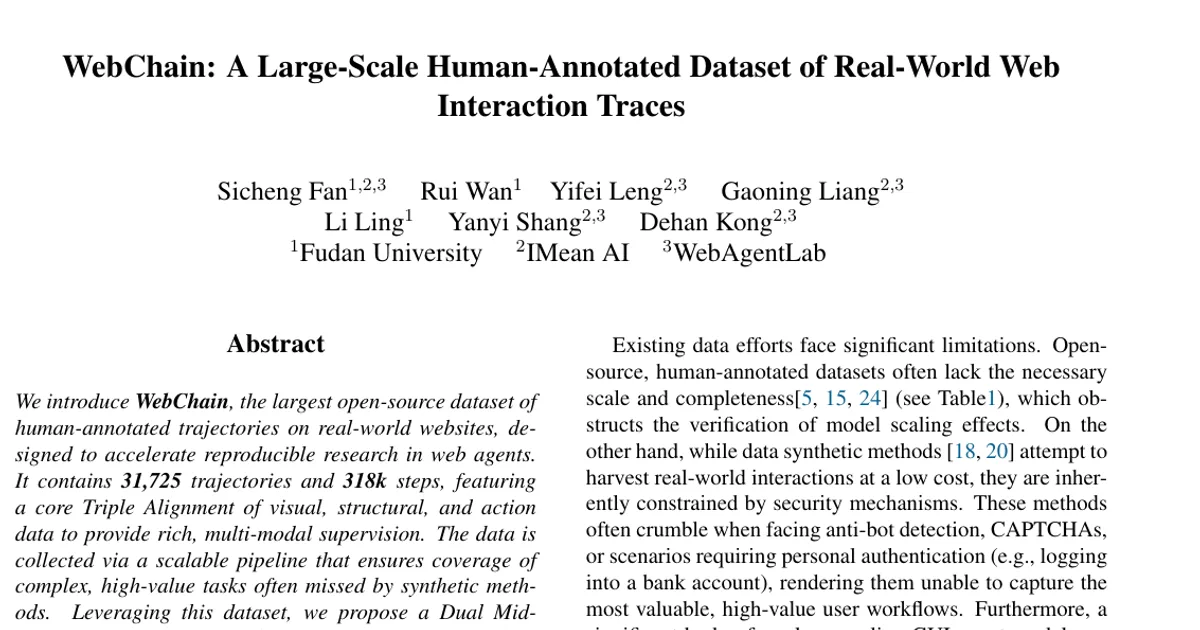
We introduce WebChain, the largest open-source dataset of human-annotated trajectories on real-world websites, designed to accelerate reproducible research in web agents. It contains 31,725 trajectories and 318k steps, featuring a core Triple Alignment of visual, structural, and action data to provide rich, multi-modal supervision. The data is collected via a scalable pipeline that ensures coverage of complex, high-value tasks often missed by synthetic methods. Leveraging this dataset, we propose a Dual Mid-Training recipe that decouples spatial grounding from planning, achieving state-of-the-art performance on our proposed WebChainBench and other public GUI benchmarks. Our work provides the data and insights necessary to build and rigorously evaluate the next generation of scalable web agents.