Research
Weak Segmentation-Guided GAN for~Realistic Color Edition
Overview Research area: Generative computer vision — specifically conditional image generation for automatic, controllable color editing. Technical level: Advanced. The work centers on GAN architectur
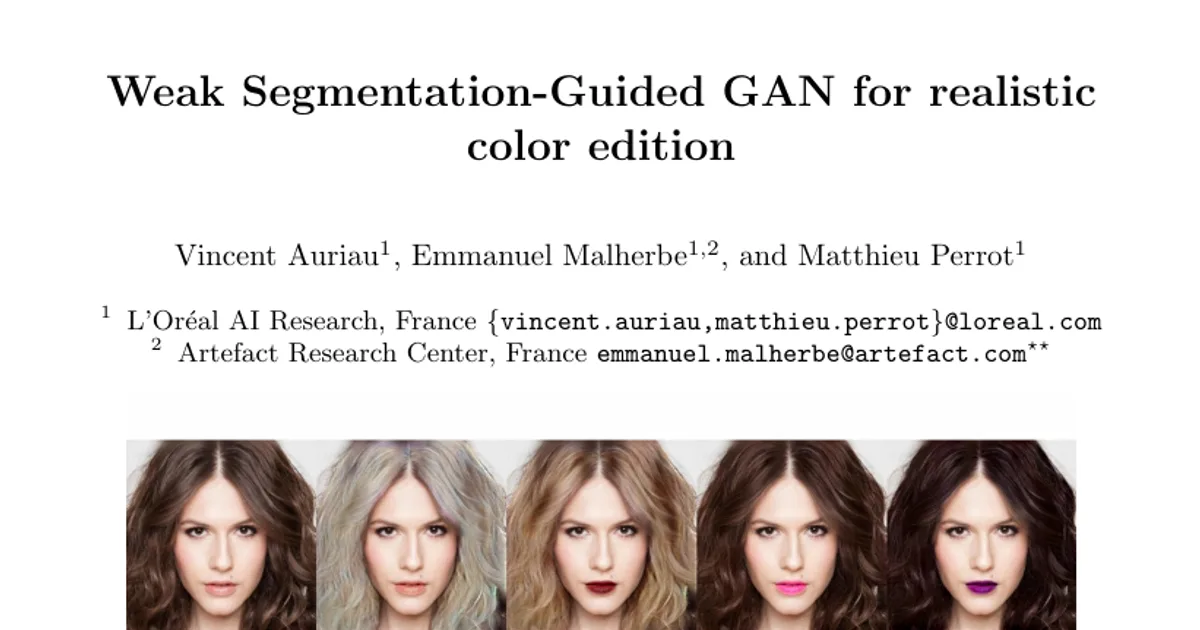
- arXiv
- 2610.16620
- Published
- 2026-10-12
- Authors
- Vincent Auriau, Emmanuel Malherbe, Matthieu Perrot
AI summary
Overview
Research area: Generative computer vision — specifically conditional image generation for automatic, controllable color editing.
Technical level: Advanced. The work centers on GAN architecture design and differentiable segmentation models, and assumes familiarity with generative adversarial training and semantic segmentation.
Scope (one sentence): The paper proposes a GAN architecture that incorporates a differentiable segmentation model to produce realistic re-colored images while allowing precise control over the resulting colors, claiming state-of-the-art results across several use cases.
What This Paper Is About
Automatically changing the colors in an image in a believable way is useful for many purposes, but existing approaches force a trade-off. Methods built on segmentation plus histogram matching give the user fine control over the desired color yet tend to produce unrealistic or artifact-ridden output and are hard to fully automate, while GANs produce realistic images but are difficult to steer toward a specific color. The paper's goal is to get both properties at once: an automatic color-editing tool whose results look real and whose output colors can be chosen precisely.
Key Contributions
- A new GAN architecture for color editing that combines generative realism with explicit user control over the target colors, addressing the central trade-off the authors identify in prior work.
- Integration of any differentiable segmentation model into the generation pipeline, rather than relying on a fixed or hand-crafted segmentation step. This is the mechanism by which the framework stays generic.
- Demonstration of a generic framework that the authors report applies across different color-editing use cases without being tied to a single scenario.
- Claimed state-of-the-art results on those use cases, producing images that the authors describe as realistic while retaining precise color control.
Note: the abstract gives no quantitative results, datasets, baselines, or architectural details; it states these contributions at a conceptual level only.
Main Findings
- Realism and controllability can be jointly achieved: The authors assert that their architecture generates images that look realistic while still offering precise color control, which they frame as the main difficulty in this problem area.
- Prior methods each fail on one axis: Segmentation-plus-histogram-matching approaches maximize controllability but sacrifice realism or are hard to automate; GANs deliver realism but resist control.
- Differentiable segmentation is the enabling ingredient: By building on any differentiable segmentation model, the approach is presented as broadly applicable rather than tailored to one segmentation method.
- Generality across use cases: The framework is reported to deliver state-of-the-art results on different use cases, suggesting it is not restricted to a single editing task.
- Details are absent from the abstract: The abstract does not specify which use cases were tested, what "state of the art" was measured against, or how realism and control were evaluated.
Methodology in Plain English
The authors design a generative adversarial network — a system where a generator creates images and a discriminator judges how real they look — but they modify it so that color choices are not left to the network alone. They plug in a segmentation model, which divides the image into meaningful regions (for example, sky, skin, foliage), and because that segmentation model is differentiable, gradients can flow back through it during training. That lets the system learn to apply the desired color to the intended regions while still being trained to produce natural-looking output. Because the design accepts any differentiable segmentation model rather than a specific one, the same framework can be reused across different editing scenarios.
Why This Matters
Research impact: The paper reframes a known tension — realism versus controllability in image generation — as something addressable through architecture rather than through post-processing tricks. If the claim holds, it suggests differentiable segmentation is a useful general-purpose conditioning signal for controllable generative models, which could influence how other conditional generation tasks are designed.
Real-world applications (as identified in the abstract):
- Changing the perceived mood or appearance of an image.
- Data augmentation, where varied color versions of images can enrich training sets.
- Film post-processing, where color grading needs to be both automatic and precisely directed.
- Any automated color-editing pipeline where an operator wants to specify a target color and receive a natural-looking result.
Industry relevance: Tools that combine automation with precise creative control are directly relevant to media production, photo and video editing software, and synthetic data generation for machine learning. The abstract's emphasis on automation addresses a practical limitation of segmentation-and-histogram-matching pipelines, which the authors describe as complex to automate.
Future Directions
- Specifying the use cases tested: The abstract refers to "different use cases" without naming them, so identifying which editing scenarios benefit most — and which do not — is an open question.
- Quantifying the realism–control trade-off: Since no metrics appear in the abstract, how realism and color fidelity are measured, and how close the method comes to perfect control, remains to be shown.
- Dependence on segmentation quality: The framework relies on an external differentiable segmentation model; how sensitive the results are to segmentation errors or to the choice of model is unstated.
- Extension beyond color editing: Given the generic design, whether the same segmentation-guided GAN approach transfers to other controlled editing operations (such as texture or style changes within regions) is a natural next question.
Target Audience
Researchers and graduate students working on generative models, conditional image synthesis, or controllable image editing will find the architectural idea most relevant. Practitioners in film post-production, photo editing tooling, and synthetic data generation — particularly those who need automatic pipelines with precise color control — are the likely applied audience. Readers without a background in GANs or segmentation will need to consult background material first, as the abstract assumes familiarity with both.
Authors’ abstract
Editing the color of images in a realistic way finds many applications such as changing the perception of an image, data augmentation or film post processing. The design of an automatic tool is a complex and long addressed challenge. In particular, two properties are difficult to meet altogether: generating realistic results without artifacts and the possibility to precisely choose the future color. Conventional methods using segmentation and histogram matching maximize the controllability but also introduce a lack of realism or are complex to automate. On the contrary, GANs that specialize in realism are difficult to control. To overcome these challenges, we propose a novel GAN architecture leveraging any differentiable segmentation model. We demonstrate the genericness of our framework that presents state of the art results on different use cases. It generates images that look realistic while offering a precise color control.