Research
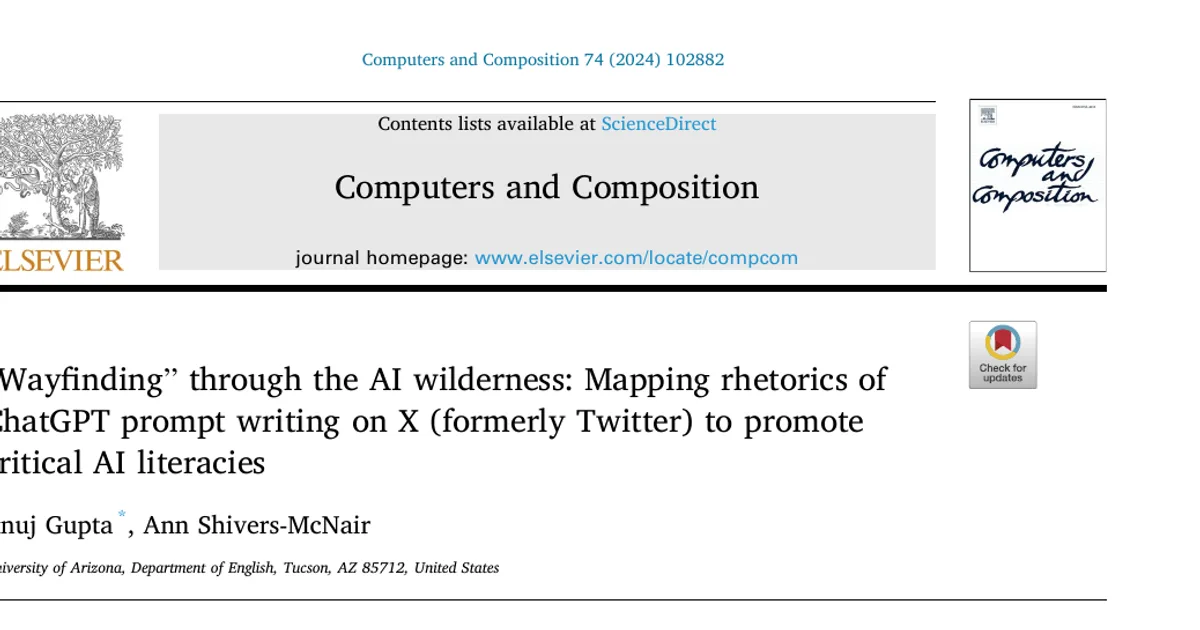
Wayfinding through the AI wilderness: Mapping rhetorics of ChatGPT prompt writing on X (formerly Twitter) to promote critical AI literacies
Overview Research area: Digital writing research and computers-and-composition, applied to critical AI literacy — specifically the rhetoric of ChatGPT prompt writing as practiced on social media. Tech
- arXiv
- 2511.00106
- Published
- 2025-10-30
- Authors
- Anuj Gupta, Ann Shivers-McNair
AI summary
Overview
Research area: Digital writing research and computers-and-composition, applied to critical AI literacy — specifically the rhetoric of ChatGPT prompt writing as practiced on social media.
Technical level: Beginner-Friendly. The paper is a qualitative-leaning study of writing practices and literacy, not a technical AI methods paper.
Scope (1 sentence): An iterative study of roughly 32,000 X (formerly Twitter) posts about ChatGPT prompt writing from November 2022 to May 2023, organized into five themes describing emerging AI literacy practices.
What This Paper Is About
Prompt writing — the practice of composing instructions that get generative AI tools like ChatGPT to produce a desired output — has generated a large, fast-moving conversation on social media. The authors argue that this public conversation is itself a rhetorical activity worth studying, and that analyzing it can help people become more critically literate about AI. Their goal is to show how a careful, reflexive research process applied to social media prompt-writing discourse can produce lessons for teachers and researchers of digital writing.
Key Contributions
- A framework that connects four traditions of digital writing research in computers and composition: how literacies are framed, how social media rhetorics are studied, how researchers engage iteratively and reflexively with methodologies and technologies, and how computational methods are blended with qualitative methods.
- A demonstration of an iterative, reflexive research process — the paper walks through how the authors gathered and analyzed their dataset rather than presenting only the conclusions.
- A thematic mapping of emerging AI literacy practices, organized into five themes about prompt writing as a public literacy.
- Practical takeaways for digital writing teachers and researchers who are teaching or analyzing critical AI literacies.
Main Findings
- Areas of communication impacted by prompt writing: The dataset revealed discussion of which domains of communication are being reshaped by the practice of writing prompts.
- Micro-literacy resources shared for prompt writing: People circulated small-scale, shareable tips and resources that function as informal literacy instruction.
- Market rhetoric shaping prompt writing: Prompts are discussed and promoted through commercial and market-oriented language, framing prompt skill as something to be bought, sold, or capitalized on.
- Rhetorical characteristics of prompts: The discourse surfaced descriptions of what actually makes a prompt function rhetorically.
- Definitions of prompt writing: Participants negotiated competing definitions of what prompt writing is and what it means.
The abstract states these five themes but does not report specific counts, subcategories, quotes, or comparative results; those details are not available in the abstract.
Methodology in Plain English
The authors did not run a controlled experiment or benchmark a model. Instead, they collected a large body of public social media posts — about 32,000 posts on X discussing prompt writing, published between November 2022 and May 2023 — and analyzed them for recurring themes. What makes their approach distinctive is that they describe the process itself as iterative and reflexive: they moved back and forth between their data, their methods, and the technologies involved, adjusting as they went. They also combine computational techniques (to handle a dataset of that size) with qualitative reading and interpretation (to understand meaning and rhetoric). They situate all of this within established traditions of computers-and-composition research, which shapes how they define literacy and how they justify their choices.
Why This Matters
Impact on research: The paper offers digital writing scholars a worked example of how computational scale and qualitative interpretation can be combined, and of how a research process can be documented reflexively rather than presented as a straight line. It reframes prompt writing as a legitimate object of rhetorical and literacy study rather than purely a technical skill.
Real-world applications:
- Classroom teaching: Writing instructors can use the five themes to design lessons that treat prompt writing critically — asking who benefits from market rhetoric around prompts, and what definitions of the practice are being assumed.
- Curriculum and literacy programs: Educators designing "critical AI literacy" content get a map of what learners are already encountering in informal online spaces.
- Writers and professionals using AI tools: Understanding the rhetorical dimensions of prompts — not just keywords — helps practitioners write instructions more deliberately.
- Platform and community organizers: People who run spaces where prompt-writing advice circulates can see how market rhetoric and shared micro-resources shape newcomers' expectations.
Industry relevance: Because much public prompt-writing discourse is commercially framed, the paper's analysis of market rhetoric is relevant to anyone building, marketing, or training employees on generative AI products — it makes visible the assumptions those framings carry.
Future Directions
- Extending the analysis to platforms and time periods beyond X posts from November 2022 to May 2023, since the discourse moves quickly.
- Developing the five themes into concrete pedagogical materials and testing how they work in actual writing courses.
- Refining the blend of computational and qualitative methods so other researchers can reproduce or adapt the iterative process.
- Investigating how the market rhetoric surrounding prompt writing affects who is included or excluded from AI literacy — a question the five themes raise but the abstract does not resolve.
Target Audience
Digital writing teachers and researchers in computers and composition are the primary audience, as the paper explicitly addresses takeaways to them. It is also useful to literacy educators, instructional designers, and anyone studying how AI practices spread through social media. A general reader interested in critical AI literacy will find it accessible, since it is a study of writing and discourse rather than of model architecture — though readers seeking quantitative performance results or technical benchmarks will not find them here.
Authors’ abstract
In this paper, we demonstrate how studying the rhetorics of ChatGPT prompt writing on social media can promote critical AI literacies. Prompt writing is the process of writing instructions for generative AI tools like ChatGPT to elicit desired outputs and there has been an upsurge of conversations about it on social media. To study this rhetorical activity, we build on four overlapping traditions of digital writing research in computers and composition that inform how we frame literacies, how we study social media rhetorics, how we engage iteratively and reflexively with methodologies and technologies, and how we blend computational methods with qualitative methods. Drawing on these four traditions, our paper shows our iterative research process through which we gathered and analyzed a dataset of 32,000 posts (formerly known as tweets) from X (formerly Twitter) about prompt writing posted between November 2022 to May 2023. We present five themes about these emerging AI literacy practices: (1) areas of communication impacted by prompt writing, (2) micro-literacy resources shared for prompt writing, (3) market rhetoric shaping prompt writing, (4) rhetorical characteristics of prompts, and (5) definitions of prompt writing. In discussing these themes and our methodologies, we highlight takeaways for digital writing teachers and researchers who are teaching and analyzing critical AI literacies.