Research
VRGaussianAvatar: Integrating 3D Gaussian Avatars into VR
VRGaussianAvatar: Integrating 3D Gaussian Avatars into VR Overview Research area: Computer vision and virtual reality — specifically 3D Gaussian Splatting (3DGS) avatar reconstruction, stereoscopic re
- arXiv
- 2602.01674
- Published
- 2026-02-02
- Authors
- Hail Song, Boram Yoon, Seokhwan Yang, Seoyoung Kang, Hyunjeong Kim, Henning Metzmacher, Woontack Woo
AI summary
VRGaussianAvatar: Integrating 3D Gaussian Avatars into VROverview
Research area: Computer vision and virtual reality — specifically 3D Gaussian Splatting (3DGS) avatar reconstruction, stereoscopic rendering, and avatar-mediated VR communication evaluated with human-subject methods.
Technical level: Advanced. The paper combines neural rendering (3DGS), transformer-based single-image avatar reconstruction, linear blend skinning, inverse kinematics, GPU rendering optimization, and a within-subject perceptual study with non-parametric factorial statistics.
Scope: The paper presents an integrated VR streaming system in which a full-body 3DGS avatar reconstructed from one image is animated using only the internal tracking sensors of a commercial head-mounted display (HMD), rendered stereoscopically in real time, and evaluated against image- and video-based mesh avatar baselines.
What This Paper Is About
Photorealistic full-body avatars matter for VR immersion, but existing mesh-based approaches built on the SMPL-X template struggle to reproduce subjects who deviate from that template, while neural rendering methods such as 3DGS are computationally heavy and poorly matched to conventional VR rendering pipelines. The goal of this work is to integrate a 3DGS full-body avatar into a real-time VR system driven solely by HMD head and hand tracking, and to check whether that produces a stronger sense of embodiment and plausibility than mesh baselines under identical control conditions.
Key Contributions
-
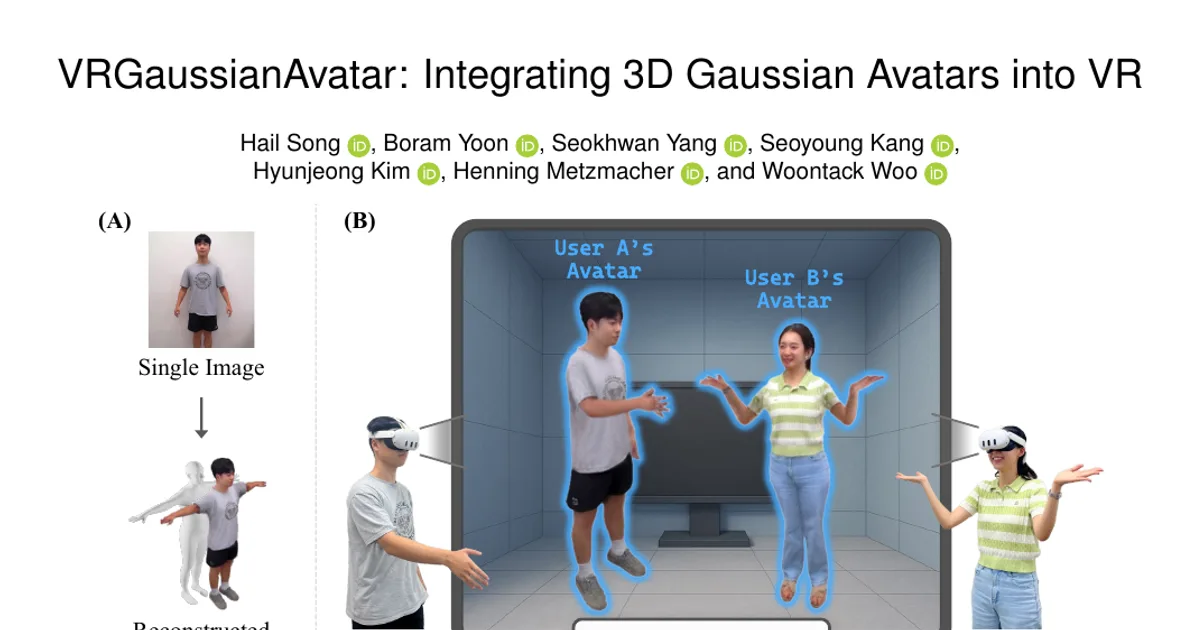
VRGaussianAvatar, an integrated VR streaming system that stereoscopically renders a 3DGS full-body avatar reconstructed from a single image and animated using only HMD tracking. The authors state that no prior work has realized full-body avatar representation using only the limited information from HMD-based body tracking and head tracking.
-
Binocular Batching, an efficient stereoscopic rendering strategy that jointly renders the left and right eye views in a single batched pass. Per-Gaussian attributes are staged once in GPU memory and reused across both eyes, while eye-specific projection and visibility are evaluated separately within the same pass.
-
A quantitative evaluation and a perceptual within-subject user study showing improved perceived appearance similarity, embodiment, and plausibility over mesh-based avatar baselines under the same HMD-only control setting.
-
The system builds on standard components — an off-the-shelf inverse kinematics solver and an off-the-shelf single-image 3DGS avatar reconstructor (the Large Human Model, LHM) — with the main contributions being the VR streaming integration, Binocular Batching, and the perceptual study.
Main Findings
-
Overall embodiment (VEQ): A main effect of avatar type was found for the aggregated VEQ score (F(1,23) = 8.464, p = .008, ηp² = .269), with self rated higher than other. No significant main effect of method (F(2,46) = 1.082, p = .348, ηp² = .045) and no interaction (F(2,46) = 2.493, p = .094, ηp² = .098) were found. Internal consistency was α_VEQ = .825.
-
Virtual Body Ownership (VBO): Significant main effects of both avatar type (F(1,23) = 15.064, p < .001, ηp² = .396) and method (F(2,46) = 21.903, p < .001, ηp² = .488). Post-hoc tests showed self higher than other, and the Ours method induced higher ownership than both video and image (all p < .001), while video and image did not differ. No interaction (F(2,46) = 1.419, p = .252).
-
Agency (AG): Significant main effects of avatar type (F(1,23) = 4.323, p = .049, ηp² = .158) and method (F(2,46) = 6.041, p = .005, ηp² = .208). Ours conveyed higher agency than video (p = .031) and image (p = .006); video and image did not differ. No interaction (F(2,46) = 0.841, p = .438).
-
Change (CH): A significant main effect of method (F(2,46) = 13.728, p < .001, ηp² = .374) but not of avatar type. Ours yielded lower CH scores — the better outcome, since lower values indicate less perceived change from one's own body — than video (p = .001) and image (p < .001), while video and image did not differ. A significant interaction was observed (F(2,46) = 7.932, p = .001, ηp² = .256): in the self condition Ours produced lower CH scores than both baselines (all p < .001), while in the other condition Ours was lower only than image (p = .024).
-
VEQ+ overall: Significant main effects of avatar type (F(1,23) = 57.715, p < .001, ηp² = .715) and method (F(2,46) = 49.487, p < .001, ηp² = .683), plus a significant interaction (F(2,46) = 16.155, p < .001, ηp² = .413). Self scored higher than other; Ours was higher than both video and image (all p < .001); video was higher than image (p < .001). Within the self condition, Ours was higher than both baselines (all p < .001) and video was higher than image (p = .005). Within the other condition, Ours again scored higher than video and image (p < .001), while video versus image was not significant. Internal consistency was α_VEQ+ = .937.
-
Self-Location (SL): Significant main effects of avatar type (F(1,23) = 9.389, p = .005, ηp² = .290) and method (F(2,46) = 12.948, p < .001, ηp² = .360); Ours showed higher SL than video (p = .001) and image (p < .001), while video and image did not differ. No interaction was found.
-
Self-Attribution (SA): Significant main effects of avatar type (F(1,23) = 45.904, p < .001, ηp² = .666) and method (F(2,46) = 44.525, p < .001, ηp² = .659), plus a significant interaction (F(2,46) = 10.653, p < .001, ηp² = .317). Self was higher than other; Ours was rated higher than video and image (all p < .001); video was higher than image (p = .006). The remaining SA results are cut off in the provided content.
-
Questionnaire reliability: Subscale alphas reported were α_VBO = .861, α_AG = .837, α_CH = .890, α_SL = .765, α_SA = .889, and α_SS = .965.
-
Reconstruction speed: The image-based mesh baseline required approximately 30 seconds for SMPL-X parameter estimation and 19 seconds for texture generation. The Gaussian Avatar Module reconstructed a full-body 3D Gaussian avatar within 10 seconds. For the video-based baseline, body reconstruction with RC-SMPL took about 30 seconds with 2 additional seconds for avatar integration, while FATE facial reconstruction on a separate NVIDIA A40 workstation required about 12 hours.
-
Quantitative image metrics and Binocular Batching speedups: L1 distance, LPIPS, PSNR, and SSIM were used as metrics, and rendering speed was measured at different resolutions to assess Binocular Batching's contribution. The numerical results of these quantitative comparisons and the rendering-time analysis are referred to in subsection 5.2 of the paper and are not included in the provided content, so specific values are not reported here.
Methodology in Plain English
The system is split into two cooperating halves that run in parallel.
The VR Frontend runs inside the headset (a Meta Quest 3 in the reference setup, built with Unity 6000.1.13f1 and Unity Final IK). It takes only the signals the device natively provides — head position and orientation plus hand tracking. An inverse kinematics solver turns those sparse cues into a full-body SMPL-X-compatible pose, using the head pose to anchor the root via a calibrated head-to-root offset and the hands as end-effector constraints when available; if hand tracking is missing, it falls back to a head-only configuration with posture priors on the torso and shoulders. Joint limits and temporal smoothing keep the result stable. From the head pose, the frontend builds left and right eye cameras by placing an interpupillary distance baseline along the head's local +X axis, composes them with the head transform to get world-space eye poses, and inverts them into world-to-camera transforms. Each frame it sends a compact request containing a frame ID, per-eye camera parameters, and the pose to the backend.
The GA Backend (Python 3.9, PyTorch 2.3.0, PyTorch3D, one NVIDIA RTX 4090) holds a pre-reconstructed 3DGS avatar. The avatar comes from a single frontal A-pose image processed by the Gaussian Avatar Module, instantiated with the off-the-shelf Large Human Model. SMPL-X geometry and image appearance are encoded into transformer tokens: 2,048 sampled surface points become 3D tokens, a frozen body encoder produces body tokens, and a frozen multi-scale head encoder produces head tokens fused into one set. A Multimodal Body-Head Transformer combines them, and a decoder predicts canonical Gaussians (position, anisotropic scale, quaternion rotation, opacity, and spherical-harmonic appearance) together with SMPL-X-compatible blend weights and bone transforms. At runtime, each new pose is applied by linear blend skinning to deform the canonical Gaussians into a posed set, which is then rasterized with standard 3DGS.
Binocular Batching is the rendering innovation: instead of rendering the left and right eyes sequentially with duplicated work, per-Gaussian attributes are staged once in GPU memory and reused for both eyes within a single batched pass, with eye-specific projection and view-dependent shading evaluated per eye in that same pass. This is intended to cut redundant memory transfers and per-frame fixed costs such as kernel launches, data marshalling, and cache warm-up, and to improve cache coherence.
Rendered eye buffers are converted to 8-bit sRGB, JPEG-compressed at a fixed quality, and sent back with the frame ID in one response. The per-frame design is stateless, which allows late frames to be deterministically dropped on the receiver. In the study, background compositing was disabled and a black background used to focus evaluation on the avatar, so only RGB JPEG frames were streamed.
Evaluation. Baselines were two mesh-based SMPL-X systems. The video-based baseline used a one-minute FACS-based facial expression video reconstructed with FATE into a textured FLAME model, plus RGBD video from an Azure Kinect DK reconstructed with RC-SMPL into a textured SMPL-X body, with head and body textures merged following prior work. The image-based baseline used the same single input image as the proposed system, with SMPLer-X for mesh recovery and TexDreamer for texture. All methods were controlled only by the HMD's internal sensors.
The user study used a 2 × 3 within-subject factorial design: avatar type (self vs. other, with other avatars of non-participant models matched in gender, ethnicity, and similar age) crossed with method (Ours, video, image). Order was counterbalanced, and the three methods within each type were counterbalanced with a Latin Square. Twenty-four participants (12 male, 12 female), aged 22 to 34 (M = 27.67, SD = 3.17), attended two sessions. Participants wore an HMD in mirror mode and followed pre-recorded audio instructions to take poses, including freely exploring their avatar and observing it from the front, left, right, and rear. Measures were the VEQ (Virtual Body Ownership, Agency, Change), VEQ+ (Self-Location, Self-Attribution, Self-Similarity), the Appearance and Behavior Plausibility subscale of the Virtual Human Plausibility Questionnaire (six items), and three self-reported items on realism, naturalness, and visuomotor synchrony — 12 items each for VEQ and VEQ+, 24 items total, all on 7-point Likert scales. Analysis used a two-way repeated measures ANOVA with the Aligned Rank Transform at α = .05, ART-C post-hoc comparisons with Bonferroni-corrected p-values, and Cronbach's alpha for internal consistency. The study was IRB approved. The quantitative evaluation used the same 24-participant setup, with L1, LPIPS, PSNR, and SSIM computed against ground-truth images after cropping renders to the full body.
Why This Matters
Impact on research. The work shifts 3DGS avatar research from isolated reconstruction quality toward deployable VR system integration, showing that a full-body neural avatar can be driven by nothing more than commercial HMD head and hand tracking, and that this yields measurably higher virtual body ownership, agency, self-location, self-attribution, and lower perceived body change than mesh baselines. It also gives a perceptual benchmark design (2 × 3 within-subject, VEQ/VEQ+/VHPQ, ART-based non-parametric analysis) that other neural avatar papers can reuse, and it introduces a rendering optimization (Binocular Batching) specific to the stereoscopic demands of 3DGS in VR.
Real-world applications.
- VR telepresence and remote meetings where participants appear as themselves rather than as generic avatars.
- Social VR and gaming, where a single photo is enough to produce a personalized full-body avatar.
- Virtual try-on, fitness, or training scenarios where an accurate body-shaped avatar increases acceptance.
- Asymmetric mixed reality or collaborative VR where plausibility of other users' avatars affects comfort and communication quality.
Industry relevance. The pipeline runs on consumer-grade hardware — a Meta Quest 3 headset, a single NVIDIA RTX 4090 GPU, and an Intel Core i9-14900K with 64 GB RAM — and reconstructs an avatar in about 10 seconds from one image, versus roughly 12 hours for the video-based baseline's facial reconstruction on an A40 workstation. That gap between one-image and video pipelines is directly relevant to any product where avatar creation has to be fast and accessible to non-expert users.
Future Directions
-
Fuller quantitative reporting. The provided content refers LPIPS, PSNR, SSIM, and L1 comparisons and the Binocular Batching rendering-speed analysis at different resolutions to subsection 5.2 but does not include those numbers, leaving the precise reconstruction-fidelity and speedup tradeoffs to be examined in the paper itself.
-
Streaming and network conditions. The reference setup communicates over localhost to minimize network overhead. Whether the system holds up over real networks, and how the stateless frame-dropping design behaves under latency and jitter, remains an open question.
-
Scene and background compositing. The study deliberately disabled background compositing and streamed RGB-only JPEG frames against a black background. The GA Backend can render with an alpha channel for compositing with a 3DGS scene/background, but that configuration was not evaluated with users.
-
Beyond HMD-only signals. The system is explicitly limited to head 6DoF and hand tracking, with a head-only fallback using posture priors when hands are absent. Lower-body motion, facial expression, and full-body tracking from additional sensors are natural extensions the current design does not address, and the paper's own framing notes that no prior work had achieved full-body avatar representation from HMD-only tracking before this system.
Target Audience
Researchers and practitioners in VR/AR, neural rendering, and human-computer interaction — particularly those working on 3DGS avatars, real-time stereoscopic rendering, or telepresence systems. It is also relevant to HCI researchers who design embodiment and plausibility studies, and to graphics or game engineers looking for a concrete example of wiring a neural avatar into a consumer VR headset pipeline. Readers need prior familiarity with 3D Gaussian Splatting, SMPL-X, and factorial experimental design to follow the method and results in full.
Authors’ abstract
We present VRGaussianAvatar, an integrated system that enables real-time full-body 3D Gaussian Splatting (3DGS) avatars in virtual reality using only head-mounted display (HMD) tracking signals. The system adopts a parallel pipeline with a VR Frontend and a GA Backend. The VR Frontend uses inverse kinematics to estimate full-body pose and streams the resulting pose along with stereo camera parameters to the backend. The GA Backend stereoscopically renders a 3DGS avatar reconstructed from a single image. To improve stereo rendering efficiency, we introduce Binocular Batching, which jointly processes left and right eye views in a single batched pass to reduce redundant computation and support high-resolution VR displays. We evaluate VRGaussianAvatar with quantitative performance tests and a within-subject user study against image- and video-based mesh avatar baselines. Results show that VRGaussianAvatar sustains interactive VR performance and yields higher perceived appearance similarity, embodiment, and plausibility. Project page and source code are available at https://vrgaussianavatar.github.io.