Research
VIRA-Bench: Diagnosing Pedagogical Contingency Understanding in Online Tutoring Videos
Overview Research area: Human-Computer Interaction / multimodal NLP — evaluation of video-language models on visually grounded pedagogical interaction. Technical level: Intermediate. Readers should kn
- arXiv
- 2610.29428
- Published
- 2026-10-21
- Authors
- Weihang Wang, Hansu Gu, Guanming Liu, Peng Zhang, Ning Gu, Tun Lu
AI summary
Overview
Research area: Human-Computer Interaction / multimodal NLP — evaluation of video-language models on visually grounded pedagogical interaction.
Technical level: Intermediate. Readers should know what multiple-choice benchmarks, ASR transcripts, and multimodal LLMs are, but the paper's argument is conceptual rather than mathematical.
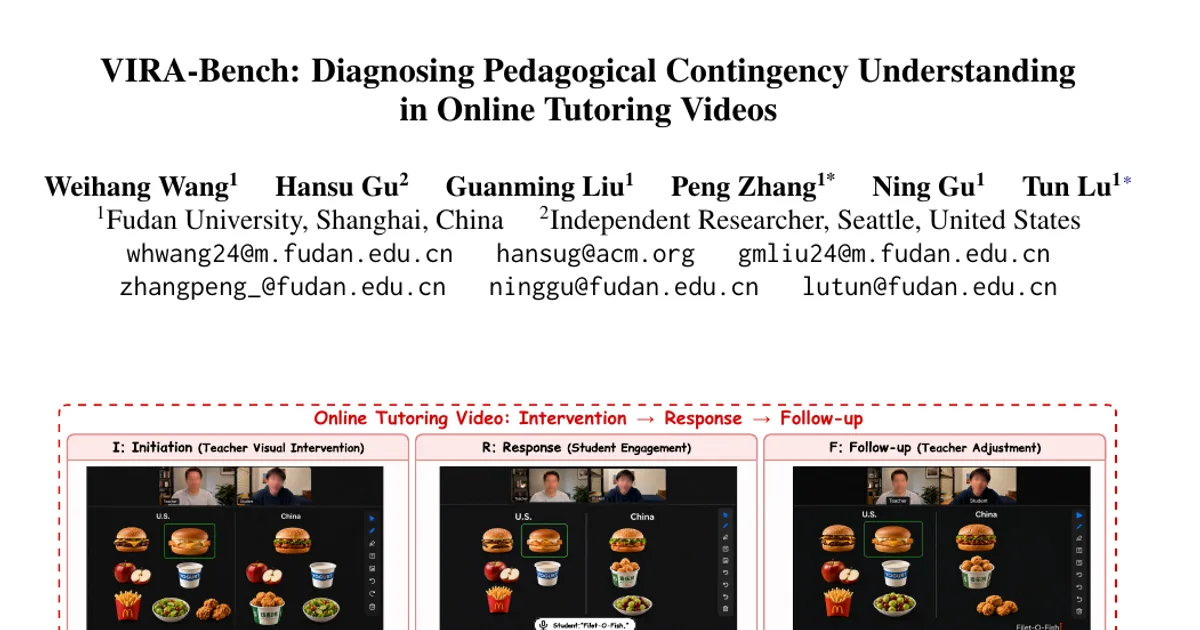
Scope: VIRA-Bench is a diagnostic benchmark of 1,005 short one-to-one online tutoring clips and 1,322 multiple-choice questions that tests whether multimodal models can link a teacher's visible intervention to the learner response it elicits and to the teacher's follow-up.
What This Paper Is About
Video benchmarks mostly test whether a model can recognize events, order them in time, or infer social states, while educational-dialogue benchmarks work almost entirely from transcripts. Neither type checks whether a model can connect a visible teacher action (circling a word, highlighting, dragging) to the learner response it triggers and then to the teacher's adjustment based on that response. The authors build VIRA-Bench to isolate this "action–response–adjustment" skill, which they call visually grounded pedagogical contingency, and to diagnose where current models break down.
Key Contributions
-
A formulated evaluation target. The authors define visually grounded pedagogical contingency understanding as a distinct diagnostic problem for video-language models, instantiated in one-to-one online tutoring and grounded in the Initiation–Response–Follow-up (IRF) exchange structure and contingent teaching theory.
-
The benchmark itself. VIRA-Bench contains 1,005 tutoring clips (15–60 s each, mean 32.4 s) and 1,322 multiple-choice questions across three diagnostic layers and eight subtasks, built through a pipeline where LLMs generate candidate descriptions and questions, researchers audit evidence against source videos, and domain experts verify a stratified sample.
-
A three-layer diagnostic decomposition. The benchmark separates Observable Evidence Grounding (497 questions), Interaction Contingency Reasoning (529 questions), and Support-Response Modeling (296 questions) by the type of cognitive operation required, not by difficulty.
-
Paired evidence interventions rather than a single leaderboard. The authors evaluate 11 models and run ASR-only, visual-shuffle, synchronized video–ASR shuffle, free-response, and Stem+Options controls on representative models, showing that each layer depends on different behavioral evidence.
Main Findings
-
Large human–model gap. The best model, Gemini 3 Pro, reaches 61.3% overall accuracy against a 91.0% human reference (95% CI 86.2–94.2) on a stratified 200-question subset, a 29.7-point gap. The human reference was produced by three expert answerers independently answering 25 questions per subtask with majority voting.
-
Wide spread across 11 models. Overall accuracy ranges from 20.3% (Qwen3-VL-32B-Inst) to 61.3%. The five leading models cluster between 55.9% and 61.3% with overlapping confidence intervals; the remaining models range from 20.3% to 43.0%.
-
A recurring layer profile. All top-tier models follow the ordering SRM > OEG > ICR, and the human reference follows the same ordering (SRM 94.0%, OEG 92.0%, ICR 88.0%) at uniformly high accuracy. Among the top five models, the OEG–ICR gap ranges from 0.8 to 10.7 points, which motivates the perturbation analyses.
-
Removing video hurts OEG most. Under ASR Text Only, OEG drops by 12.7–22.0 points across the five analyzed models. Content Recognition falls by 23–40 points and Action Identification by 16–25 points across the four stronger models, while Behavior Extraction falls by only 4–9 points — verbal cues partially support behavior extraction. Every OEG decline survives Holm-corrected McNemar testing, whereas most ICR and SRM effects do not.
-
Disrupting event order hurts ICR most. Under Visual Shuffle with Fixed ASR, ICR falls by 11.9–19.1 points across the five models, and all five declines survive Holm correction. Sequence Recognition shows the largest drops (16–30 points; Gemini 3 Flash 56.4 to 32.8, MiMo-V2.5 55.2 to 30.0). Four of five OEG changes and four of five SRM changes are not significant under the same perturbation.
-
Cross-modal mismatch does not explain the ICR decline. A synchronized shuffle that permutes each visual segment together with its aligned ASR span reproduces the pattern: ICR falls by 21.5 points for Gemini 3 Flash and 19.7 for Qwen3.6-Plus, while OEG changes by only 6.9 and 0.6 points.
-
Answer format affects absolute scores, not the layer pattern. Free response lowers overall accuracy by 12.1 and 11.7 points for the two tested models, yet both remain stronger on OEG than ICR. Under Stem+Options (no video, ASR, or description), accuracy is only 29.2–29.7% versus 55.9–59.7% under full Video+ASR, and layer scores are nearly flat.
-
Below-chance results are not a label artifact. The three below-chance models spread predictions across labels A–D at 22.0–26.6% each, and all 1,322 responses per model parse successfully; gold labels are balanced across A–D.
-
Trivial surface factors do not account for the ICR effect. ICR has the shortest question stems (13.0 words), option lengths comparable to OEG/SRM (20.0 vs. 18.8/19.5 words), and clip durations that differ by at most 1.1 seconds across layers. The authors state that other unmeasured layer differences may remain.
Methodology in Plain English
The source material is a corpus of over 1,000 professionally recorded one-to-one online English tutoring sessions from 2018–2021, each 1–2 hours long; the released benchmark covers 72 learners and 22 teachers, mostly Mandarin-first-language learners, so teacher speech naturally includes code-switching.
To find the moments worth testing, the pipeline works coarse to fine. Automatic speech recognition (Whisper-large-v3) narrows each long session to roughly 15–30 minutes of likely instructional talk. Shared-screen frames are then sampled at 2 fps and compared using structural similarity; a visual content event fires when the SSIM score drops below 0.88 or more than 3% of pixels change, capturing writing, circling, highlighting, dragging, or slide transitions. Each event anchors a 15–60 second window (3 s before, 12 s after, truncated at 60 s).
Filtering is layered and each stage's yield is reported: 2,760 visual event anchors become 1,840 candidate clips after merging and de-duplication (33.3% filtered), 1,480 after quality screening (19.6% removed for unclear screens, missing student responses, or overlapping exchanges), and 1,370 after researcher evidence audit (7.4% removed for unrecoverable evidence). Question-level filtering leaves 1,005 clips with at least one valid question (26.6% filtered).
Question construction keeps generation and evaluation separate. GPT-4o writes structured evidence descriptions (screen events, student behaviors, teacher speech acts, temporal dynamics, cognitive demand), which researchers audit against the video before any question is written. GPT-5 then generates four-option questions from audited descriptions under constraints on option-length parity, specificity, and tone. Two held-out validators, GLM-5V-Turbo and Claude-Haiku-4.5, remove items answerable from the stem alone (10.6% removed) and items lacking explicit evidence support (a further 34.4%), leaving 1,326. A 360-question expert audit (300 random, 60 high-risk) produced 340 accepted unchanged, 16 minor revisions, and 4 removals — a 94.4% direct acceptance rate and 1.1% removal rate — yielding 1,322 final questions. No construction or validation model appears on the leaderboard.
Evaluation is zero-shot: video sampled at 1 frame per second plus ASR, question, and four labeled options, with option order shuffled per model–item pair. Three input manipulations isolate evidence dependencies: ASR Text Only (video removed), Visual Shuffle with Fixed ASR (visual segments permuted, transcript unchanged), and Synchronized Video+ASR Shuffle (segments permuted with their aligned transcript spans). Faces are blurred with MediaPipe prior to processing; a 50-clip comparison found accuracy differences below 3 percentage points.
Why This Matters
Impact on research. The paper argues that aggregate video-QA scores conflate capabilities that fail for different reasons. By pairing each layer with an intervention that selectively degrades it, the benchmark converts layer scores into testable development targets: better OEG should show up as better recovery of actions and screen state from video, and better ICR should appear under intact order and shrink when the exchange is permuted. The authors are explicit that this identifies behavioral evidence dependencies, not an internal architectural mechanism.
Real-world applications:
- Automated feedback for online tutoring platforms, where a system could flag exchanges whose follow-up is not actually conditioned on the learner's response.
- Teacher training and coaching, where reviewing short intervention–response–follow-up clips is more actionable than watching full lessons.
- Evaluation of AI tutoring assistants, which are often judged on transcripts alone and may recognize each turn without tracking contingency.
- Multimodal insight tooling for recorded instruction, such as surfacing moments where a learner's visible confusion did or did not draw an adjustment.
Industry relevance. Companies building AI teaching assistants, classroom-observation products, or video-understanding APIs need benchmarks that do not saturate on event recognition. The 29.7-point gap between the best model and the human reference, combined with the finding that static question cues yield only 29.2–29.7%, indicates that current systems cannot be trusted with judgment about whether support matched learner state.
Future Directions
-
Extending beyond short one-to-one English tutoring. The limitations section notes that 15–60 s excerpts from one-to-one tutoring may not transfer to multi-party classrooms, other subject domains, or longitudinal scaffolding that fades across sessions — the current benchmark explicitly targets local contingency within a single exchange.
-
Moving past multiple choice. The protocol targets reproducible multimodal understanding rather than open-ended generation, action, or multi-turn adaptation; free-response testing here only lowered accuracy by 12.1 and 11.7 points for two models rather than replacing the paradigm.
-
Closing the Support-Response Modeling gap. The best model remains 29.1 points below the human reference on SRM, which the authors read as motivation for tests of learner-state tracking beyond partial cues from individual channels.
-
Reducing residual annotation artifacts. Despite multi-model validation and expert audit of a 360-question stratified sample, the authors acknowledge that occasional construction artifacts may remain, and that unmeasured differences among layers could still contribute to the ICR-specific effect.
Target Audience
Researchers in multimodal video understanding and benchmark design who need evaluation targets finer than aggregate video-QA accuracy; learning-science and educational-NLP researchers interested in operationalizing IRF and contingent scaffolding as computational tasks; and practitioners building classroom observation, tutoring analytics, or AI teaching assistants who want to know which capabilities current models actually lack.
Authors’ abstract
Understanding a one-to-one tutoring video requires more than recognizing its events. A model must connect a visible teacher intervention to the learner response it elicits and to the follow-up adjusted to that response. Existing video and educational-dialogue benchmarks typically emphasize event recognition, temporal reasoning, social-state inference, or transcript-based interaction, but rarely diagnose this action-response-adjustment relation. We introduce VIRA-Bench, a focused diagnostic benchmark for short-horizon pedagogical contingency in one-to-one online tutoring. VIRA-Bench contains 1,005 tutoring clips and 1,322 multiple-choice questions with researcher evidence audit and expert verification, organized into Observable Evidence Grounding (OEG), Interaction Contingency Reasoning (ICR), and Support-Response Modeling (SRM). Across 11 models, the best reaches 61.3%, well below the 91.0% human reference on a stratified subset, and ICR generally has the lowest layer accuracy among leading models. Under controlled input manipulations, removing video most strongly degrades OEG, whereas disrupting temporal order most strongly degrades ICR. Free-response, Stem+Options, and synchronized-shuffle controls show that response format, static question cues, and video-ASR mismatch do not explain these layer-specific patterns. The results identify distinct behavioral evidence dependencies without claiming an internal architectural mechanism. VIRA-Bench provides a focused evaluation resource for multimodal dialogue grounding, pedagogical discourse, and temporal reasoning in online tutoring.