Research
VideoMaMa++: Temporally Consistent Video Matting via Preserve-and-Refine Token
Overview Research area: Computer vision — video matting, specifically diffusion-transformer-based alpha matte generation for long videos. Technical level: Advanced (assumes familiarity with diffusion
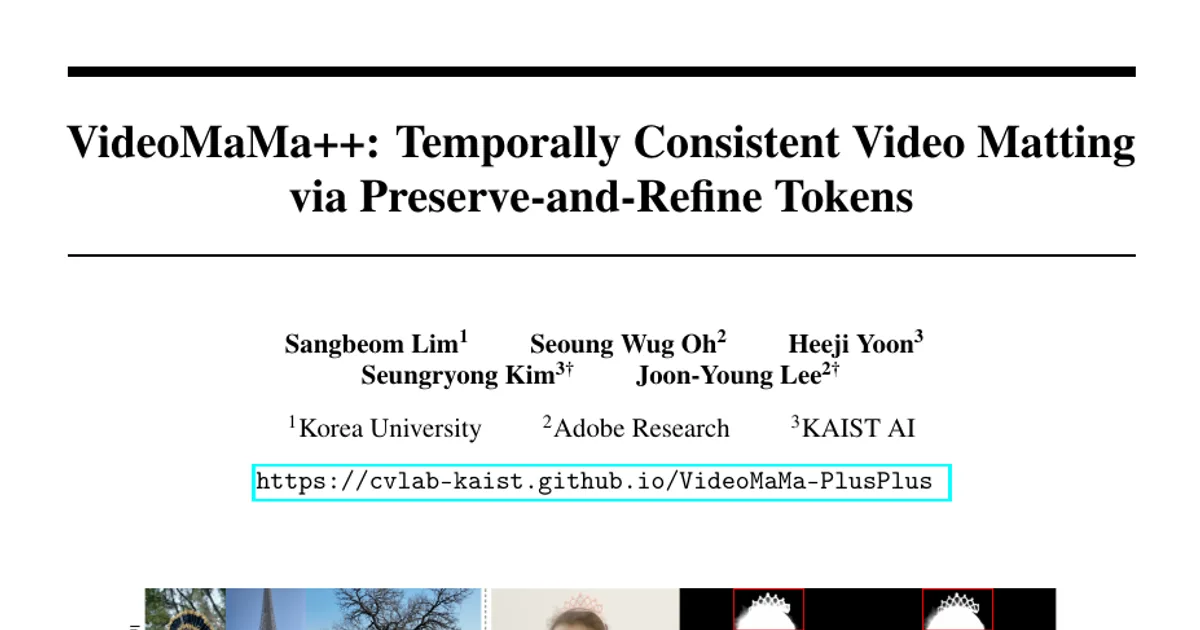
- arXiv
- 2610.26857
- Published
- 2026-10-19
- Authors
- Sangbeom Lim, Seoung Wug Oh, Heeji Yoon, Seungryong Kim, Joon-Young Lee
AI summary
Overview
- Research area: Computer vision — video matting, specifically diffusion-transformer-based alpha matte generation for long videos.
- Technical level: Advanced (assumes familiarity with diffusion models, Diffusion Transformers, VAEs, LoRA, and matting metrics such as MAD, Gradient, dtSSD, and Conn).
- Scope: The paper introduces VideoMaMa++, a mask-guided video matting framework built on a pretrained video Diffusion Transformer, with a preserve/refine token mechanism that keeps mattes consistent across the chunk boundaries imposed by diffusion inference on long videos.
What This Paper Is About
Diffusion-based video matting produces detailed alpha mattes and generalizes well from synthetic training data, but the diffusion backbone is so compute-heavy that it can only process a short chunk of 6–24 frames at a time. Ordinary videos therefore span many chunks, and because each chunk is matted independently from the same coarse mask guidance, the results drift at chunk boundaries, causing flickering edges and discontinuous transparency. The paper's goal is a framework that keeps fine-detail quality while making mattes temporally consistent across chunk boundaries and over long sequences, without retraining for long video.
Key Contributions
- Token-level guidance representation. Instead of fusing RGB frames, coarse mask, and noisy matte latent by channel concatenation (as in the prior U-Net-based VideoMaMa), the method keeps RGB and mask as separate token streams that interact with the noise tokens through full spatio-temporal self-attention in a Diffusion Transformer, letting the model adaptively weight texture cues at boundaries and mask cues in the interior.
- Preserve and refine tokens. Two learnable token embeddings act as a per-frame conditioning interface: a preserve token marks a frame whose guidance is already a fine matte to be retained, and a refine token marks a frame that should be converted from a coarse mask into a fine matte.
- Chunk-consistent inference. A sliding-window scheme passes already-generated mattes across chunk boundaries via the preserve token on overlap frames, and a globally shared reference anchor (by default the first chunk's predicted matte) is supplied as a preserve input to every chunk to prevent error accumulation — with no additional training required.
- State-of-the-art results and an annotation-free boundary test. The method leads on VideoMatte240K, YouTubeMatte, and V-HIM60 (Hard) in both fine-detail accuracy and temporal consistency, and a seam-discontinuity test shows it stays at chance level at chunk boundaries where VideoMaMa spikes.
Main Findings
- Best on every metric on every benchmark. On VideoMatte (1920×1080), VideoMaMa++ reaches MAD 3.86 versus VideoMaMa's 4.34, MSE 0.12 versus 0.27, Gradient 1.79 versus 4.06, and dtSSD 0.82 versus 1.21. On YouTubeMatte it reaches MAD 1.15 versus 1.41, MSE 0.23 versus 0.30, Gradient 3.27 versus 4.08, and dtSSD 1.17 versus 1.31. On V-HIM60 (Hard) it reaches MAD 1.69 versus 2.30, MSE 0.45 versus 0.75, Gradient 2.92 versus 5.04, dtSSD 1.98 versus 2.51, and Conn 2.72 versus 3.83. It also outperforms SAM3, MGM, MGM-IW, MaGGIe, MaGGIe-FT, MatAnyone, and MatAnyone 2 across these tables.
- Gains concentrate on boundary sharpness and temporal smoothness. The authors attribute the Gradient improvements to the DiT generative prior recovering fine boundary detail and the dtSSD improvements to the preserve/refine mechanism producing temporally coherent mattes despite chunk-wise processing.
- The preserve token sharply reduces chunk-boundary drift. In a targeted test where overlap frames are generated twice (once per adjacent chunk), removing the preserve token gives MAD 0.7128 and Gradient 0.6811 discrepancy, while using it gives MAD 0.2583 and Gradient 0.1235.
- The reference anchor prevents long-range error accumulation. Adding it improves all six metrics on both benchmarks, for example VideoMatte MAD from 3.9505 to 3.8633, MSE from 0.1518 to 0.1240, and Gradient from 2.2398 to 1.7887; YouTubeMatte MAD from 1.2691 to 1.1526 and Gradient from 4.4151 to 3.2741. Re-aggregating MAD by chunk index shows the no-anchor variant rising steadily toward the final chunk while the anchored variant stays substantially flatter.
- Anchor choice is flexible and robust to corruption. Using the first, a random, or the last frame of the first chunk, or re-anchoring every 3 chunks, gives nearly unchanged MAD on V-HIM60 (1.69, 1.70, 1.72, 1.70 respectively). Corrupting the anchor with dilated or eroded masks, motion blur, or full occlusion degrades MAD only from 1.71 (clean) to at most 1.76 (full occlusion).
- Token concatenation beats channel concatenation. On V-HIM60, channel concatenation gives MAD 2.2253 versus 1.6924 for token concatenation, and Gradient 4.7119 versus 2.9813.
- One denoising step is best. MAD is 1.6680 at one step, 1.7221 at two, 2.7264 at three, 10.7571 at five, and 16.6343 at ten; more steps over-refine the matte and degrade boundary sharpness.
- Six-frame chunks are the sweet spot. With overlap fixed at 2 frames, MAD is 2.1206 for chunk size 3, 1.6942 for 6, and 1.7906 for 12.
- Higher LoRA rank helps monotonically. MAD improves from 2.4294 at rank 64 to 2.3018 at rank 128 and 1.6942 at rank 512, which is the default.
- Robust to the choice of mask generator. On V-HIM60 the refined MAD is 3.1119 with XMem, 1.9430 with Cutie, 1.8994 with SAM2, and 1.6924 with SAM3 inputs.
- Soft SAM logits help in-benchmark but not in the wild. Retraining with SAM logit maps instead of binary masks improves all four reported metrics (MAD 1.6272 versus 1.6942), but the gain does not transfer to in-the-wild video, so binary masks remain the default.
- Interactive refinement works. Marking the worst frame in a chunk as refine and the rest as preserve improves the matte even without new guidance.
- Annotation-free seam test. On in-the-wild clips, VideoMaMa's matte change spikes at seams while VideoMaMa++ stays at chance level; on YouTubeMatte the same test detects VideoMaMa's discontinuity and finds none in ground-truth mattes.
Methodology in Plain English
The pipeline has three stages. First, the user gives a single prompt on the first frame, and an off-the-shelf video segmentation model (SAM3 in the main experiments) propagates it to produce a coarse binary mask for every frame — this decouples "where is the object" from "what are the exact pixel-level edges." Second, a video Diffusion Transformer takes the RGB frames, the mask track, and a noisy latent of the matte as three separate token streams and denoises them jointly, with self-attention allowed to look across space and time. The mask stream supplies a rough spatial anchor; the RGB stream supplies high-frequency cues such as hair strands; attention combines them per location. Third, long videos are processed chunk by chunk in a sliding window: overlapping frames from the previous chunk are fed in as finished mattes tagged with the preserve token, the new frames are tagged with the refine token and their coarse masks, and a single globally chosen anchor frame — by default the first chunk's own prediction — is included as a preserve input in every chunk.
Training uses 3-frame clips at 1024×1024 resolution, with the RGB and mask conditioning, and with a random subset of frames switched to ground-truth alpha mattes and tagged with the preserve token, so the model learns both behaviors inside one clip. The pretrained Wan 2.1 (1.3B) DiT is adapted with LoRA (rank 512) rather than fully fine-tuned, and supervision is applied in pixel space on the decoded output rather than with the original flow-matching objective. Inference uses 6-frame chunks with a 2-frame overlap (one overlap frame is the anchor) and a single denoising step. Rotary position embeddings let the model transfer from 3-frame training clips to 6-frame inference chunks.
Why This Matters
- Research impact: The paper identifies chunk-boundary inconsistency as a structural consequence of diffusion-based perception on long video, and offers an explicit, training-free mechanism (preserve/refine tokens plus a global anchor) as an alternative to implicit KV-cache autoregression, which the authors argue re-entangles localization with detail generation. The annotation-free seam test also gives the field a way to measure boundary discontinuities without ground truth.
- Real-world applications:
- Background replacement in video editing, where flickering edges at chunk seams are highly visible.
- Visual composition and VFX rotoscoping, where hair strands and motion-blurred edges must be preserved.
- Relighting and other post-production pipelines that require accurate alpha.
- Interactive correction workflows, where an artist re-tags a bad frame as refine and keeps trusted neighbors as preserve anchors.
- Industry relevance: The method is built on an open 1.3B DiT with LoRA adapters rather than full fine-tuning, runs at a single denoising step, and is robust to whichever segmentation model supplies the mask (XMem, Cutie, SAM2, SAM3), which makes it plausible to slot into existing segmentation-plus-compositing toolchains. The authors do acknowledge it remains more computationally demanding than feed-forward matting models.
Future Directions
- Reducing DiT inference cost, which the conclusion names explicitly as a limitation relative to feed-forward models and as a promising direction.
- Benchmarking temporal smoothness on real footage, also named in the conclusion, since current temporal metrics rely on datasets with ground truth.
- Handling upstream tracker failures: the paper states that if the tracker locks onto the wrong object for an entire sequence, the matte follows that track — a limitation shared by all mask-guided methods and left open.
- Extending soft guidance beyond the benchmark: the SAM-logit variant helped on V-HIM60 but overfit to SAM's logit distribution in the wild, so making continuous guidance generalize is an open question.
- Refreshing anchors on more drastic footage: re-anchoring every few chunks matched the default on V-HIM60, but the authors note refreshing remains available for content with more drastic change.
Target Audience
Researchers and practitioners in computer vision and generative modeling who work on video matting, video editing, or diffusion-based dense perception; engineers building post-production and compositing pipelines that need temporally stable alpha mattes; and readers already comfortable with diffusion transformers, LoRA, and standard matting metrics who want to understand how to make chunk-wise diffusion inference consistent over long video.
Authors’ abstract
Diffusion-based video matting has recently emerged as a leading approach, leveraging video diffusion priors from internet-scale pretraining to achieve strong zero-shot generalization from limited synthetic data. However, the heavy compute of these diffusion backbones limits inference to a short chunk of just 6 to 24 frames, so even ordinary videos span multiple chunks. Because each chunk is matted independently from coarse mask guidance, existing methods fail to maintain consistency across chunk boundaries, producing flickering edges and discontinuous transparency. We address this with a mask-guided diffusion-matting framework built on two ideas. The RGB and mask conditioning are represented as separate token streams that interact through full spatio-temporal self-attention, letting the model adaptively combine fine RGB texture with coarse mask layout rather than committing to a fixed channel-wise fusion. On top of this, we propose a novel pair of learnable embeddings, the preserve token and the refine token, that act as a per-frame conditioning interface and enable a sliding-window inference scheme in which already-generated mattes are propagated across chunk boundaries for local temporal consistency, complemented by a globally shared reference anchor at every chunk to prevent error accumulation in long sequences without any additional training. Across standard video matting benchmarks and in-the-wild long footage, our framework outperforms prior diffusion-based methods in both fine-detail accuracy and temporal consistency, and uniquely maintains consistency across chunk boundaries on long videos.