Research
Unveiling the Heart-Brain Connection: An Analysis of ECG in Cognitive Performance
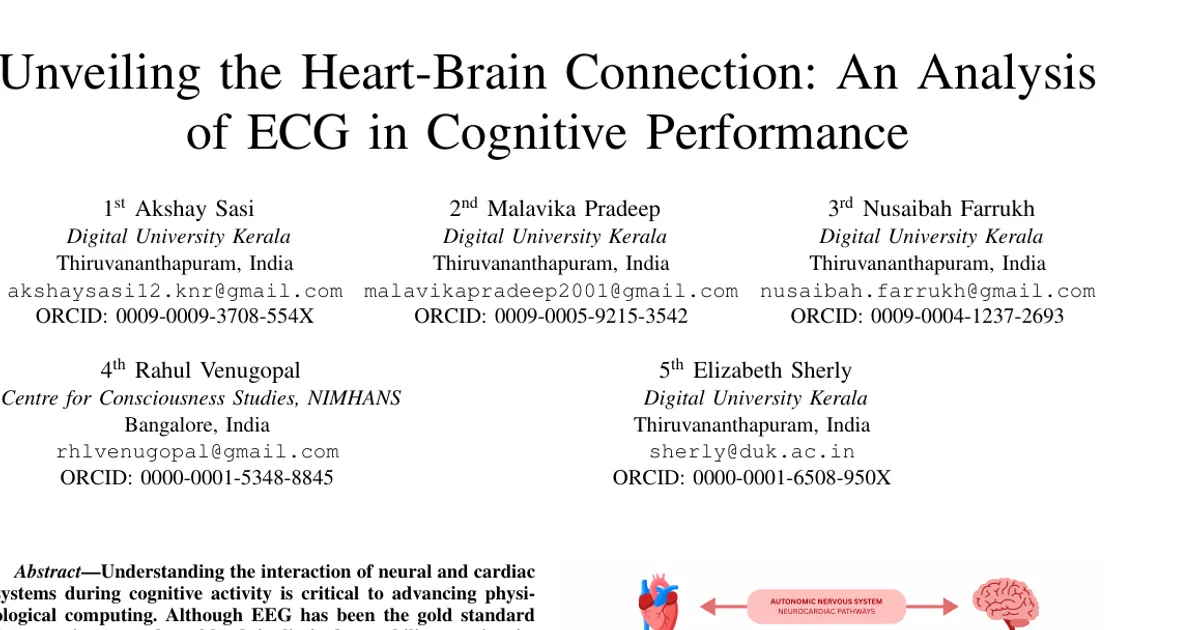
Unveiling the Heart-Brain Connection: An Analysis of ECG in Cognitive Performance Authors: Akshay Sasi, Malavika Pradeep, Nusaibah Farrukh (Digital University Kerala); Rahul Venugopal (Centre for Cons
- arXiv
- 2601.01424
- Published
- 2026-01-04
- Authors
- Akshay Sasi, Malavika Pradeep, Nusaibah Farrukh, Rahul Venugopal, Elizabeth Sherly
AI summary
Unveiling the Heart-Brain Connection: An Analysis of ECG in Cognitive PerformanceAuthors: Akshay Sasi, Malavika Pradeep, Nusaibah Farrukh (Digital University Kerala); Rahul Venugopal (Centre for Consciousness Studies, NIMHANS); Elizabeth Sherly (Digital University Kerala) arXiv: 2601.01424v1 [cs.LG], 04 Jan 2026
Overview
Research area: Physiological computing / healthcare AI — specifically cross-modal machine learning that relates cardiac signals (ECG) to neural signals (EEG) for cognitive load estimation.
Technical level: Intermediate. The paper assumes familiarity with physiological signal processing (filtering, R-peak detection, RR intervals, HRV), feature-based machine learning, and deep learning architectures, but the core ideas and results are described in accessible terms.
Scope in one sentence: The paper tests whether ECG-derived features can reflect working-memory load as reliably as EEG, using the OpenNeuro ds003838 auditory Digit Span dataset, the Catch22 time-series feature set, classical and deep classifiers, and bidirectional ECG-to-EEG transfer learning.
What This Paper Is About
EEG is treated as the gold standard for measuring mental workload, but its hardware is inconvenient and prone to artifacts, which makes it unsuitable for continuous everyday monitoring. ECG is widely available in consumer wearables, so the authors ask whether cardiac activity carries enough information about cognitive load to act as a practical stand-in for EEG. Their goal is to build a cross-modal framework that projects ECG features into an EEG-representative "cognitive space," so that workload can be inferred from ECG alone.
Key Contributions
-
Empirical demonstration that Catch22 descriptors outperform conventional HRV metrics for ECG-based cognitive load classification, attributed to Catch22's ability to capture nonlinear and dynamical time-series structure rather than variance-based RR statistics.
-
A fusion classifier based on transfer learning that combines ECG and EEG modalities, trained on Catch22 features from one modality and evaluated on the other, in both directions (ECG→EEG and EEG→ECG).
-
Evidence for heart-brain functional coupling: the cross-modal framework shows that ECG-derived signals can serve as a reliable proxy for EEG in estimating cognitive workload during the auditory Digit Span Task (OpenNeuro ds003838).
-
A multimodal dataset analysis pipeline using two paradigms involving working-memory and passive-listening tasks, with synchronized ECG and EEG processed into a shared 5D array (subject × condition × subcondition × trial × time).
Main Findings
-
Catch22 beats HRV for ECG decoding. Using 22 Catch22 features instead of 5 HRV features dramatically improved Memory Classifier (MC) performance — for example, XGBoost reached 98.68% with Catch22 versus 79.12% with HRV. Random Forest scored 97.71% (Catch22) versus 80.89% (HRV), and SVM 89.19% versus 68.76%.
-
Binary baseline separation fails across all approaches. The Binary Classifier (Just Listen vs. Memory) topped out at 59.78% (Catch22 + XGBoost) for ECG. HRV-based BC results were 50.33% (RF), 52.52% (SVM), and 55.64% (XGBoost); Catch22 RF reached 58.38% and SVM 44.55%. The authors conclude the passive "Just Listen" state lacks a strong, consistent physiological signature.
-
EEG with Catch22 is near-perfect on memory load. MC accuracies were 99.58% (Random Forest, macro-F1 1.00), 98.62% (SVM), and 99.82% (XGBoost, macro-F1 1.00). EEG also struggled on BC (55.52% RF, 60.86% SVM, 57.54% XGBoost) and was moderate on the Four-Class task (67.68% RF, 66.74% SVM, 63.94% XGBoost), mirroring ECG behavior.
-
Deep learning on raw signals approaches feature-based methods for memory load. ECG 1D-CNN reached 98.46%, BiLSTM 95.42%, and Transformer 95.71%. EEG 1D-CNN reached 99.40%, Transformer 99.52%, but BiLSTM underperformed at 70.45%. On BC and FC, deep models also failed to resolve baseline separation (e.g., ECG 1D-CNN 43.38% BC; EEG Transformer 68.42% BC; FC results clustered around 65–68%).
-
Cross-modal transfer is strong in the memory-load task. ECG→EEG transfer achieved 99.62% accuracy with XGBoost (RF 99.58%, SVM 90.26%), essentially matching native EEG performance. EEG→ECG transfer also stayed high at 93.11% with Random Forest (XGBoost 87.67%, SVM 82.96%).
-
Four-class performance improved under ECG→EEG transfer. The fusion model reached 74.63% (Random Forest, macro-F1 0.64; XGBoost 73.68%), outperforming native EEG-only models in the four-class setting, which the authors suggest indicates ECG features may stabilize neural representations. ECG→EEG BC transfer remained near chance (49.99% RF, 49.58% SVM, 50.34% XGBoost).
-
Feature importance differs by model family. HRV models relied on one or two dominant metrics (XGBoost: AutoMutualInfo f17, AC_1e_Crossing f6, pNN40 f10; Random Forest: MeanNN and RMSSD-driven), while Catch22 spread importance across multiple nonlinear features (XGBoost: HistogramMode_5, OutlierPos, ACF_1/e_Drop; Random Forest: OutlierPos, LowFreqPower, pNN40). A re-evaluation flagged TransitionVar (F18) as consistently strongest, and the fusion Random Forest used HistMode_10, LowFreqPower, pNN40, and TransitionVar as stable predictors across neural and cardiac domains.
-
Short observation windows explain HRV's weakness. HRV measures such as SDNN and RMSSD require at least 60 seconds of RR data for statistical stability, while the analyzed retention window was only 3 seconds and often contained as few as 5 cardiac cycles — too few for reliable variance estimates.
-
The bottleneck is engagement, not load level. Across ECG, EEG, machine learning, and deep learning models, distinguishing levels of cognitive load was easier than separating cognitive engagement from the passive listening condition.
Methodology in Plain English
Data. The study used OpenNeuro dataset ds003838, which contains synchronized EEG and ECG recordings from an auditory digit span task in 86 participants. After quality assessment, 65 participants with clean EEG and ECG signals were retained. Participants completed trials with 5, 9, or 13 digits plus a baseline "Just Listen" condition, with baseline, encoding, and retention phases; only the 3-second retention phase was analyzed.
ECG processing. Raw ECG was filtered with a second-order bandpass filter (0.5–40 Hz) to remove baseline drift and high-frequency noise. The NeuroKit2 library handled R-peak detection via adaptive thresholding, RR intervals were computed as the time between successive R-peaks, and artifact correction applied Median Absolute Deviation (MAD) filtering to remove outliers.
EEG processing. EEG was handled with MNE-Python: bandpass filtering (1–45 Hz) to retain theta, alpha, and beta bands, a 50 Hz notch filter for line noise, and Independent Component Analysis to remove ocular and muscle artifacts (validated against EOG channels). Signals were epoched to the retention window, restricted to memory-relevant channels (Fz, Pz, Cz, P3, P4), downsampled to 128 Hz, and baseline-corrected.
Features. Two ECG feature pipelines were compared. The first used time-domain HRV metrics — MeanNN, SDNN, RMSSD, SD1, SD2 — plus frequency-domain measures (LF, HF, LF/HF). The second used the Catch22 feature set, 22 standardized time-series descriptors spanning statistical, dynamical, and entropy-based domains, computed from raw ECG per trial. In total, 27 features were extracted per trial (5 HRV metrics + 22 Catch22 descriptors) at a sampling rate of 250 Hz.
Classification. Models were trained for three tasks: Memory Load (5/9/13), Binary Load (baseline vs. memory), and Four-Class (Just Listen, 5, 9, 13). Feature-based machine learning (Random Forest, SVM, XGBoost) used HRV and Catch22 features, while 1D-CNN, BiLSTM, and Transformer networks were trained end-to-end on raw signals. Evaluation used accuracy, macro-F1, weighted-F1, ROC-AUC for binary tasks, and confusion matrices for inter-class error analysis.
Cross-modal transfer. For fusion, Catch22 features were extracted from ECG and from each of the five EEG channels, producing 110-dimensional vectors (5 × 22). Models were trained on one modality's features and tested on the other's, in both directions.
Why This Matters
The work positions ECG as a scalable, interpretable, wearable alternative for cognitive monitoring, bridging central (EEG) and peripheral (ECG) physiology. If cardiac signals can carry memory-load information at accuracy approaching EEG, cognitive state tracking becomes feasible outside the lab. It also supplies concrete evidence for heart-brain functional coupling during a working-memory task.
Real-world applications:
- Continuous cognitive health tracking through everyday wearables, without clinical-grade neural hardware.
- Monitoring cognitive overload in safety-critical settings such as healthcare and aviation, where the paper specifically notes overload is of critical concern.
- Adaptive cognitive feedback systems and workplace stress surveillance, which the authors name as valuable translation pathways.
- Early detection of neuro-cognitive decline, also listed among the paper's suggested extensions.
Industry relevance: Consumer wearable manufacturers, digital health and physiological computing companies, and organizations seeking non-invasive, real-time operator-state monitoring all stand to benefit from a technique that reduces the hardware burden of workload assessment to hardware already present in many devices.
Future Directions
- Better baseline separation. All models failed to identify the resting "Just Listen" condition; the authors propose placing greater emphasis on separating baseline cognition.
- Broader cognitive demands. Extending beyond memory to attention, fatigue, emotion, and stress states, since only auditory-task cognitive load was assessed and generalizability to other domains and real-world noise remains unvalidated.
- Richer feature and model design. Exploring hybrid representations that combine Catch22 with spectral, non-linear, and frequency-domain descriptors, plus lightweight CNN-LSTM and transformer architectures optimized for real-time wearable deployment via pruning, quantization, or edge-efficient inference.
- Deeper coupling investigations and more modalities. Using multimodal neuroimaging such as fMRI/MEG alongside behavioral sources like gaze, speech, and micro-expressions, and adding wearable-friendly signals such as PPG, GSR, and respiration.
Target Audience
Researchers and practitioners in physiological computing, affective and cognitive state estimation, and healthcare AI; machine learning engineers working on cross-modal or transfer learning; and wearable technology developers interested in replacing EEG with more accessible cardiac sensing. Readers with a background in biosignal processing or applied machine learning will get the most out of it, though the paper's framing of the problem is clear enough for newcomers who want a concrete example of cross-modal physiological inference.
Code and experimental resources are publicly available at https://github.com/AkshaySasi/Unveiling-the-Heart-Brain-Connection-An-Analysis-of-ECG-in-Cognitive-Performance.
Authors’ abstract
Understanding the interaction of neural and cardiac systems during cognitive activity is critical to advancing physiological computing. Although EEG has been the gold standard for assessing mental workload, its limited portability restricts its real-world use. Widely available ECG through wearable devices proposes a pragmatic alternative. This research investigates whether ECG signals can reliably reflect cognitive load and serve as proxies for EEG-based indicators. In this work, we present multimodal data acquired from two different paradigms involving working-memory and passive-listening tasks. For each modality, we extracted ECG time-domain HRV metrics and Catch22 descriptors against EEG spectral and Catch22 features, respectively. We propose a cross-modal XGBoost framework to project the ECG features onto EEG-representative cognitive spaces, thereby allowing workload inferences using only ECG. Our results show that ECG-derived projections expressively capture variation in cognitive states and provide good support for accurate classification. Our findings underpin ECG as an interpretable, real-time, wearable solution for everyday cognitive monitoring.