Research
Unlocking Noisy Real-World Corpora for Foundation Model Pre-Training via Quality-Aware Tokenization
Overview Research area: Machine learning — tokenization and data quality for foundation model pre-training, applied to genomics and quantitative finance. Technical level: Advanced. The paper combines
- arXiv
- 2602.06394
- Published
- 2026-02-06
- Authors
- Arvid E. Gollwitzer, Paridhi Latawa, David de Gruijl, Deepak A. Subramanian, Adrián Noriega de la Colina
AI summary
Overview
Research area: Machine learning — tokenization and data quality for foundation model pre-training, applied to genomics and quantitative finance.
Technical level: Advanced. The paper combines bilevel optimization, complexity theory (NP-hardness, Σ₂ᵖ-hardness), Markov decision processes with PPO, Gumbel-Softmax relaxation, and information bottleneck analysis, alongside large-scale empirical evaluations.
Scope: A single paper introducing QA-Token (Quality-Aware Tokenization), a method that folds data reliability scores into vocabulary construction, validated on genomic sequencing data and high-frequency financial data up to a 7B-parameter, 1.7-trillion-base-pair foundation model.
What This Paper Is About
Standard tokenizers such as Byte-Pair Encoding (BPE) decide which symbol pairs to merge purely from frequency statistics, implicitly assuming that frequently occurring data is worth learning from. That assumption breaks down when data is noisy — third-generation sequencing error rates exceed 10%, and over 40% of high-frequency financial data contains microstructure noise. QA-Token's goal is to make tokenizers deliberately prefer merges among high-confidence regions and suppress merges among unreliable ones, so that large noisy corpora can be used for pre-training without a separate cleaning pipeline.
Key Contributions
-
Bilevel optimization formulation with complexity analysis. The authors formalize tokenization as a bilevel problem (Definition 3.1) that jointly optimizes vocabulary construction and downstream language model performance, prove it is NP-hard in general and Σ₂ᵖ-hard in the polynomial bilevel programming case, with worst-case cost of O(|Σ|^K · K! · N · n · |Θ|) evaluations, and develop an approximation scheme.
-
Reinforcement learning for merge policies with convergence guarantees. Vocabulary construction is cast as a Markov Decision Process (Definition 4.1) solved with PPO, with a proof of MDP well-formedness (Proposition E.5) and a (1 − 1/e)-approximation to the optimal adaptive policy via adaptive submodularity.
-
Differentiable quality-sensitivity parameters. Gumbel-Softmax relaxation (Theorem C.8) enables end-to-end learning of quality sensitivity α, domain factors such as β_pos and β_vol, and reward weights, with consistency, bounded gradients (Proposition C.7), and an O(1/√T) convergence rate (Proposition E.2).
-
Domain-specific instantiations with empirical validation. QA-BPE-seq for genomics and QAT-QF for finance, achieving state-of-the-art results across 15+ benchmarks, plus a demonstration that the approach scales to foundation models without inference overhead.
Main Findings
-
Genomic variant calling improves by 6.7 percentage points F1. QA-BPE-seq reaches 0.891 ± 0.004 F1 versus 0.824 ± 0.004 for standard BPE, with taxonomic classification at 0.917 ± 0.003 versus 0.856 ± 0.005, over n = 10 runs with 95% CIs (p < 0.001).
-
Byte-level models fail on noisy genomic data. ByT5 and CANINE run 2.5× slower and score 7–9% lower in accuracy than QA-BPE-seq.
-
Emergent vocabulary structure. Learned merges align with biological units such as codons and motifs in high-quality regions without explicit supervision.
-
Financial trading Sharpe ratio improves 30%. QAT-QF achieves 1.72 ± 0.07 versus 1.32 ± 0.05 for BPE, alongside return prediction of 68.3% ± 0.5 versus 61.2% ± 0.5 and regime classification of 86.4 ± 0.3 versus 73.5 ± 0.6 (p < 0.01, Holm-Bonferroni corrected).
-
Foundation-scale pathogen detection reaches state of the art. Re-tokenizing METAGENE-1's 1.7 trillion base-pair corpus yields 94.53 MCC, surpassing the original METAGENE-1 by 1.57 points (p < 0.001), with the largest single-task gain of +2.04 MCC on highly degraded metagenomic samples.
-
Token count drops 15%. The 370B-token baseline becomes 315B tokens, so QA-BPE-seq completes epochs in fewer optimization steps while exposing models to identical raw data volume.
-
Broad GUE benchmark gains. All genome understanding categories improve, with the largest single increase at +3.2 MCC on promoter detection, a win rate rising from 46.4% to 57.1% (+10.7%), and improvements of +1.4 to +1.8 MCC/F1 across regulatory elements, epigenetics, structure, and variant tasks.
-
Financial foundation model gains 16% zero-shot and 13% few-shot on average. A 1.2B-parameter model (24 layers, 2048 dim) trained on 500 billion time-series observations shows the largest zero-shot improvements in volatility and microstructure tasks, including +27.0% on order flow imbalance and +11.6% F1 on regime detection.
-
Ablations confirm each component matters. Removing quality reward costs 7.4% variant F1; removing RL merge policy optimization costs 3.3%; removing adaptive parameters costs 3.8%; removing the information reward costs 2.1%; removing the biological reward costs 0.7%; the QualTok baseline with fixed α = 0.5 and uniform weights sits 5.7% below the full model.
-
One-time cost, zero inference overhead. Vocabulary construction requires 50–60 GPU-hours versus minutes for BPE, but tokenization speed afterward is identical to BPE at roughly 10 ms per sequence.
Methodology in Plain English
The researchers start from a simple observation: BPE merges the most frequent adjacent symbol pairs. Their replacement merge score multiplies three things together — how strongly two symbols associate statistically (a PMI-like term), how reliable those symbols are (a quality term raised to a learnable power α), and any domain-specific constraint. Because the full problem of jointly choosing a vocabulary and training a language model is intractable, they split it into stages. First, they treat vocabulary building as a game in which an agent repeatedly picks which pair to merge, trained with reinforcement learning using rewards that combine quality, information content, complexity, and domain signals — each reward normalized by running statistics so that no single term dominates. Second, they make the quality-sensitivity parameters themselves learnable by replacing the hard "pick one merge" decision with a Gumbel-Softmax soft relaxation, so gradients from the downstream task can flow back into the tokenizer. Temperature annealing drives this relaxation toward hard selections over training. Finally, they construct the vocabulary greedily with the learned parameters.
For quality scores, the paper requires boundedness in [0,1], Lipschitz continuity for stable gradients, and monotonicity under noise injection. Genomics uses Phred base-call scores with position-adjusted exponential decay (learned β_pos = 0.014 ± 0.002) aggregated by geometric mean, so one bad base ruins the whole token. Finance combines four dimensions — liquidity, signal quality, stability, and information content — with learned weights (β_vol = 0.50 ± 0.05) and arithmetic mean aggregation, reflecting additive noise. Experiments use 10 trials, 95% confidence intervals, Welch's t-tests, and Holm-Bonferroni correction at p = 0.05.
Why This Matters
The paper reframes tokenization as a place where data quality decisions get made, rather than a purely statistical pre-processing step. It argues that the gap between data accessibility and data usability — not raw availability — is what currently limits foundation model training on real-world corpora. If quality signals can be baked into vocabulary construction once, cheaply, and then carry no inference cost, noisy archives become valuable training material.
Real-world applications the authors describe:
- Pandemic surveillance. Environmental samples for pathogen monitoring contain 40–60% noise from contamination and sequencing errors; QA-Token trains directly on such metagenomic data and achieves 94.53 MCC, which the authors frame as enabling real-time global monitoring.
- Drug discovery. Long-read sequencing for structural variants has 10–15% error rates; the 6.7-point F1 gain in variant calling is presented as accelerating drug target identification from complex genomic rearrangements.
- Evolutionary biology. Ancient DNA is heavily degraded with more than 50% damage; quality-aware tokenization aims to preserve authentic ancient sequences while filtering damage.
- Clinical and scientific data streams. The discussion extends to noisy hospital records, cloud-corrupted satellite imagery, and failing sensor networks as domains where noisy data could be trained on directly.
Industry relevance centers on finance: global markets generate 5TB of data per day, with 40% containing microstructure noise, and the authors argue that a 30% Sharpe ratio improvement and 27% better order flow prediction translate to lower execution costs, while 18% better tail risk estimation and 11.6% better regime detection improve risk management. They also note a democratization angle — smaller institutions could compete without expensive data cleaning infrastructure.
Future Directions
- Universal quality metrics derived from data statistics. The authors propose local entropy and consistency measures to remove the need for hand-designed, domain-specific quality signals — currently listed as a limitation, since domains without established metrics require custom design.
- Online adaptation for streaming data. Extending the two-stage construction to update vocabularies continuously as data arrives.
- Multimodal extension. Applying quality-aware tokenization to vision-language and audio-text settings.
- Efficiency improvements. Distillation and pruning are suggested to reduce the vocabulary construction overhead, which the authors acknowledge limits rapid iteration during development.
- Open question on initialization. The paper discusses initialization strategies and quality bounds for approaching global optima, given that the two-timescale analysis only guarantees convergence to a local Nash equilibrium under assumptions (A1)–(A4).
Target Audience
This paper is aimed at machine learning researchers working on tokenization, data curation, and foundation model pre-training; computational biologists and bioinformaticians dealing with noisy sequencing archives; quantitative finance researchers working on high-frequency market microstructure and time-series models; and ML systems engineers interested in the trade-off between one-time vocabulary construction cost and zero inference overhead. Readers need comfort with bilevel optimization, reinforcement learning, and information theory to follow the theory, though the empirical tables and domain sections are readable with a general ML background.
Authors’ abstract
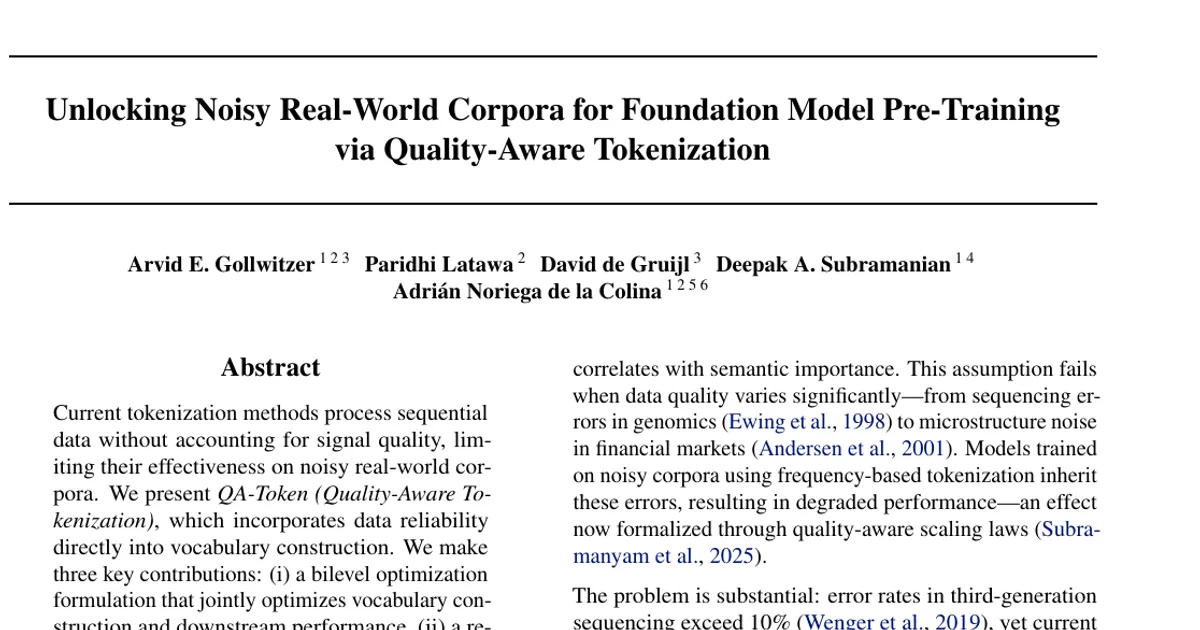
Current tokenization methods process sequential data without accounting for signal quality, limiting their effectiveness on noisy real-world corpora. We present QA-Token (Quality-Aware Tokenization), which incorporates data reliability directly into vocabulary construction. We make three key contributions: (i) a bilevel optimization formulation that jointly optimizes vocabulary construction and downstream performance, (ii) a reinforcement learning approach that learns merge policies through quality-aware rewards with convergence guarantees, and (iii) an adaptive parameter learning mechanism via Gumbel-Softmax relaxation for end-to-end optimization. Our experimental evaluation demonstrates consistent improvements: genomics (6.7 percentage point F1 gain in variant calling over BPE), finance (30% Sharpe ratio improvement). At foundation scale, we tokenize a pretraining corpus comprising 1.7 trillion base-pairs and achieve state-of-the-art pathogen detection (94.53 MCC) while reducing token count by 15%. We unlock noisy real-world corpora, spanning petabases of genomic sequences and terabytes of financial time series, for foundation model training with zero inference overhead.