Research
Unlocking Lossless Speedups in LLMs via Discrete Diffusion
Overview Research area: Efficient inference for large language models, at the intersection of autoregressive (AR) language modeling and discrete diffusion. Technical level: Advanced. The abstract assu
- arXiv
- 2609.04010
- Published
- 2026-09-03
- Authors
- Subham Sekhar Sahoo, Lingjie Chen, Khiem Pham, Jonathan Geuter, Chaitanya Dwivedi, Varad Pimpalkhute, Yash Akhauri, Alexander Moreno, Mikhail Yurochkin, Zhenting Wang, Mostafa Elhoushi, Nolan Dey, Shane Bergsma, Joel Hestness, John Thickstun, Eric Xing, Zhengzhong Liu
AI summary
Overview
Research area: Efficient inference for large language models, at the intersection of autoregressive (AR) language modeling and discrete diffusion.
Technical level: Advanced. The abstract assumes familiarity with next-token prediction, autoregressive decoding, speculative decoding, diffusion models, and distillation.
Scope: This paper introduces a class of "diffusion-augmented" LLMs that keep an autoregressive model's distribution but generate several tokens at a time using diffusion, together with a sampler family that makes the acceleration lossless.
What This Paper Is About
Large language models are typically trained and run by predicting one token at a time, which forces generation to happen sequentially and makes inference slow. Existing ways to speed this up have trade-offs: speculative decoding needs a separate smaller draft model, and diffusion-based LLMs generate in parallel but do not match the quality of the underlying autoregressive model. This paper's goal is to get parallel token generation while preserving exactly the distribution and quality of an ordinary AR model, without needing a draft model.
Key Contributions
- Diffusion-augmented LLMs. A new class of models that defines an autoregressive model distribution but uses diffusion to draw multiple tokens in parallel from that same distribution.
- Decoupled parameters with a cheap distillation stage. The model's parameters are split into AR weights, trained with the standard next-token prediction objective, and lightweight diffusion weights, trained to generate multiple tokens simultaneously via a Diffusion Distillation phase that the authors describe as adding negligible overhead to existing LLM training pipelines.
- The Psi-Spec sampler family. A set of samplers that enables lossless acceleration as well as inference-time scaling at a fixed context length, without requiring a separate draft model and without sacrificing the quality of the underlying AR model.
- Uno models. The resulting models, which can either be trained from scratch or produced by augmenting existing open-weight AR LLMs.
Main Findings
- Higher throughput than speculative decoding: Uno achieves higher throughput than leading speculative-decoding methods at every evaluated batch size, according to the abstract.
- Up to 3x speedup: The reported speedup over the base AR model reaches up to 3x, including at the largest batch size the device supports.
- Small model beats larger competitors: The 8B Uno model is claimed to outperform the leading open diffusion LLM, the 26B DiffusionGemma, and the proprietary Mercury 2 across all evaluated benchmarks in agentic tool use, coding, and long-context reasoning.
- Lossless by construction: Unlike diffusion LLMs, the method is described as accelerating generation without sacrificing the quality of the underlying autoregressive model.
- Missing detail: The abstract does not report absolute throughput or latency figures, specific benchmark names or scores, training compute, or dataset sizes, so those cannot be summarized here.
Methodology in Plain English
The approach splits a single model's parameters into two roles. One set — the AR weights — is trained exactly as usual, by predicting the next token. The other, much lighter set — the diffusion weights — is trained to produce several tokens at once. That second training step is framed as distillation, and the authors say it can be bolted onto existing training pipelines at minimal cost.
At inference time, the Psi-Spec samplers use the diffusion weights to propose or draw multiple tokens in parallel, while the model as a whole still represents the same distribution as the original autoregressive model. Because the target distribution is unchanged, the acceleration is claimed to be lossless rather than an approximation, and because the parallel generation comes from weights already inside the model, no separate draft model is required. The same sampler family is also described as supporting inference-time scaling, meaning you can spend more computation at inference to get more out of the model, while keeping the context length fixed.
Why This Matters
Research impact: The work offers a way to reconcile two usually competing goals — the quality and well-defined distribution of autoregressive LLMs and the parallelism of diffusion models. If the lossless claim holds broadly, it reframes speculative decoding as an internal property of a single model rather than a two-model system, and it suggests a path to inference-time scaling in an AR setting.
Real-world applications:
- Interactive coding assistants and agentic tool-use systems, where latency and throughput directly affect usability.
- Long-context reasoning tasks over large documents, where sequential decoding is especially costly.
- High-throughput production serving, since the reported gains hold at large batch sizes, which is where serving economics matter most.
- Deploying capable models on constrained hardware, since a smaller augmented model is claimed to match much larger diffusion LLMs.
Industry relevance: Serving cost per token and tokens per second are central operational metrics for anyone running LLMs. A method that reuses existing open-weight models, avoids a separate draft model in the serving stack, and reportedly scales to the largest batch size a device supports is directly relevant to inference providers and to teams deploying open-weight models.
Future Directions
- Broader validation of the lossless claim: The abstract reports comparisons on agentic tool use, coding, and long-context reasoning; whether quality is equally preserved across other task types and languages is left open.
- Scaling behavior: Uno is demonstrated at 8B parameters against much larger diffusion LLMs; how the approach behaves at larger scales and across different AR model families is not addressed in the abstract.
- Training from scratch versus augmentation: The abstract states both routes are possible but does not say how the two compare in cost or final quality.
- Inference-time scaling: Psi-Spec is described as enabling inference-time scaling at fixed context length, but the abstract does not specify how compute should be allocated or what the returns look like.
- Composition with other efficiency techniques: How diffusion-augmented decoding interacts with quantization, caching, and other inference optimizations is not covered.
Target Audience
Researchers and engineers working on LLM inference efficiency, decoding algorithms, and diffusion language models; practitioners who operate LLM serving systems and care about throughput and latency at scale; and readers interested in the theoretical relationship between autoregressive and diffusion-based generation.
Authors’ abstract
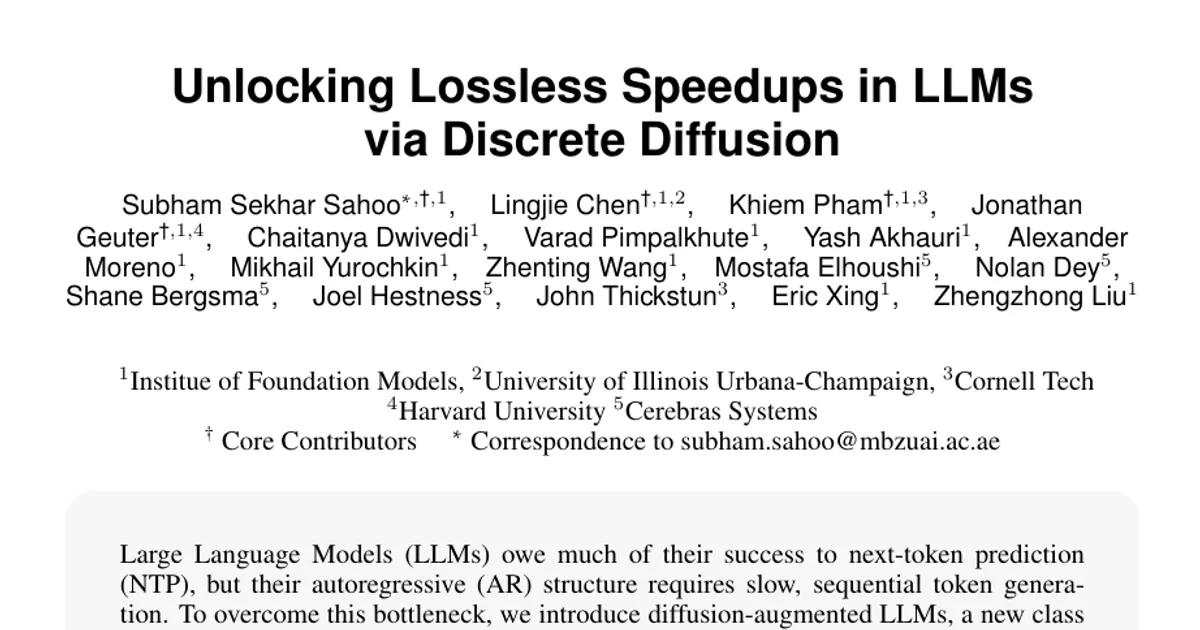
Large Language Models (LLMs) owe much of their success to next-token prediction (NTP), but their autoregressive (AR) structure requires slow, sequential token generation. To overcome this bottleneck, we introduce diffusion-augmented LLMs, a new class of models that defines an AR model distribution while using diffusion to draw multiple tokens in parallel from that distribution. We decouple the parameters of these models into two sets: AR weights, trained using the standard NTP objective, and lightweight diffusion weights, trained to generate multiple tokens simultaneously. The diffusion weights are learned through a simple Diffusion Distillation phase that adds negligible overhead to existing LLM training pipelines. We also introduce $Ψ$-Spec, a family of samplers that enables lossless acceleration and inference-time scaling at a fixed context length. Unlike speculative decoding, our method requires no separate draft model. Unlike diffusion LLMs (d-LLMs), it accelerates generation without sacrificing the quality of the underlying AR model. The resulting models, called Uno, can be trained from scratch or built by augmenting existing open-weight AR LLMs. Uno achieves higher throughput than leading speculative-decoding methods at every evaluated batch size and delivers up to $3\times$ speedups over the base AR model, including at the largest batch size supported by the device. Notably, our 8B Uno model outperforms the leading open d-LLM, the 26B DiffusionGemma, and the proprietary Mercury 2 across all evaluated benchmarks in agentic tool use, coding, and long-context reasoning. We release code and checkpoints at: https://s-sahoo.github.io/uno/