Research
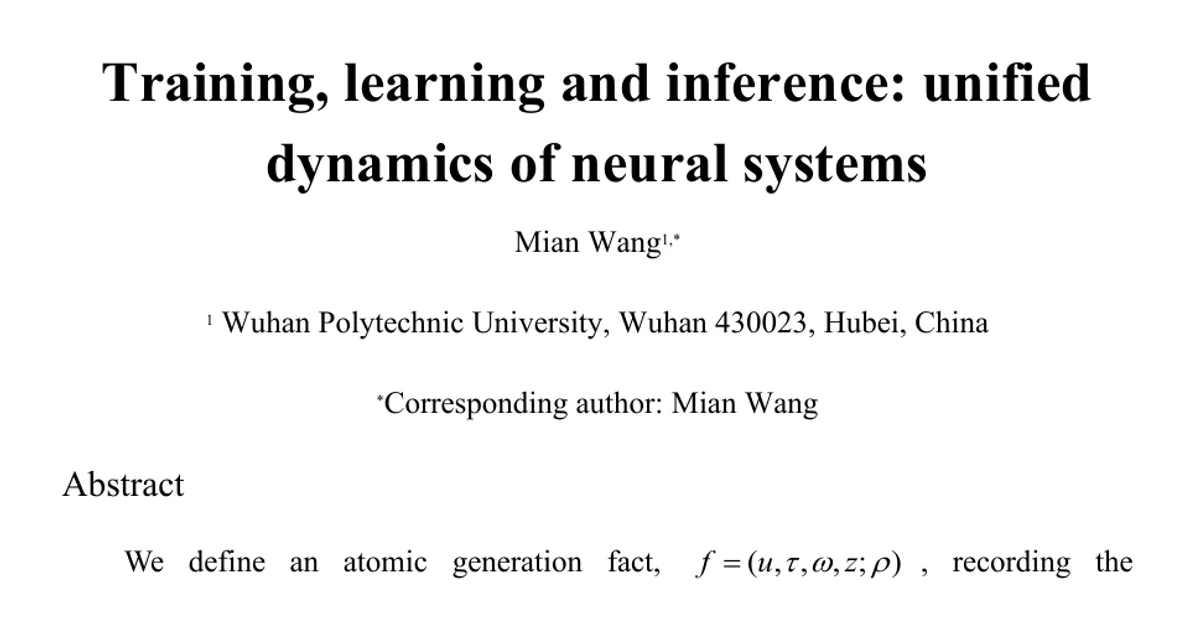
Training, learning and inference: unified dynamics of neural systems
Overview Research area: Machine learning theory, sitting at the intersection of training-dynamics analysis, mechanistic interpretability, and structured scientific knowledge representation. Technical
- arXiv
- 2608.20965
- Published
- 2026-08-21
- Authors
- Mian Wang
AI summary
Overview
Research area: Machine learning theory, sitting at the intersection of training-dynamics analysis, mechanistic interpretability, and structured scientific knowledge representation.
Technical level: Advanced. The abstract assumes familiarity with optimizer state (Adam), functional responses to parameter updates, attention, and diffusion models.
Scope: The paper proposes a formal fact-based substrate for recording machine learning experiments, then uses it to describe training, learning, and inference as one unified dynamical system, tested on nanoGPT and extended to ResNet and diffusion models.
What This Paper Is About
The paper's core problem is that training, learning, and inference are usually described with separate vocabularies, and the histories of how a model's capabilities were produced are not preserved in a compilable, machine-readable form. It introduces a "generation fact" tuple that records the origin, transformation, occurrence, result, and relational role of any atomic generation event, and compiles many such facts into a Generation-Fact Graph. Using that substrate, the author argues that training, learning, and inference are three views of a single underlying dynamic rather than three unrelated phenomena.
Key Contributions
-
A formal fact substrate. It defines the atomic generation fact f = (u, tau, omega, z; rho) capturing origin, realized transformation, concrete occurrence, generated result, and relation role, and compiles these into a Generation-Fact Graph (GFG) described as an AI-native, compilable scientific fact substrate that preserves generation histories.
-
A recursive scientific process built on the GFG. Analysis, intervention, replay, and validation are themselves treated as facts, so each cycle feeds the next — making the experimental process itself part of the recorded substrate.
-
A unified account of training and learning. Training is modeled as the evolution of a parameter–optimizer system with state and memory; learning is modeled as persistent reorganization of distributed functional support caused by those responses. A second-order predictor built from three coordinates is claimed to operate before post-update outputs are read.
-
Inference reframed as frozen dynamics, with causal evidence. Inference is characterized as a frozen projection of training–learning dynamics, supported by component gating and rollback experiments showing causal recruitment and non-additive combination of query-conditioned support, plus a controlled-feedback result suggesting double-edged reinforcement effects.
Main Findings
-
Training is a stateful response process. Every actual training action enters a receiving state and produces a finite-amplitude nonlinear functional response that is conditioned both by that state and by target-specific update geometry, rather than being a context-free step.
-
Learning is persistent reorganization of support. The responses above durably rearrange distributed functional support. Capability formation, maintenance, decline, and recovery become observable when target-specific states are measured against their readout boundaries.
-
A three-coordinate predictor works before the output is read. Target-boundary state, target-specific update geometry, and the parameter-Adam receiving state together form a second-order predictor. On held-out runs it reached 91.43% accuracy and 91.49% macro-averaged recall across four transitions. The abstract does not name or describe those four transitions, and gives no baseline comparison.
-
Inference is a frozen projection of the same dynamics. Rather than a separate mechanism, inference is presented as a static projection of what training–learning dynamics put in place.
-
Causal recruitment and non-additive combination. Component gating and rollback indicate that query-conditioned support formed during training is causally recruited and combined non-additively, yielding organizational conditions realized by Attention.
-
Feedback can cut both ways. Controlled feedback experiments indicate possible double-edged reinforcement effects, though the abstract does not specify direction, magnitude, or conditions.
-
Results extend past nanoGPT. ResNet/CIFAR-100 and diffusion/CIFAR-10 experiments are reported to confirm receiving-state-conditioned responses, persistent support reorganization, and frozen inference projection beyond the nanoGPT setting.
Methodology in Plain English
The approach has two layers. The first is representational: define a small tuple that records everything relevant about a single generation event — where it came from, what transformation was applied, when it occurred, what it produced, and how it relates to other facts — then compile many of these into a graph. Because the graph preserves generation histories, the research process itself (analyzing, intervening, replaying, validating) can be written into it, so each round of study leaves facts that later rounds can build on.
The second layer is empirical and centered on nanoGPT. The author tracks the state of the parameter–optimizer system as training actions arrive, records the response each action produces, and watches how functional support redistributes over time. Three quantities — the target-boundary state, the target-specific update geometry, and the parameter-Adam receiving state — are used to predict transitions before the updated model's outputs are read. Causal claims are tested by gating components off and rolling back, and reinforcement effects are probed with controlled feedback. The same experimental pattern is then repeated with ResNet on CIFAR-100 and a diffusion model on CIFAR-10.
The abstract does not report model sizes, dataset sizes, training budgets, ablation tables, or baseline comparisons, so the details of how each experiment was configured are not available from it.
Why This Matters
Research impact. If generation histories can be compiled and reused, experiment records become first-class scientific objects rather than incidental logs, which bears on reproducibility and on how findings accumulate. The paper also proposes a single vocabulary for training, learning, and inference, which — if it holds — would connect areas (optimization dynamics, capability formation, mechanistic interpretability) that are usually studied with separate tools. The claim that a predictor can anticipate transitions from three coordinates before reading outputs is the most consequential and the most in need of independent replication.
Potential real-world applications (these follow from what the abstract claims; the abstract itself does not describe deployed systems or product results):
- Monitoring long training or fine-tuning runs for early signs of capability decline or recovery.
- Auditing generative outputs by tracing the recorded history of how each result was produced.
- Building reproducibility infrastructure where experiments, interventions, and validations are stored as queryable facts.
- Interpretability tooling that targets which components are causally recruited for a given query.
Industry relevance. Teams that train, fine-tune, and deploy large models carry real cost from unpredictable capability shifts and from limited visibility into why a model behaves as it does. A framework that predicts transitions before they show up in outputs, and that keeps an auditable history of how capabilities formed, speaks directly to training reliability, model governance, and provenance requirements. The abstract provides no evidence about cost, deployment feasibility, or scale beyond the reported models, so the practical payoff is a claim rather than a demonstrated result.
Future Directions
- Identify and generalize the four transitions. The abstract reports a predictor over four transitions without naming them. Reproducing the predictor across broader families of transitions, architectures, and scales is the obvious next test.
- Clarify the double-edged reinforcement effect. "Possible" is the strength of the claim; establishing the conditions under which feedback helps versus harms, and how strongly, is unresolved.
- Scale and diversify the substrate. The GFG is described as AI-native and scientific; applying it beyond model training to other experimental domains, and defining interchange with existing scientific data formats, would test its generality.
- Turn organizational conditions into actions. The paper links Attention to organizational conditions that support non-additive, causally recruited query-conditioned support. Whether those conditions can be deliberately engineered, edited, or repaired remains open.
Target Audience
Most useful to machine learning theorists and mechanistic interpretability researchers, particularly those working on training dynamics, capability formation, and the relationship between optimizer state and model behavior. It also suits ML infrastructure and reproducibility engineers interested in structured experiment provenance, and researchers in scientific knowledge representation who want to see a fact-graph substrate applied to machine learning. The paper is not beginner-friendly: it presupposes comfort with optimizer state, functional responses, attention, and diffusion models, and the abstract offers no tutorial scaffolding. Readers looking for benchmark comparisons, ablations, or reproducible hyperparameters will not find them in the abstract.
Authors’ abstract
We define an atomic generation fact f=(u,tau,omega,z;rho), recording the origin, realized transformation, concrete occurrence, generated result and relation role. Compiled into a Generation-Fact Graph (GFG), these facts provide an AI-native, compilable scientific fact substrate preserving generation histories. We establish a GFG-based recursive scientific process in which analysis, intervention, replay and validation form facts for later cycles. Using nanoGPT, we establish unified training-learning dynamics. Training is the evolution of a parameter-optimizer system with state and memory: each actual training action enters the receiving state and produces a finite-amplitude nonlinear functional response conditioned by that state and target-specific update geometry. Learning is the persistent reorganization of distributed functional support by these responses; capability formation, maintenance, decline or recovery becomes observable when target-specific states are evaluated against their readout boundaries. Three primary coordinates - target-boundary state, target-specific update geometry and parameter-Adam receiving state - yield a second-order predictor operating before post-update outputs are read. On held-out runs, it achieved 91.43% accuracy and 91.49% macro-averaged recall across four transitions. We further establish inference as a frozen projection of training-learning dynamics. Component gating and rollback show causal recruitment and non-additive combination of query-conditioned support formed during training, deriving organizational conditions realized by Attention. Controlled feedback indicates possible double-edged reinforcement effects. ResNet/CIFAR-100 and diffusion/CIFAR-10 experiments confirm receiving-state-conditioned responses, persistent support reorganization and frozen inference projection beyond nanoGPT.