Research
Train Smarter, Not Harder: Switching Signal-Guided Training in Active Learning
Overview Research area: Active learning (AL) and training-efficiency methods for NLP, specifically text classification with transformer encoder backbones. Technical level: Intermediate. The core idea
- arXiv
- 2609.06806
- Published
- 2026-09-06
- Authors
- Nagham Omar, Maya Rozenshtein, Evgeny Mishlyakov, Avigdor Gal
AI summary
Overview
Research area: Active learning (AL) and training-efficiency methods for NLP, specifically text classification with transformer encoder backbones.
Technical level: Intermediate. The core idea is accessible, but the paper assumes familiarity with pool-based active learning, calibration (negative log-likelihood), and transformer fine-tuning.
Scope: The paper proposes HybridAL, an adaptive schedule that decides per round whether to retrain a model from scratch or fine-tune from the previous checkpoint, switching once when an online stabilization signal indicates the model trajectory has settled, and evaluates it across three encoder backbones, six text-classification datasets, and five seeds per configuration.
What This Paper Is About
Active learning pipelines almost always fix one training strategy for every acquisition round: either retrain from scratch on all accumulated labels, or fine-tune from the previous checkpoint. The authors argue this choice is an overlooked decision variable with exploitable structure, since early rounds benefit from retraining while later rounds can be handled by cheaper fine-tuning once the model has stabilized. Their goal is a schedule that detects stabilization online and switches automatically, preserving classification performance while reducing training time and reclaiming calibration quality.
Key Contributions
-
Training strategy as a decision variable. The paper identifies the choice between Retrain and FineTune as an underexplored variable in pool-based active learning, and provides HybridAL (Algorithm 1), an adaptive schedule that switches from Retrain to FineTune once stabilization is detected.
-
A general stabilization-detection criterion. Definition 1 formalizes stabilization as the earliest round at which a switching signal's round-to-round change stays below a threshold ε for k consecutive rounds (patience). Eight signals are compared, and two are identified as complementary operating points: Δα (spectral exponent change, weight-based, no extra validation pass, favors speed) and ΔAcc (validation accuracy change, favors calibration).
-
An empirical evaluation across backbones and tasks. HybridAL is tested across three encoder backbones and six text-classification tasks with five seeds each, showing endpoint F1 non-inferior to both Retrain and FineTune at a 0.010 margin, time savings up to 49%, and recovery of a substantial fraction of Retrain's calibration advantage.
-
Evidence that adaptive timing, not switching itself, drives the gain. Comparisons against FixedSwitch@k for k ∈ {3, 5, 7, 10} show HybridAL obtains lower NLL than pre-committed switching, at moderate additional cost.
Main Findings
-
Endpoint F1 is preserved. Pooled across the six datasets, the means of both HybridAL variants lie within 0.5–0.9 percentage points of Retrain and FineTune. TOST on paired differences over all 90 (backbone, dataset, seed) cells, with the margin anchored to Retrain's mean seed-to-seed F1 standard deviation of 0.0131, shows non-inferiority at δ = 0.010 to Retrain, to FineTune, and to the per-cell better of the two. At δ = 0.005, three of four hybrid–baseline pairs pass; the exception is ΔAcc vs. FineTune (p = 0.051).
-
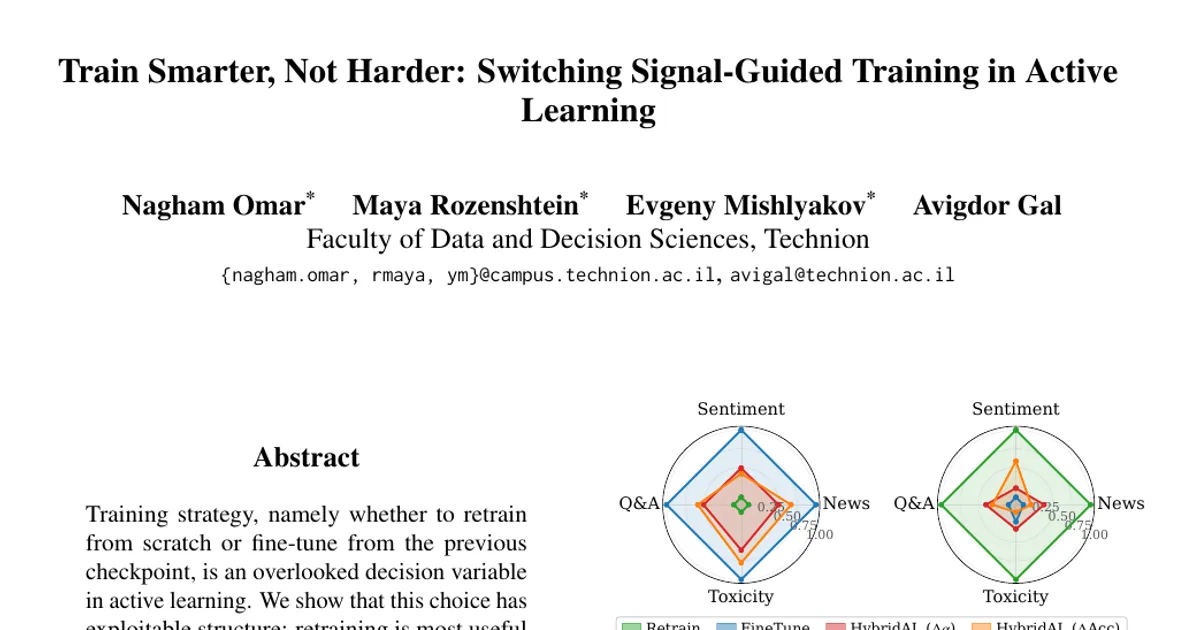
Training-time savings up to 49%. HybridAL (ΔAcc) saves 15–32% of Retrain's time at only 18–28% higher NLL, reclaiming 39–59% of FineTune's raw NLL gap. HybridAL (Δα) saves 12–49% of Retrain's time at 32–36% higher NLL.
-
A structured time–calibration trade-off. Retrain achieves the lowest test NLL on every backbone (0.498 on RoBERTa to 0.532 on DistilBERT) but is slowest (838–1,599 seconds). FineTune is 33–41% faster but incurs 44–47% higher NLL. On BERT, HybridAL (Δα) Pareto-dominates FineTune: it is faster (819 s vs. 936 s) and better calibrated (NLL 0.710 vs. 0.753).
-
Per-round NLL ordering is stable. From approximately round 5 onward, validation NLL follows Retrain < HybridAL (ΔAcc) < HybridAL (Δα) < FineTune, with FineTune climbing late. A temperature-scaling analysis attributes this ordering to training-time overconfidence inherited from warm-starting.
-
NewOnly underperforms. Pooled across all six datasets, NewOnly's mean trails the strongest non-NewOnly method by approximately 1.7 pp on DistilBERT and 2.7 pp on BERT, with a statistically significant deficit on Yahoo Answers across all backbones (p < 0.05). The gap concentrates on hard multi-class tasks: TweetEval (−8.2 pp DistilBERT, −5.8 pp BERT) and Yahoo Answers (−2.9 pp DistilBERT, −5.9 pp BERT); on RoBERTa it vanishes (≤ 0.2 pp pooled). NewOnly is excluded from the substantive Pareto frontier because its early-round calibration is the worst of the tested methods.
-
Adaptive timing beats fixed switching. FixedSwitch schedules commit to an early switch and are faster, but their NLL clusters near FineTune's (≈ 0.75), while both HybridAL variants move closer to Retrain's (≈ 0.52), with HybridAL (ΔAcc) the lowest non-Retrain method. HybridAL's empirical switch lands later (mean t⋆ ≈ 9–12; range 3–25 across cells), and varies by dataset (e.g., t⋆ ≈ 6 on TweetEval vs. 11 on Yahoo Answers for Δα), which no fixed schedule reproduces.
-
Signal selection. In the DistilBERT signal ablation (6 datasets × 5 seeds, normalized ε = 0.5, k = 3), Δα has a 97% fire rate (mean t⋆ 7.9) and ΔAcc has 93% (mean t⋆ 9.1), the two highest. ℓ2 weight distance never fires (0% fire rate). Δα and ΔAcc are mutually uncorrelated (ρ ≈ 0), capturing complementary information.
-
Hyperparameters transfer. Tuning on IMDb and AG News produced (ε⋆, k⋆) = (10⁻⁴, 3) for Δα and (5 × 10⁻³, 2) for ΔAcc, applied without retuning. The two-order-of-magnitude ε gap reflects different signal units, not sensitivity; F1 varies ≤ 1.1 pp across the tuning grid.
Methodology in Plain English
The setup is standard pool-based active learning. Each run starts with 200 class-stratified labeled examples and runs for 25 rounds, acquiring 32 examples per round for a final budget of 1,000 labels. An acquisition function (entropy by default) picks which unlabeled examples to label next, and after each round the model is updated.
The novel piece is how the model is updated. HybridAL starts in Retrain mode, reinitializing from pre-trained weights each round and training on all accumulated labeled data. After each round it computes a switching signal on the current model and measures how much that signal changed from the previous round. If the change stays below a threshold ε for k consecutive rounds, the schedule permanently switches to FineTune mode, which continues from the previous checkpoint and converges in fewer epochs under early stopping. The switch is one-way by design, guaranteeing monotonically decreasing per-round cost; the authors report that a reversible variant would oscillate because post-switch signal values frequently re-cross ε.
Two signals are used in the main results. The spectral exponent change Δα is computed from the weight matrices themselves (the mean power-law tail exponent of each layer's eigenvalue spectrum, differenced between rounds), requiring no extra forward pass. The validation accuracy change ΔAcc is measured on a fixed held-out validation set shared by all methods for early stopping and per-round evaluation. Baseline methods include Retrain, FineTune, NewOnly (trains only on the newly acquired batch), and four FixedSwitch schedules at rounds 3, 5, 7, and 10.
Models are DistilBERT (∼66M), BERT-base (∼110M), and RoBERTa-base (∼125M), trained with AdamW (lr 2×10⁻⁵, weight decay 10⁻³, batch size 16, up to 10 epochs with early stopping at patience 2). FineTune converges in 3.4 epochs on average versus 5.5 for Retrain. Datasets are IMDb, SST-2, and Jigsaw (binary) and TweetEval, AG News, and Yahoo Answers (multi-class), with Yahoo stratified-downsampled to 60k. Runs use seeds 42–46, and the full experiment set comprises 1,626 runs taking approximately 280 GPU-hours on two NVIDIA RTX 2080 Ti cards.
Why This Matters
Impact on research. The paper reframes a pipeline decision that AL research typically treats as fixed. Its central claim—that adaptive timing rather than switching itself produces the calibration gain—is supported by the FixedSwitch comparison, and it complements prior work showing warm-starting costs concentrate in early rounds (Ash and Adams, 2020; Beck et al., 2021). The stabilization criterion is deliberately general: any round-to-round model-trajectory signal can be plugged in, and the paper's eight-signal ablation maps which families fire and how quickly.
Real-world applications:
- Annotating domain-specific text corpora where labels are scarce and each acquisition round currently requires a full model retrain, such as clinical notes, legal documents, or customer feedback.
- LLM-assisted annotation pipelines, where per-sample labeling cost has dropped and the model-update step has become the dominant bottleneck; the paper cites this trend (Scala et al., 2025) as motivation.
- Repeated model refresh cycles in production classification systems, where retraining each cycle is affordable but wasteful once the model has matured.
- Compute-constrained research settings, since the time savings of 12–49% relative to full retraining reduce the cost of running large AL sweeps.
Industry relevance. The two variants map cleanly onto two operational preferences. Where a validation set is available and probability quality matters for downstream decisions, HybridAL (ΔAcc) is the safer default, with the lowest non-Retrain NLL. Where validation passes are a concern and speed dominates, HybridAL (Δα) uses weight statistics alone and Pareto-dominates FineTune on BERT. The authors caution against safety-critical use, since residual miscalibration carries direct welfare consequences in those settings.
Future Directions
-
Damped or hysteresis-based reversal. The current switch is irreversible. Re-crossing of ε after switching occurs on every dataset, so a naive reversible variant oscillates. The authors propose a damped per-round controller that selects a strategy at each acquisition step without oscillation, and note that such a mechanism could recover calibration when a genuinely novel regime appears late in training.
-
Isolating calibration's effect on acquisition utility. Post-switch, the examples HybridAL acquires overlap little with those Retrain selects, yet class balance and endpoint F1 are maintained. This shows acquisition quality is not degraded, not that better calibration improves it. Testing this would require refitting a temperature τt before acquisition at every round and comparing against native probabilities.
-
Replay-based extensions. Combining HybridAL's switching logic with replay methods that interleave a small buffer of previously labeled examples could help, especially on stronger backbones where NewOnly's F1 deficit already narrows.
-
Generalization beyond encoder classification. Two properties are tied to the tested setting: Δα's scale depends on architecture and depth, so tuned (ε, k) would not carry over to models with different spectra, and the time savings depend on full-parameter updates converging in fewer epochs. Whether the stabilization transition appears in decoder-based models, substantially larger backbones (all tested models are under 150M parameters), or tasks beyond classification is left open.
A further open question is the absence of a formal guarantee: stabilization detection is empirical, with no guarantee on when the switch fires for an unseen dataset and no closed-form bound on the calibration loss it incurs.
Target Audience
Researchers and practitioners in active learning, data-efficient NLP, and training-efficiency methods who want to reduce the cost of iterative model updates without sacrificing endpoint accuracy. It is most useful to those already running pool-based AL loops with encoder models and to engineers deciding whether each acquisition round warrants a full retrain. Readers seeking formal guarantees on switching behavior, or results on decoder-based or parameter-efficient fine-tuning regimes, should treat those as explicitly out of scope.
Authors’ abstract
Training strategy, namely whether to retrain from scratch or fine-tune from the previous checkpoint, is an overlooked decision variable in active learning. We show that this choice has exploitable structure: retraining is most useful in early rounds, when each batch can substantially reshape the labeled distribution, while fine-tuning becomes safer once the model trajectory stabilizes. We propose HybridAL, an adaptive training schedule that monitors an online stabilization signal and switches from retraining to fine-tuning after sustained stabilization. Two complementary signals, spectral exponent change $Δα$ (weight-based) and accuracy change $Δ$Acc (validation-based), span different points on the time-calibration trade-off. Across three encoder backbones and six text-classification tasks (five seeds each), HybridAL keeps endpoint macro-F1 non-inferior to retraining and fine-tuning at a 0.010 margin, saves up to 49% of retraining time, and recovers a substantial fraction of retraining's calibration advantage as measured by negative log-likelihood (NLL). Compared with schedules that switch at a pre-committed round, HybridAL obtains lower NLL at moderate additional cost, showing that trajectory-dependent switching provides a stronger time-calibration trade-off than fixed early switching.