Research
TRACE: A Generalizable Drift Detector for Streaming Data-Driven Optimization
Overview Research area: Machine learning for optimization — specifically Streaming Data-Driven Optimization (SDDO), concept drift detection, and surrogate-assisted evolutionary algorithms. Technical l
- arXiv
- 2512.07082
- Published
- 2025-12-08
- Authors
- Yuan-Ting Zhong, Ting Huang, Xiaolin Xiao, Yue-Jiao Gong
AI summary
Overview
Research area: Machine learning for optimization — specifically Streaming Data-Driven Optimization (SDDO), concept drift detection, and surrogate-assisted evolutionary algorithms.
Technical level: Advanced. The paper assumes familiarity with transformer attention mechanisms, surrogate modeling, evolutionary optimization, and streaming/online learning terminology.
One-sentence scope: The paper proposes TRACE, a transferable, learnable concept-drift detector for streaming data-driven optimization that can be plugged into existing streaming evolutionary algorithms to enable adaptation under unknown, unpredictable drift.
What This Paper Is About
Many optimization tasks are fed by continuous streams of data whose underlying distribution changes unpredictably over time — a phenomenon called concept drift. Existing streaming data-driven evolutionary algorithms (SDDEAs) usually assume restrictive conditions such as fixed and known drift intervals or full observability of each environment, and existing drift detectors from stream data mining were designed for classification with discrete or bounded outputs, making them a poor fit for the unbounded, real-valued regression settings of optimization. The goal of this work is a generalizable drift detector that can be trained once and then accurately detect drift on previously unseen datasets, and that can be inserted into streaming optimizers without changing their optimization logic.
Key Contributions
-
Principled stream tokenization for drift modeling. The authors transform a raw data stream into a sequence of statistical representations by computing surrogate prediction errors, extracting seven statistics per sliding window (mean, standard deviation, minimum, maximum, and the first, second, and third quartiles), and packaging these into labeled token sequences. A special context token summarizing the current environment is prepended, producing sequences of length (T+1) where T is the number of windowed feature vectors.
-
A unified framework for learning transferable drift patterns. TRACE is built on attention-driven sequence modeling with two complementary mechanisms: Global Multi-Head Self-Attention (G-MSA), which captures long-range temporal and structural patterns, and Context-Guided MSA (C-MSA), which uses the context token as the sole query to measure how recent tokens deviate from the current environment. A pointer-like classification head then outputs a probability distribution over T+1 classes (T time windows plus a no-drift class), localizing drift events explicitly.
-
A plug-and-play detection module for streaming optimizers. The authors build TRACE-EA by embedding TRACE into the DASE algorithm, replacing DASE's original hand-crafted drift detector (HCDD). TRACE-EA runs a continuous detection-adaptation loop: when drift is detected it instantiates a new environment, queries an archive of past environments by feature similarity, and transfers relevant surrogate models and population states to warm-start optimization.
-
Comprehensive validation across tasks and domains. Evaluation spans in-distribution data (SDDObench), out-of-distribution data (DBG and GMPB), cross-task optimization, an ablation study of TRACE's components, and four real-world stream clustering datasets.
Main Findings
-
Drift detection accuracy. TRACE consistently outperformed all baselines on precision on most tasks, and remained robust under both incremental and sudden drift scenarios (SDDObench_F1: D2, D4), where traditional methods often suffered from high false positive rates. It also performed strongly on the out-of-distribution datasets GMPB and DBG, which the authors cite as evidence of transferability.
-
Optimization performance. TRACE-EA consistently outperformed all baseline SDDEAs on the Dynamic Tracking Error metric across benchmarks. For example, on instance F4D1 it reported 9.9e-02 (± 3.7e-02) versus 4.9e+01 (± 2.2e-01) for SAEF-1GP, 4.4e+00 (± 2.1e+00) for BDDEA-LDG, 6.3e+00 (± 4.5e-01) for TT-DDEA, 6.4e+01 (± 1.1e+00) for DSEMFS, 1.6e+02 (± 2.2e+00) for DETO, 1.1e+02 (± 1.8e+01) for MLDE, and 2.7e-01 (± 1.7e-01) for DASE.
-
Ablation results. On DBG_F1, the full TRACE model reached precision/F1 of 0.77/0.73 (D1), 0.75/0.71 (D2), 0.73/0.70 (D3), and 0.69/0.65 (D4). Removing G-MSA caused the sharpest drop (0.59/0.25 at D1), removing C-MSA degraded accuracy (0.50/0.20 at D1), removing positional encodings reduced performance (0.65/0.45 at D1), and replacing the pointer-like classifier with a standard fully connected layer also reduced performance (0.60/0.51 at D1).
-
What C-MSA learned. Visualizing C-MSA attention weights over six consecutive steps in DBG_F1D1 showed attention distributed unevenly: the model consistently focused on tokens corresponding to time steps with notable distributional shifts, and the first context token consistently received high attention as an anchor of the current environment. In that example the ground-truth drift was at token 12.
-
What G-MSA learned. PCA projections of G-MSA output embeddings across six consecutive time steps in DBG_F1D1 showed that as the stream arrives, token clusters shift and drifted tokens become increasingly separated from the main cluster, indicating G-MSA distinguishes coherent from distributionally distinct tokens.
-
Real-world stream clustering. Applied to Convtype, Electricity, Kddcup99, and Pokerhand under the ACDE framework with the Davies-Bouldin Index (lower is better), TRACE-EA achieved lower DBI values with reduced variance across 11 runs. Improvements were especially pronounced on Electricity and Kddcup99, which involve varying drifts.
-
Efficiency. The authors report that TRACE demonstrates a fast detection response and low computational overhead; the specific overhead figures are not given in the main text.
-
Limitations stated by the authors. The fixed sliding window causes detection delay, and the current plug-and-play design may leave performance gains on the table compared with a tighter detector-optimizer integration.
Methodology in Plain English
The authors start from the observation that in a stable environment, a surrogate model's prediction errors fluctuate around a stable mean, but when the data distribution shifts, the surrogate's predictive performance degrades noticeably. So instead of trying to detect drift directly in raw, high-dimensional, unbounded objective values, they detect it in the behavior of prediction errors.
The pipeline works in stages. First, a surrogate model is trained per environment to predict objective values, and per-sample prediction errors are computed as relative error when the true value is nonzero and absolute error otherwise. Second, a sliding window of length n collects the n most recent errors, and seven summary statistics are computed from them to form a single "token." Third, T consecutive tokens are selected and a special context token — summarizing all data observed in the current environment up to the start of that window — is prepended. Each such sequence is labeled either 0 (no drift) or l (drift occurs at the l-th step, 1 ≤ l ≤ T).
TRACE itself has three parts: an embedding module that maps the statistical features into a high-dimensional latent space (with padding tokens for variable-length sequences and positional encoding), a dual-attention encoder, and a classification head. The encoder combines G-MSA, a standard transformer-style multi-head self-attention that lets every token attend to every other token, with C-MSA, which uses the context token as its only query and all other tokens as keys and values — directly measuring how recent windows deviate from the environment's baseline. The concatenated outputs feed a pointer-like classification head made of two linear layers with GELU activation, dropout, and layer normalization, producing probabilities over T+1 classes.
Training uses synthetic streams from SDDObench, a dedicated SDDO benchmark, with cross-entropy loss over the predicted drift index. Training mimics a realistic streaming process: a surrogate is built for the initial environment, labeled sequences are generated by sliding window as the stream progresses, and the surrogate is updated when new data signals a shift. Training samples are randomly truncated after the true drift index to expose the model to diverse temporal patterns. Per the experimental setup, each SDDObench instance produced 60 environments with a randomly chosen number of samples from {600, 750, 900}; the sliding window size was 30; sequences had a maximum length of 20; a Radial Basis Function Network served as the surrogate; training used batch size 32, a fixed learning rate of 5 × 10⁻⁴, and 50 epochs. Runs were performed on an AMD EPYC 9745 CPU @ 3.45GHz with an NVIDIA RTX 4080 Super GPU, using Python 3.10.12 and PyTorch 2.0.1.
For the higher-level evaluation, TRACE-EA replaces DASE's hand-crafted HCDD detector with TRACE. Detection and adaptation form a loop: at each time step a small data batch arrives, the sliding window and token sequence are updated, and TRACE makes a prediction. If no drift is detected, optimization continues; if drift is detected, a new environment is instantiated and an archive of past environments is queried for a similar one, from which surrogate models and population knowledge are transferred. Results were averaged over 11 independent runs, with statistical significance assessed using the Kruskal–Wallis test followed by Dunnett's post-hoc analysis.
Why This Matters
Impact on research. The paper targets a real methodological gap: drift detection methods from stream data mining are built for classification with discrete or bounded outputs and look for spikes in prediction accuracy, while SDDO involves unbounded real-valued objectives where drift can manifest as subtle degradation of the optimization landscape rather than an obvious error spike. By training a detector on synthetic streams and testing it on out-of-distribution benchmarks, the work argues that drift patterns themselves are learnable and transferable — a shift away from hand-crafted, threshold-based detection rules. It also provides a drop-in module that lets existing SDDEAs operate under unknown drift without redesigning their optimization logic.
Real-world applications (as identified in the paper):
- Traffic optimization in smart cities, where sensors and monitoring systems produce real-time streams that shift due to accidents or weather.
- Network monitoring, where clustering quality must be maintained under continuous distributional change.
- Energy systems, where conditions evolve and models must be adapted online.
- User behavior analysis, where preferences shift over time and stale models degrade decisions.
Industry relevance. Any deployed system that retrains or adapts models against a live data feed faces the question of when to adapt. A detector that generalizes across unseen datasets and requires no per-deployment threshold tuning is directly useful for operational pipelines, and the archive-based knowledge transfer in TRACE-EA means adaptation reuses prior work rather than restarting optimization — reducing redundant computation under streaming conditions.
Future Directions
- Adaptive windowing. The authors explicitly identify the fixed sliding window as a source of detection delay and suggest adaptive windowing techniques as a mitigation.
- Tighter detector-optimizer integration. The paper notes that going beyond the current plug-and-play design toward a deeper coupling of the drift detector and the optimizer could yield further performance gains.
- Automated algorithm design. The authors point to automated algorithm design as a promising avenue for discovering synergistic detector-optimizer frameworks automatically, citing recent work in that area.
- Broader generalization testing. While TRACE was evaluated on SDDObench (in-distribution), DBG and GMPB (out-of-distribution), and four real-world stream clustering datasets, the paper does not report the scale or characteristics of those real-world datasets in the main text, leaving open how far the transferability claim extends beyond these benchmarks.
Target Audience
Researchers and practitioners working on evolutionary computation, surrogate-assisted optimization, and streaming or online learning will benefit most, particularly those dealing with dynamic optimization problems where the data distribution changes without warning. It is also relevant to applied machine learning engineers who need drift detection for regression-type, real-valued prediction tasks rather than classification, and to those building production systems that must decide when to adapt a deployed model. Readers without background in attention mechanisms or surrogate modeling will find the methodology section demanding; the paper directs additional detail to its appendices, which are not included in the main content.
Authors’ abstract
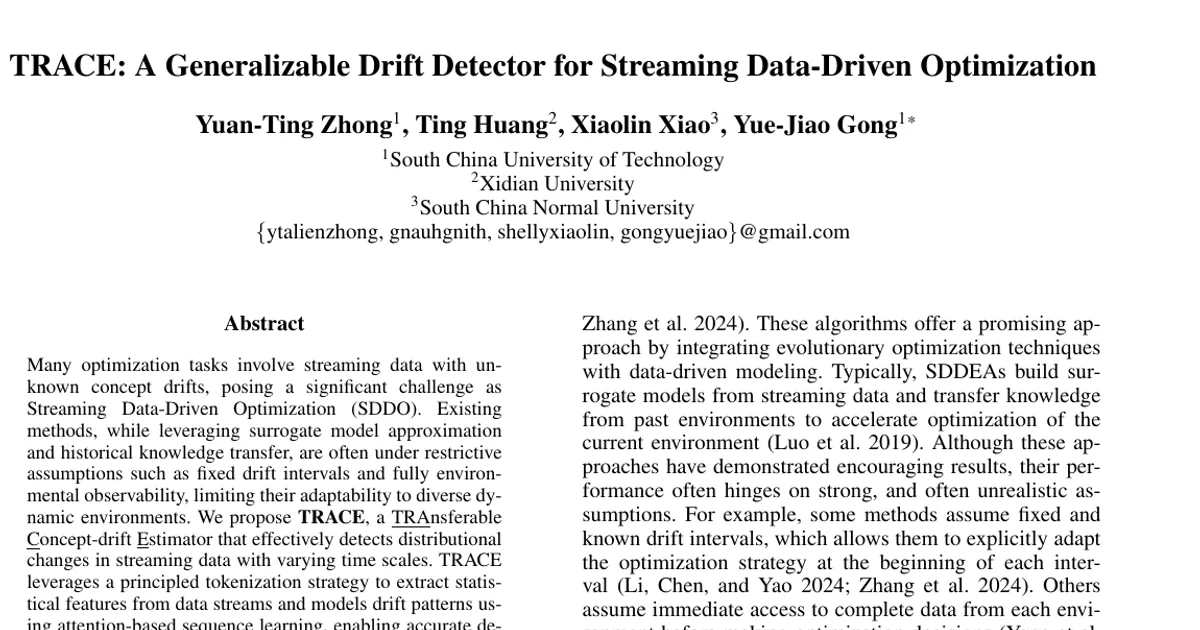
Many optimization tasks involve streaming data with unknown concept drifts, posing a significant challenge as Streaming Data-Driven Optimization (SDDO). Existing methods, while leveraging surrogate model approximation and historical knowledge transfer, are often under restrictive assumptions such as fixed drift intervals and fully environmental observability, limiting their adaptability to diverse dynamic environments. We propose TRACE, a TRAnsferable C}oncept-drift Estimator that effectively detects distributional changes in streaming data with varying time scales. TRACE leverages a principled tokenization strategy to extract statistical features from data streams and models drift patterns using attention-based sequence learning, enabling accurate detection on unseen datasets and highlighting the transferability of learned drift patterns. Further, we showcase TRACE's plug-and-play nature by integrating it into a streaming optimizer, facilitating adaptive optimization under unknown drifts. Comprehensive experimental results on diverse benchmarks demonstrate the superior generalization, robustness, and effectiveness of our approach in SDDO scenarios.