Research
Towards Efficient Reasoning: Learning Causal Shortcuts for Diffusion Language Models
Towards Efficient Reasoning: Learning Causal Shortcuts for Diffusion Language Models Overview Research area: Natural language processing — specifically training methods for Diffusion Language Models (
- arXiv
- 2609.28272
- Published
- 2026-09-23
- Authors
- Dian Jin, Kairong Han, Baohong Li, Xinpeng Dong, Zijing Hu, Nuanqiao Shan, Fei Wu, Kun Kuang
AI summary
Towards Efficient Reasoning: Learning Causal Shortcuts for Diffusion Language ModelsOverview
Research area: Natural language processing — specifically training methods for Diffusion Language Models (DLMs), with a focus on mathematical reasoning and code generation.
Technical level: Advanced. The paper combines masked diffusion training objectives (NELBO), conditional mutual information scoring, and large-scale supervised fine-tuning of 8B-scale models.
Scope in one sentence: The paper proposes a training framework, Causal Shortcut Learning (CSL), that identifies the tokens most responsible for guiding a diffusion language model toward a correct reasoning path and masks those tokens in parallel during fine-tuning, reporting accuracy gains over SFT and five SFT-variant baselines on seven math benchmarks and two code benchmarks.
What This Paper Is About
Diffusion language models generate text with bidirectional attention and random masking rather than strictly left-to-right decoding, which theoretically gives them a much larger space of possible generation trajectories — but also makes it hard for them to concentrate on the tokens that actually steer reasoning toward the right answer. The authors ask whether a small set of "shortcut" tokens can be identified that spans a full reasoning sequence and reliably points the model toward the correct trajectory, and whether training the model to focus on those tokens improves both accuracy and convergence speed.
Key Contributions
- A Conditional Mutual Information (CMI) score that quantifies how much a single token reduces the uncertainty of the remaining masked tokens, used as a measure of that token's importance for reasoning. The paper frames this as the expected pairwise conditional mutual information between a revealed token and other masked tokens.
- The concept of "causal shortcuts" — token chains selected by CMI that cover the full sequence and provide explicit guidance toward correct reasoning trajectories, together with a step-by-step extraction procedure to build them (and a sliding-window variant to reduce the naive O(KL) complexity to O(KD)).
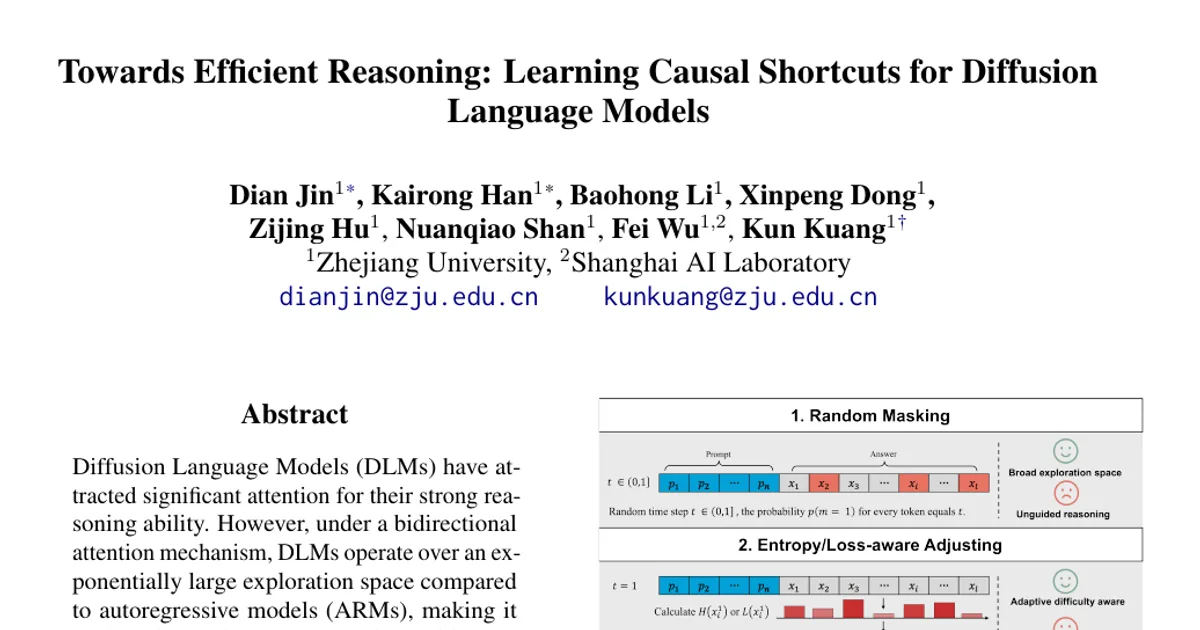
- The Causal Shortcut Learning (CSL) framework, which applies parallel prioritized masking to the causal shortcut tokens during training, combined with random masking on the remaining tokens, so the model converges faster and more accurately to correct answers.
- Extensive empirical validation on seven mathematical reasoning benchmarks (GSM8K, MATH-500, SAT, Sudoku, GPQA, MMLU-STEM, ARC-C) and two code benchmarks (HumanEval, MBPP) with two base models, plus ablations on extraction strategy, shortcut set size K, and entropy dynamics.
Main Findings
- Accuracy gains over SFT: CSL achieves an average improvement of 1.92% over SFT-only models on LLaDA-8B-Instruct and 1.58% on LLaDA-1.5 across the nine tasks, with the single largest reported gain being 4.20% on MATH-500 at a generation length of 256.
- Math benchmark results (first model block, labeled LLaDA-8B-Instruct in Table 2): CSL reaches an average of 56.35% versus 54.41% for SFT and 54.07% for the base model. Per-task scores for CSL are GSM8K-256 79.83%, GSM8K-512 80.52%, MATH-256 36.40%, MATH-512 38.60%, SAT 78.18%, Sudoku 14.84%, GPQA 30.58%, MMLU 61.88%, ARC-C 86.35%.
- Second model block: CSL averages 56.29% versus 54.71% for SFT and 55.02% for the base model, with per-task scores of 79.30%, 81.20%, 35.00%, 38.80%, 79.09%, 14.01%, 31.25%, 62.45%, and 85.49% across the same nine columns. (Note: the paper's table header repeats "LLaDA-8B-Instruct" for this block, while the text attributes the 1.58% average gain to LLaDA-1.5.)
- Code generation results (LLaDA-8B-Instruct base): CSL averages 38.81% versus 36.51% for SFT and 35.41% for the base model, an average improvement of 2.30% over SFT-only. Gains over SFT are 3.50% on MBPP at length 256 and 3.89% on MBPP at length 512. CSL scores HumanEval 32.32% (256) and 35.37% (512), and MBPP 43.19% (256) and 44.36% (512).
- Baseline instability: MGDM (a reweighting-based method) suffers severe performance collapse on the code tasks, with an average of 14.97% versus 38.81% for CSL; the paper cites this when arguing that reweighting-based training is unstable.
- Causal shortcuts as prompt guidance (Figure 2): CMI-GT token selection yields a 17.3% improvement under the 1/32-length timestep setting and raises accuracy to 87.2% under larger timestep settings, while CMI-Self (model-sampled tokens) substantially degrades accuracy, which the authors attribute to biased trajectories and error accumulation.
- Entropy behavior: CSL shows faster entropy decay, particularly for t > 0.5, and reaches an entropy threshold of 1.0 earlier with a lead of 0.087 timestep (Table 5: SFT 0.901 vs CSL 0.814 on GSM8K "Correct"; 0.916 vs 0.869 on GSM8K "All"; 0.922 vs 0.867 on MATH "Correct"; 0.930 vs 0.891 on MATH "All"). Cumulative entropy is also lower (Table 6: 57.78 to 51.36 on GSM8K-256, 94.62 to 85.32 on GSM8K-512, 84.90 to 78.72 on MATH-256, 138.4 to 121.1 on MATH-512), with a gap reaching 17.263 at the end of decoding on MATH.
- Digits and operators: CSL shows lower entropy and earlier generation order for numbers and operators than the comparison setting (Figure 6).
- Extraction strategy ablation (Table 4): At K = 0.2L, step-by-step extraction gives 79.83%/80.52% on GSM8K-256/512 and 36.40%/38.60% on MATH-256/512, whereas random selection at the same K gives 73.83%/76.12% and 32.20%/34.20%, and one-step gives 75.21%/77.33% and 32.80%/33.60%. K = 0.2L is reported as the best setting; K = 0.1L leaves the trajectory uncovered while K = 0.3L adds too many tokens.
- CMI score model quality: The learned scoring model reaches an NDCG of 92.1% and a Top-5% Hit Rate of 85.4% at λ = 1.0 (Table 7), and reaches 92.1%/85.4% with 1,000 training samples versus 92.6%/87.2% with 5,000 samples (Table 8), against a full dataset of around 20,000 samples. The paper reports the CMI estimation NDCG as reaching 0.92.
Methodology in Plain English
The authors start from the observation that during diffusion training, all tokens are treated roughly equally, even though only some of them actually drive the reasoning forward. To find those tokens, they measure entropy — how uncertain the model is about each still-masked position — and then test what happens when a candidate token is revealed: if revealing it sharply reduces uncertainty about the rest of the masked sequence, it carries a lot of causal information and receives a high CMI score.
Selecting all high-CMI tokens at once does not work, because the highest-scoring tokens cluster near the prompt and leave the rest of the reasoning sequence uncovered. Instead, the authors select one token at a time: pick the highest-CMI token, reveal it, recompute the scores (which suppresses the nearby peak and exposes the next one), and repeat K times. This "step-by-step" procedure produces a token chain that spans the sequence. Because searching all L positions at every step is quadratic, they restrict each step's search to a sliding window of D candidates, and, for large datasets, train a lightweight scoring model on a small annotated subset to predict CMI on the rest of the data and avoid the expensive extraction pass.
The extracted shortcut tokens are then used during fine-tuning with parallel masking: instead of masking them randomly, the training objective always masks the shortcut tokens in parallel and applies random masking to everything else. Two arguments are given for why this is safe and useful — shortcut tokens cover the whole trajectory, so parallel updates let the model learn them efficiently, and they have weak local dependencies, so masking them simultaneously does not break strong token-to-token relationships. Experiments fine-tune LLaDA-8B-Instruct and LLaDA-1.5 with LoRA (learning rate 2×10⁻⁴, rank 8) for 4 and 8 epochs respectively, on a sequence length of 2048 for math and 1024 for code, using 4 NVIDIA A100 40G GPUs, a fixed block generation size of 32, 0-shot evaluation, and random seed 42.
Why This Matters
Impact on research: The paper reframes token importance in diffusion language model training as a causal question rather than a difficulty or uncertainty question, and argues that entropy- or loss-based reweighting (MGDM, DiffusionBert, GIFT, DSFT) conflates "hard" with "important." It also offers a concrete empirical handle on error accumulation during long-sequence diffusion decoding, showing faster entropy decay and lower cumulative entropy under CSL.
Real-world applications:
- Mathematical reasoning assistants and tutoring systems that need reliable step-by-step solutions rather than plausible-sounding ones.
- Code generation and code completion tools, where the paper reports gains on HumanEval and MBPP.
- Efficient inference pipelines, since the paper links causal shortcuts to reaching correct answers in fewer decoding steps.
- Data-efficient fine-tuning workflows, since the CMI score model is shown to work from roughly 1,000 annotated samples against a 20,000-sample dataset.
Industry relevance: Any organization fine-tuning diffusion-based language models for reasoning-heavy tasks can apply CSL as a training-time modification on top of existing SFT pipelines, without changing the model architecture or the inference interface. The reported stability advantage over reweighting methods is relevant to teams that need predictable fine-tuning behavior, and the paper's own limitations section notes the method is architecturally independent, which suggests portability to other masked diffusion models.
Future Directions
- Scaling beyond 8B parameters: the authors state that computational constraints limited experiments to 8B-scale models and expect the method to scale to larger DLMs. They do not report results at larger scales.
- Proxy signals from internal representations: the limitations section suggests using hidden states or attention patterns as importance signals instead of a preprocessing-based CMI score, which would allow adaptive focus on informative tokens during training.
- Importance-aware training as a general direction: the authors frame the allocation of learning capacity across tokens as a fundamental open challenge in DLM training.
- Choice of K on diverse data: the paper defers discussion of fixed versus dynamic K values across varied training data to an appendix, leaving the selection rule an open practical question.
Target Audience
Researchers and graduate students working on diffusion language models, masked-language training objectives, or reasoning-oriented fine-tuning; machine learning engineers who fine-tune large models for math or code tasks and want a training-time method that does not require architectural changes; and readers interested in how information-theoretic measures such as conditional mutual information can be turned into practical data-selection and masking policies.
Authors’ abstract
Diffusion Language Models (DLMs) have attracted significant attention for their strong reasoning ability. However, under a bidirectional attention mechanism, DLMs operate over an exponentially large exploration space compared to autoregressive models (ARMs), making it challenging to focus on reasoning-guiding tokens under random masking. We define causal shortcuts as token chains that cover the full sequence and provide explicit guidance towards correct reasoning trajectories. We analyze the effects of causal shortcuts on the reasoning accuracy and convergence speed of DLMs, and find that they largely improve answer convergence efficiency and generation accuracy. Motivated by this, we propose a Causal Shortcut Learning (CSL) Framework for DLMs. Specifically, we introduce a step-by-step token extraction procedure to extract causal shortcuts from data, and apply parallel prioritized masking on these tokens during training to enable efficient and accurate convergence to correct answers via causal shortcuts. Extensive experiments across multiple reasoning benchmarks and two base models demonstrate that CSL consistently outperforms existing SFT-variant baselines, achieving an average improvement of $1.92\%$ over SFT-only models, and up to $4.20\%$ on MATH-500. The code is available at the \href{https://github.com/ZJUDianJin/Causal-Shortcuts-Learning}{https://github.com/ZJUDianJin/Causal-Shortcuts-Learning