Research
Toward Maturity-Based Certification of Embodied AI: Quantifying Trustworthiness Through Measurement Mechanisms
Overview Research area: Trustworthiness certification and assurance for embodied AI (E-AI), with uncertainty quantification (UQ) as an exemplar measurement mechanism. Technical level: Intermediate. Th
- arXiv
- 2601.03470
- Published
- 2026-01-06
- Authors
- Michael C. Darling, Alan H. Hesu, Michael A. Mardikes, Brian C. McGuigan, Reed M. Milewicz
AI summary
Overview
Research area: Trustworthiness certification and assurance for embodied AI (E-AI), with uncertainty quantification (UQ) as an exemplar measurement mechanism.
Technical level: Intermediate. The paper is a conceptual framework and position paper rather than an empirical study; it assumes familiarity with machine learning lifecycle concepts but introduces most terminology.
Scope: The paper proposes a maturity-model-based certification framework for embodied AI that converts abstract trustworthiness characteristics into quantifiable, auditable measurements, illustrated with a UAS detection case study.
What This Paper Is About
Embodied AI systems (drones, autonomous vehicles, healthcare devices) must act in unpredictably changing physical environments, but today's verification methods evaluate isolated properties—accuracy on held-out data, robustness to adversarial perturbations, fairness across groups—rather than holistic, lifecycle-wide trustworthiness. The authors argue that certifiable embodied AI requires maturity models with structured assessment, quantitative scoring, and explicit handling of multi-objective trade-offs, and they demonstrate the idea using uncertainty quantification as a concrete example measurement mechanism. The goal is to move from abstract trustworthiness principles to measurable evidence that can support certification decisions.
Key Contributions
-
A maturity-based certification framework for embodied AI with three interconnected components: a Dimensional Assessment Structure that maps NIST trustworthiness characteristics onto stages of the ML development lifecycle (requirements, data collection/curation, model training, validation/testing, deployment, monitoring), a Maturity Scoring Methodology with level-specific criteria and required evidence, and a Multi-Objective Optimization component for making trade-offs explicit and defensible.
-
A five-level maturity scoring scheme, analogous to commonly used five-level maturity models (Initial to Optimizing), illustrated with a notional robustness ladder: Level 1 (Ad-hoc Testing), Level 2 (Structured Testing), Level 3 (Measurement-Driven), Level 4 (Statistical Guarantees, including conformal prediction with specified coverage and runtime monitoring with measurement-based triggers), and Level 5 (Formal Verification with formally verified runtime safety mechanisms).
-
Four properties required of effective measurement mechanisms—quantifiable metrics with thresholds defining maturity boundaries, actionable outputs tied to concrete system decisions and safety mechanisms, formal properties providing mathematical guarantees where possible, and coverage across the development and operational lifecycle. The authors contrast this with existing explainability maturity work such as MM4XAI-AE, which relies on binary indicators assessed through documentation review.
-
An uncertainty quantification exemplar mapped across NIST characteristics, ML lifecycle phases, and system lifecycle phases, plus a motivating UAS detection case study that describes a closed-loop synthetic data pipeline driven by uncertainty analysis.
Main Findings
- UQ satisfies the proposed measurement-mechanism properties: UQ produces quantifiable metrics including calibration error, entropy, ensemble variance, out-of-distribution detection scores, and conformal prediction set sizes; the paper states that thresholds of these metrics could map directly to maturity levels.
- UQ maps onto multiple NIST trustworthiness characteristics: reliability/validity (probability calibration measures whether predicted confidences match actual frequency of being correct), robustness (OOD detection identifies examples beyond the training distribution), transparency/explainability (uncertainty estimates identify credible versus questionable input regions, and decomposition into epistemic versus aleatoric components provides interpretable confidence explanations), and safety (uncertainty thresholds could trigger runtime guardrails).
- UQ spans the full lifecycle: from requirements (notional example: "system must maintain uncertainty below 0.3 in specified weather conditions") through data collection (active learning and targeted acquisition), training (architecture, loss design, regularization), validation/testing (calibration, OOD detection, coverage validation), integration (uncertainty propagation across components), deployment (runtime monitoring and threshold-based guardrails), and operations/maintenance (longitudinal tracking of degradation, distribution shift, and anomalies).
- Preliminary UAS results show a correlation between prediction uncertainty and classification error: the model is less likely to be correct when uncertainty is high, indicating UQ can serve trustworthiness assessment.
- The paper reports no quantitative performance results: no accuracy figures, dataset sizes, or benchmark scores are given; the UAS work is described as ongoing with preliminary findings only.
- Open questions remain within the case study: at what uncertainty level a system should alert, refuse to decide, or invoke fallbacks and how thresholds differ across deployment contexts (military versus civilian airspace); which features (lighting, aircraft size, terrain complexity) drive uncertainty—the authors state they have not yet identified these; how to translate statements like "model shows high uncertainty in forested terrain at dusk" into a quantitative robustness maturity score; and how much synthetic data and testing is "enough."
Methodology in Plain English
The authors take a conceptual, framework-building approach rather than an experimental one. They start from the NIST AI Risk Management Framework's list of trustworthy AI characteristics, which they treat as goal posts that still need to be made measurable. They then borrow the structure of established maturity models like CMMI, which assess and improve software development processes, and adapt it to embodied AI by building a matrix: trustworthiness characteristics on one axis, ML development lifecycle stages on the other, with each intersection treated as an assessable element. For each element, maturity levels are defined with criteria and required evidence. To connect theory to practice, they select uncertainty quantification as a single concrete measurement mechanism and walk it through the matrix, showing which UQ metrics exist, how they could be tied to thresholds, and where in the lifecycle they apply.
For the case study, they describe ongoing UAS detection work: because collecting real-world imagery across all aircraft types, terrains, lighting, weather, viewing angles, and adversarial appearance modifications is expensive and time-consuming, they are building a synthetic data pipeline with external control over UAS characteristics, environmental factors, and confounding factors such as birds and clutter. This pipeline runs in a closed loop—ensemble-based uncertainty measurement finds robustness gaps, additional synthetic data similar to high-uncertainty samples is generated (with similarity measured in latent space using UMAP and in feature space via the generation parameters), models are retrained, and uncertainty is reassessed.
Why This Matters
The paper argues that current verification techniques and trustworthiness frameworks are not keeping pace with embodied AI challenges, and that E-AI requires continuous renewal of trust as systems act over extended periods—a whole-of-system approach rather than isolated property checks.
Real-world applications discussed or implied:
- Counter-UAS and airspace security: detecting, classifying, and tracking drones via radar, RF receivers, cameras, and acoustic arrays, including preventing errant UAS from entering restricted airspace near airports and intercepting unauthorized UAS used to harass or disrupt operations.
- Military operations: battlefields where both sides deploy drone fleets, requiring detection under adversarial conditions.
- Autonomous vehicles and drones generally, cited as examples of embodied AI with physical presence.
- Healthcare devices operating with physical presence in safety-critical contexts.
Industry relevance: The framework targets certification decisions, meaning it is aimed at regulators, certification authorities, and developers who need auditable criteria. The paper notes a specific human-factors concern—high false alarm rates and nuisance alarm rates degrade operator vigilance and trust, desensitizing operators who may then ignore genuine threats. It also notes that balancing security (minimizing false negatives) against operator trust (minimizing false alarms) is a multi-objective trade-off where formalization would help. The authors position explicit, quantifiable measurement mechanisms as bringing clarity to the design and use of complex systems.
Future Directions
- Maturity model design: determining what maturity level structure makes sense for embodied AI and how to design criteria that drive meaningful improvement rather than "checkbox compliance."
- Measurement methodology: identifying which measurement mechanisms are most mature and suitable for each NIST characteristic, and what combination of testing, formal verification, and runtime monitoring constitutes sufficient evidence for each maturity level.
- Multi-objective optimization formalization: mathematically representing trade-offs between trustworthiness characteristics measured by different mechanisms, and identifying decision-theoretic frameworks to help stakeholders navigate design trade-offs; the authors note preliminary work on linking ML outputs to optimal decisions under uncertainty exists but has not been extended to multi-objective trustworthiness trade-offs.
- Runtime assurance and formal methods integration: how maturity assessments translate into runtime monitoring requirements, what guardrails measurement outputs should trigger, how to validate that runtime monitors themselves are trustworthy, and how measurement-based maturity assessments connect to formal verification—including which mechanisms can provide formal guarantees.
- Cross-cutting open questions the paper raises: ensuring maturity levels are comparable across different trustworthiness characteristics, determining evidence sufficiency for certification decisions, integrating multiple mechanisms into existing development workflows without overwhelming developers, and accounting for hardware-software coupling in embodied AI.
Target Audience
This paper is most useful to researchers and practitioners working on assurance, verification, and certification of embodied AI and safety-critical autonomous systems; standards and regulatory bodies seeking to operationalize trustworthiness characteristics into auditable criteria; developers of UAS detection and counter-UAS systems; and ML researchers working on uncertainty quantification who want to understand how their techniques could map to certification frameworks. Readers looking for empirical benchmarks or quantitative results will not find them here—the contribution is conceptual and agenda-setting, and the authors explicitly invite the community to extend the approach across all trustworthiness characteristics.
Authors’ abstract
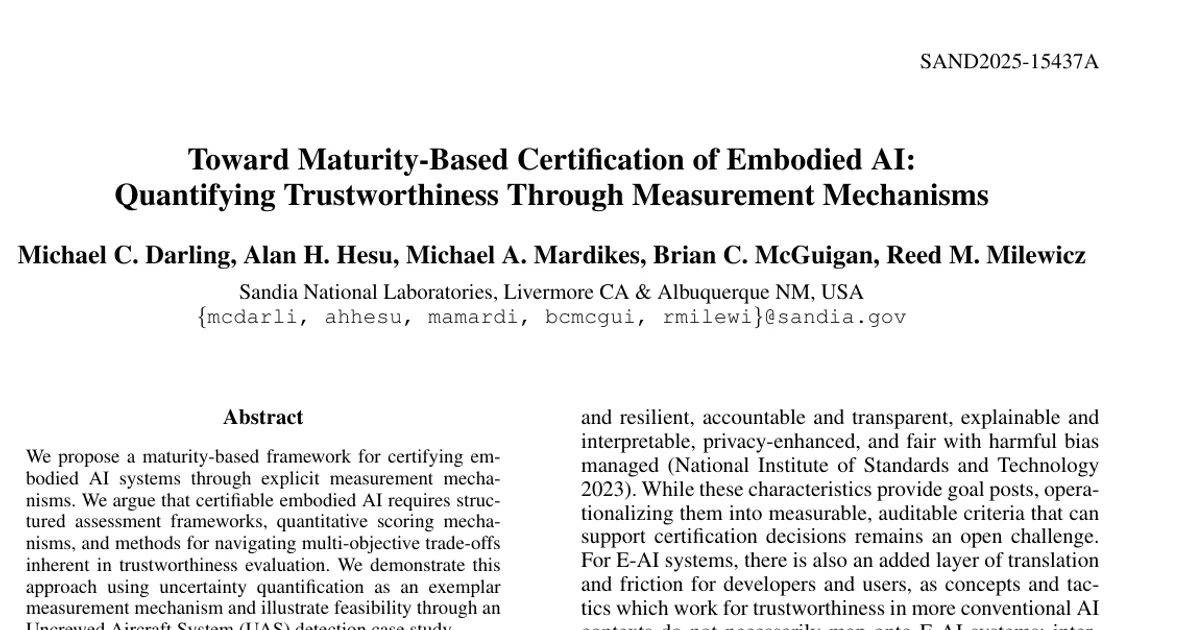
We propose a maturity-based framework for certifying embodied AI systems through explicit measurement mechanisms. We argue that certifiable embodied AI requires structured assessment frameworks, quantitative scoring mechanisms, and methods for navigating multi-objective trade-offs inherent in trustworthiness evaluation. We demonstrate this approach using uncertainty quantification as an exemplar measurement mechanism and illustrate feasibility through an Uncrewed Aircraft System (UAS) detection case study.