Research
TokSuite: Measuring the Impact of Tokenizer Choice on Language Model Behavior
Overview Research area: Natural Language Processing — tokenization, multilingual language model evaluation, and robustness benchmarking. Technical level: Intermediate. Readers should be comfortable wi
- arXiv
- 2512.20757
- Published
- 2025-12-23
- Authors
- Gül Sena Altıntaş, Malikeh Ehghaghi, Brian Lester, Fengyuan Liu, Wanru Zhao, Marco Ciccone, Colin Raffel
AI summary
Overview
Research area: Natural Language Processing — tokenization, multilingual language model evaluation, and robustness benchmarking.
Technical level: Intermediate. Readers should be comfortable with tokenizers (BPE, WordPiece, Unigram, byte-level), vocabulary sizes, and standard LM evaluation practice; no deep mathematical background is required.
Scope: The paper trains and releases 14 language models that are identical except for their tokenizer, alongside a multilingual, perturbation-based benchmark of approximately 5,000 samples, in order to isolate how tokenizer choice alone affects model robustness.
What This Paper Is About
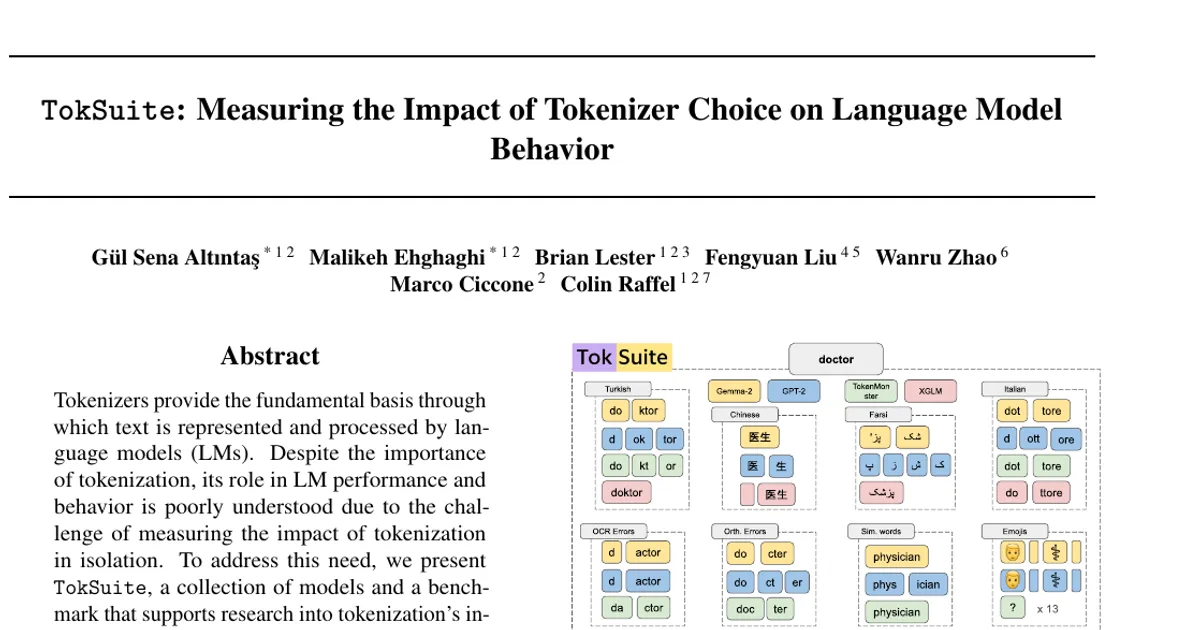
Researchers cannot easily tell how much of a language model's behavior comes from its tokenizer, because real models differ in architecture, training data, and training duration at the same time. TokSuite addresses this by holding everything else fixed — architecture, initialization, data, and training budget — and varying only the tokenizer across 14 released models, paired with a benchmark of real-world linguistic perturbations curated by native speakers in English, Chinese, Farsi, Italian, and Turkish.
Key Contributions
-
Fourteen matched pre-trained models. The authors trained and released 14 LMs that share the same architecture, initialization, dataset, and training budget, and differ only in which one of 14 off-the-shelf tokenizers they use: ByT5, TokenMonster, Phi-3, GPT-2, Comma, mBERT, Llama-3.2, Tekken, Qwen-3, GPT-4o, BLOOM, Aya, Gemma-2, and XGLM. Vocabulary sizes range from 259 tokens (byte-level ByT5) to over 256,000 (Aya or XGLM).
-
A vocabulary unification framework. Because different vocabularies share tokens, the authors construct a unified "super vocabulary" as the union of all tokenizer vocabularies (based on UTF-8 byte representations of each element) and create bijective mappings from each tokenizer's token IDs into that shared space. This lets shared tokens receive the same embedding initialization across all 14 models, reducing initialization as a confounding factor.
-
The TokSuite benchmark. A multilingual robustness benchmark of approximately 5,000 samples built on 40 canonical English multiple-choice text-completion questions, translated into Farsi, Italian, Turkish, and Chinese, then perturbed by native speakers. It adds a math dataset with 20 canonical technical questions and a STEM dataset with 44 canonical technical questions. The benchmark is integrated into lm-eval-harness.
-
A set of empirical findings on how tokenizer design relates to robustness, spanning multilingual noise, orthographic and morphological variation, technical content, Unicode formatting, and model scale.
Main Findings
-
Small-vocabulary, unconventional tokenizers lead on robustness. TokenMonster achieves the best average robustness across all multilingual perturbations, with the lowest average relative performance drop of 17%, despite having a 32,000-token vocabulary trained exclusively on English — roughly one-eighth the size of multilingual competitors such as Aya or XGLM.
-
Byte-level tokenization is robust but inefficient. ByT5 outperforms 9 models despite using only a 259-token vocabulary, showing 0.04/0.06 drops for English/non-English orthographic errors, a 0.00 drop for English grammatical errors, and a top average 0.18 drop for multilingual noise. It even shows a performance improvement of -0.11 with zero-width characters. This comes at an efficiency cost: the highest subword fertility and proportion-of-continued-words (PCW) scores across all languages.
-
Noise hurts non-English languages more. The average performance drop due to noise is 0.21 for non-English languages versus 0.15 for English. A spacing error in the Turkish phrase "gün sayısı" causes re-tokenization into sequences such as
gün, ##s, ay, ##ısıfor mBERT orgü, ns, ay, ısıfor Llama-3.2, whereas ByT5's character-level design turns errors into predictably altered sequences of known bytes. -
Technical content is a weak spot. Models show average drops of 0.22 for LaTeX and 0.28 for STEM content, even in simplified text-completion format with mild notation.
-
Unicode formatting is the hardest perturbation for nearly everyone. Unicode styling and character transformations produce an average drop of 0.53, the highest observed. XGLM resists this because of NFKC normalization during preprocessing, though that also means it cannot faithfully represent or generate such formatting.
-
Robustness is largely scale-independent. In a controlled experiment with identically trained Llama-3.2 models of 300M, 1B, and 7B parameters, average drops were 0.26, 0.26, and 0.22 respectively. Larger industry-scale models trained for orders of magnitude longer show only modest robustness improvements, suggesting tokenizer design dominates parameter count, training duration, and data.
-
Canonical tasks are handled well, so drops are attributable to perturbation. For each canonical question, over 70% of the models responded correctly, and performance consistently exceeds 70-75% accuracy on canonical tasks in English and non-English settings.
-
Intrinsic compression metrics do not explain the results. Differences in robustness are not explained by standard intrinsic metrics such as fertility, vocabulary size, parity, or PCW.
-
All reported differences are statistically supported. Values are averaged across 10,000 bootstrap samples with 95% confidence intervals; all discussed performance differences exceed one standard deviation, and most are statistically significant under paired Wilcoxon signed-rank tests at α = 0.05.
Methodology in Plain English
The authors start by picking 14 tokenizers that already exist in the wild and cover the main design axes: BPE, WordPiece, Unigram, TokenMonster, and byte-level approaches; monolingual and multilingual training data; different normalization, whitespace, and out-of-vocabulary strategies; and vocabularies from 259 to over 256,000 tokens.
To keep comparisons fair, they build one shared "super vocabulary" from the union of all 14 vocabularies and map each tokenizer's IDs into it, so that a token appearing in multiple vocabularies starts with the same embedding value in every model.
Each of the 14 models is then trained with Meta's Lingua framework using a Llama-3.2-1B-style architecture with untied embeddings and roughly one billion non-embedding parameters. All models see 100,000 steps with batches of 256 sequences of length 4096, optimized with AdamW (weight decay 0.1, peak learning rate 0.001, cosine annealing, 2000 warm-up steps). The corpus totals about 100 billion tokens: 40B English tokens from FineWeb-Edu and 60B multilingual tokens split equally across the Chinese, Turkish, Italian, and Farsi subsets of FineWeb2-HQ (15B each). The authors deliberately fix the token budget rather than the raw byte budget, meaning different models see different amounts of raw text — 100B tokens corresponds to roughly 100GB of UTF-8 bytes for ByT5, 278GB for Comma, and 471GB for Gemma-2. They justify this because training each model on the same text for different numbers of steps would under- or over-train some models, and they validate the choice with a same-text-budget experiment across four models.
As a sanity check, the models are evaluated on HellaSwag, ARC, PIQA, and XNLI, where they perform reasonably well given their size and budget.
For the benchmark, 40 canonical multiple-choice questions that nearly all 14 models answer correctly are selected through a model-in-the-loop process, translated by native speakers into the four other languages, and then given targeted perturbations reflecting real usage: non-native keyboard substitutions, homoglyphs, optional Farsi diacritics, Italian accent errors, Turkish keyboard effects (ş to s), Pinyin and other romanization, colloquial register, emoji substitution, morphological fragmentation, typos and OCR-style noise, grammatical errors, and Unicode styling characters. Math and STEM questions cover LaTeX-style formatting, ASCII structural representations, and translated arithmetic.
Evaluation uses lm-eval-harness with byte-length-normalized log-likelihood. Because models differ in baseline ability, the headline metric is the relative accuracy drop (canonical accuracy minus perturbed accuracy, divided by canonical accuracy), where lower is more robust. Efficiency of tokenization is measured separately on 10,000 parallel Flores200 samples using subword fertility, parity (cross-lingual token-length ratio for parallel sentences), and proportion of continued words.
Why This Matters
Impact on research. Tokenization is often treated as an afterthought — the GPT-2 tokenizer was reused for Meta's OPT, and the GPT-NeoX-20B tokenizer was reused for MPT-7B-8k and the Pythia models. This paper supplies the controlled artifact that this kind of research has been missing: matched models that let researchers attribute behavioral differences to tokenization rather than to architecture or data. It also shows that common intrinsic metrics such as fertility and vocabulary size do not predict downstream robustness, which challenges how tokenizers are typically chosen.
Real-world applications:
- Multilingual deployment: knowing that noise degrades non-English inputs roughly 40% more than English (0.21 versus 0.15) helps teams prioritize tokenizer testing for non-English users.
- User-facing text input: the benchmark targets exactly the variations users produce — non-native keyboards, missing diacritics, homoglyphs, emoji substitution, and typos — so findings map directly to chat, search, and autocomplete systems.
- Technical and scientific tools: with average drops of 0.22 on LaTeX and 0.28 on STEM content, teams building math, coding, or scientific assistants learn that formatting conventions, not just vocabulary coverage, drive failures.
- Content-format handling: the 0.53 average drop on Unicode styling shows that styled or transformed text is a broadly shared failure mode, relevant to moderation, search indexing, and document processing.
Industry relevance. Practitioners typically pick tokenizers off the shelf and inherit them across model generations. This paper suggests that the choice materially affects robustness while being nearly independent of model scale, and that unconventional options (TokenMonster, ByT5) can beat large multilingual vocabularies on robustness in the authors' evaluations — while trading off efficiency and canonical performance. The benchmark's lm-eval-harness integration makes it usable as a practical test before committing to a tokenizer.
Future Directions
- Hybrid tokenization strategies. The authors suggest combining subword efficiency with byte-level robustness, pointing to BPE dropout and subword regularization as candidates worth investigating.
- A fully controlled factorial study. The paper's key limitation is that off-the-shelf tokenizers differ simultaneously in vocabulary size, algorithm, normalization, pre-tokenization, and training corpus. Training tokenizers from scratch while varying one design factor at a time is stated as beyond this work's scope.
- Explaining why consistency wins. The authors speculate that TokenMonster's advantage comes from its distillation-based vocabulary construction and "ungreedy" algorithm that limits how many distinct token sequences represent the same word, but note that intrinsic compression metrics do not capture this.
- Decoder-side fixes. Token healing and byte-level probability computation are reported to provide limited improvement on TokSuite, leaving open how generation-time methods could complement better tokenizers.
Target Audience
Researchers working on tokenization, multilingual NLP, or LM evaluation; engineers selecting or inheriting tokenizers for production models; and practitioners building systems that must tolerate noisy, formatted, or non-English user text. Readers who want a controlled empirical answer to "
Authors’ abstract
Tokenizers provide the fundamental basis through which text is represented and processed by language models (LMs). Despite the importance of tokenization, its role in LM performance and behavior is poorly understood due to the challenge of measuring the impact of tokenization in isolation. To address this need, we present TokSuite, a collection of models and a benchmark that supports research into tokenization's influence on LMs. Specifically, we release fourteen pre-trained models that use different off-the-shelf tokenizers but are otherwise identical, using the same architecture, dataset, training budget, and initialization. We also release a multilingual robustness benchmark that measures model performance under real-world perturbations in English, Chinese, Farsi, Italian, and Turkish, curated by native annotators. Together, TokSuite allows robust decoupling of the influence of a model's tokenizer, supporting a series of novel findings that elucidate the respective benefits and shortcomings of a wide range of popular tokenizers.