Research
The Safeguard Worked. Is the LLM System Safer?
Overview Research area: Security and safety evaluation of deployed large language model (LLM) services (cs.CR), specifically the gap between how safeguard performance is reported in the literature and
- arXiv
- 2609.00519
- Published
- 2026-09-01
- Authors
- Pingyu Wu, Weiming Zhang, Nenghai Yu
AI summary
Overview
Research area: Security and safety evaluation of deployed large language model (LLM) services (cs.CR), specifically the gap between how safeguard performance is reported in the literature and what a deployment decision actually needs to know.
Technical level: Advanced. The paper formalizes deployment safety with a seven-coordinate evaluation anchor, continuation-value functionals, total-variation closures, and sharp bounds with proofs in an appendix.
One-sentence scope: The paper derives, for each kind of quantity a safeguard paper reports, the strongest conclusion that follows about the harmful assistance a guarded service still supplies, and then applies that reading as a coding instrument to 198 papers.
What This Paper Is About
Safeguards in deployed LLM services are usually judged by refusal rates, attack success rates, and policy violation rates, but those numbers describe how a control performed on the requests it was tested on. A deployment instead has to answer how much help with harmful tasks the service still gives an attacker who keeps adapting or finds another way in. The paper determines what each reported result implies for that deployment question, so results from different safeguard families can be compared under one criterion, and then checks what the published record actually supplies.
Key Contributions
-
From results to deployment conclusions. The authors determine the strongest conclusion each reported safeguard result supports about remaining harmful assistance, and prove when no stronger conclusion follows from that result alone. This identifies when reanalysis can help and when a different measurement is necessary.
-
Missing evidence made explicit. Those determinations are turned into an auditable coding instrument that records the source facts each conclusion requires. Applied to a paper, it identifies the precise missing fact that prevents a deployment conclusion without rerunning the safeguard.
-
A case-based stress test. Across the coded claims, the supported conclusion tracks the evidence reported rather than the technique category, which makes a benchmark gain a hypothesis about deployment rather than a guarantee.
-
A common object of comparison. The paper defines a deployment-safety claim instance with a fixed evaluation anchor and ten coding slots (LB1–LB4 for lower-endpoint evidence, UB0–UB5 for upper-endpoint evidence), so results from different safeguard families become comparable under one deployment criterion.
Main Findings
-
The quantifier asymmetry drives everything. An upper bound on residual assistance must cover every attacker law in the declared class, because the deployed quantity is a supremum over that class. A lower bound needs only one attainable attack law. This asymmetry, not mechanism strength, explains the different evidence requirements.
-
Harmful help can be shown to remain without running an attack. A lower bound follows from benign measurements plus a bound on the attacker-to-benign distance on value-relevant coordinates, so a floor on residual assistance does not require an executed attack.
-
Zero residual is a conjunction of three deployment-wide facts. Under the closed-mediation bound, a zero-residual certificate holds exactly when coverage α = 1, conditional failure ε = 0, and continuation r = 0. None of these three is reported by a local score.
-
Local perfection is globally non-identifying. Even with ε = 0, the sharp bound equals one when α = 0 or r = 1. Any number of mechanisms may establish their local facts without error on every invocation and remain compatible with maximal risky-system value.
-
Detection accuracy's certified contribution is bounded by coverage and continuation. Improving ε to ε′ moves the certified bound by exactly α(ε − ε′)(1 − r). Where coverage or continuation is unmeasured, that contribution cannot be quantified; where either is adverse, it is zero.
-
Several safeguards can fail together as often as the strongest one fails alone. With marginal per-layer bounds, the sharp bound on ordered failures is min-j ε_j rather than the product. The product requires history-uniform conditional bounds, so the improvement from a composition argument comes from the dependence premise, not the layer count.
-
Blocking more behavior can leave only riskier useful options. Removing feasible laws at fixed benign and adverse value functions cannot lower the attainable frontier, and can raise it or empty the feasible set. Under a uniform dual-use relation with fraction ρ > 0, any exactly simulable deployment meeting a positive utility target has residual assistance of at least ρq > 0.
-
A new label, credential, or isolation boundary changes nothing by itself. If two committed deployments share the same benign value-relevant law and the same maliciously reachable law set, they have identical utility, identical residual assistance, and identical simulation distance.
-
The coded record is asymmetric. Coding covered 198 distinct papers at two levels of detail: twelve receive full ten-slot depth coding and 187 receive endpoint-route wide coding, with one paper in both strata. Establishing how little harmful assistance remains requires three deployment facts together, and the one supplied least often is what remains possible after the check succeeds: five of the 24 depth-coded claims supply it. Across both coding strata, one coded claim rules out the worst case. Of the 152 wide-coded claims, 108 report an adverse value putting the residual above zero.
-
Four schedule rows are noninformative, for three distinct reasons. A marginal error rate on a fixed suite fails on the quantifier because it averages over histories without constraining the conditional kernel after any particular one. An enumerated attack set inside a declared budget samples a class that an upper bound must cover, so it cannot bound a supremum. A conditional failure rate is insufficient when another gate can reduce its contribution to zero. A relabeled boundary contributes no quantity used by either bound. Sharpness means that making the reported value in any of these rows more favorable cannot replace the missing relation or quantity.
-
Reported adversarial results motivate the framing. Nasr et al. evaluated 12 jailbreak and prompt-injection defenses with adaptive, defense-aware attacks; their attacks exceeded 90% success against most defenses, although a majority of the original evaluations had reported rates near zero. Holding scenarios, attackers, defenders, and scoring fixed, Jain et al. measured 0 to 1% attack success on the first turn and 5.4 to 14.0% after 15 rounds of adaptation to defender feedback. FragFuse achieved 86.3% access-control bypass but 41.1% end-to-end harmful-task success.
Methodology in Plain English
The authors start by defining the quantity a deployment actually cares about: how much harmful assistance the guarded service still supplies once its safeguards have acted, normalized to the interval from 0 to 1. They fix an "evaluation anchor" of seven coordinates — the service without the intervention, the intervention itself, the task and operating environment, the outcome scale, the declared attacker class, the rights and legitimate-use constraints, and a minimum normal-utility requirement — and hold all of them fixed across comparisons so that only the presence of the safeguard differs.
They then take each familiar kind of reported result, one at a time, and ask: given this number, measured on this outcome scale, inside this attacker class, what is the tightest claim about remaining harmful assistance that logically follows? Each answer is proved to be sharp, meaning no better claim follows from that number alone, with proofs and attaining constructions in an appendix. This produces a schedule mapping reported evidence to bounds, in which some rows give lower bounds, some give upper bounds, and some turn out to be noninformative.
To apply the schedule to publications, they define a claim instance with a fixed anchor and ten coding slots recording the source facts each construction consumes. A coordinate in a source is either supported by a locator, validly derived, or left unknown with no default. The instrument was applied to 198 distinct papers, twelve at full depth and 187 at endpoint-route width, and the resulting counts are treated as hypotheses about what an evaluation should report rather than as measurements of deployed systems.
Why This Matters
Impact on research. The paper argues that a better local score is not, by itself, a stronger claim about the deployment, and that safeguard research cannot stop at raising local scores. It supplies a way to compare results across safeguard families under one deployment criterion, and to make each conclusion auditable back to the reported evidence, so that a benchmark gain is treated as a hypothesis rather than a guarantee.
Real-world applications (as framed by the paper):
- Production LLM services and agentic systems. Deployed systems combine model-level refusal with runtime classifiers, account monitoring, access controls, tool policies, permissions, and execution containment; the framework indicates which of these contributes to a bound and which is merely a relabeling.
- Mediation-based safeguards. For classifiers that gate entry into a protected domain, the three gates of coverage, conditional failure, and continuation determine whether a flawless local check translates into any deployment guarantee at all.
- Released model weights and other transferable artifacts. When an artifact has no mediation domain, the direct reachable-set route applies, and the model's value bound must hold over every reachable system within the declared tampering budget.
- Trusted state and credential design. Because a new label or isolation boundary helps only if it changes value-relevant behavior or attacker-reachable states, the relevant quantity is the distance to the nearest maliciously reachable state marginal rather than average acquisition accuracy.
Industry relevance. The paper's central result for practitioners is that a near-zero or zero local failure rate can coexist with a maximally risky deployment when coverage or post-success continuation is adverse. It gives a specific list of the deployment-wide facts that must be measured for a safety claim to hold, and it identifies which widely reported numbers cannot be converted into one.
Future Directions
- Measure the missing gate. The coded record shows that what remains possible after a safeguard check succeeds is the least-supplied of the three required deployment facts; the schedule says this is exactly what must be measured to close the gap.
- Report zero-residual certificates as conjunctions. A zero-residual certificate through mediation requires complete coverage of every path to the outcome, no conditional failure on those paths, and no continuation after a covered success, so evaluations would need to report all three rather than one.
- Replace marginal rates with history-conditioned evidence. A marginal error rate on a fixed suite yields no simulation bound; what is needed is a per-update conditional bound holding at every adaptive history.
- Test the coded counts as hypotheses. Section 7 treats the counts from the 198-paper coding as hypotheses about what an evaluation should report, which invites further coding work and checks on whether the asymmetry persists across a broader corpus.
Target Audience
Evaluators and red-teamers who report safeguard numbers, safeguard and defense researchers who want their results to translate into deployment claims, safety-case and assurance authors who connect individual measurements to broader arguments, and system owners or reviewers who have to decide how much harmful assistance a guarded LLM service still supplies. The paper assumes comfort with formal definitions, suprema over attacker strategy classes, and bound derivations, so readers without that background will find the schedule and the coding instrument the most directly usable parts.
Authors’ abstract
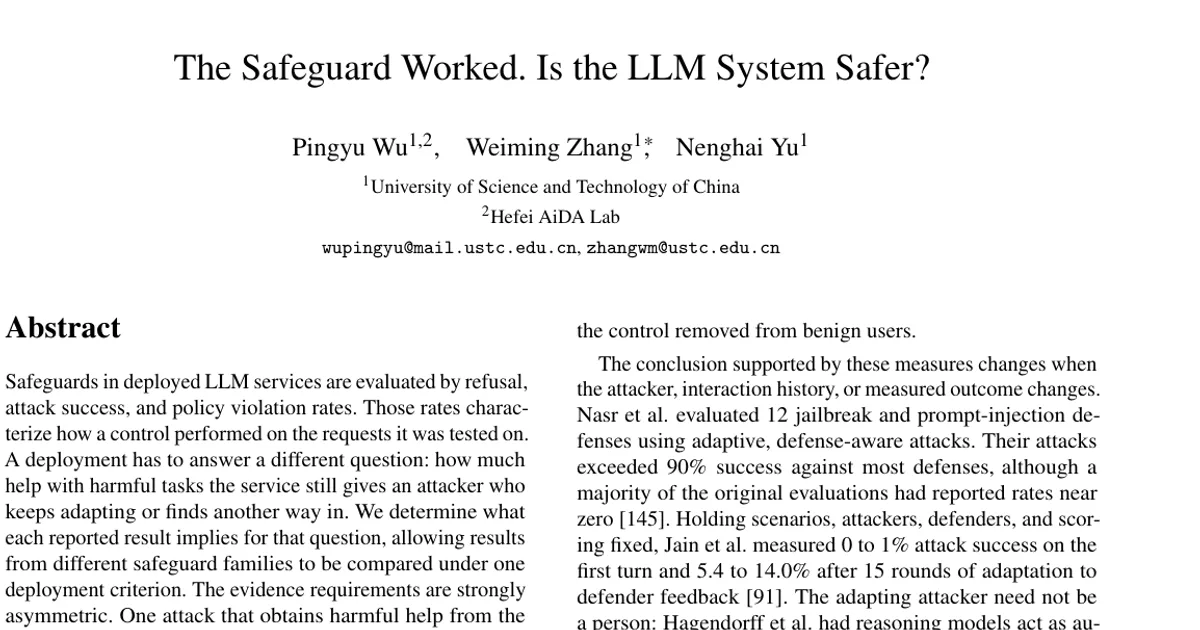
Safeguards in deployed LLM services are evaluated by refusal, attack success, and policy violation rates. Those rates characterize how a control performed on the requests it was tested on. A deployment has to answer a different question: how much help with harmful tasks the service still gives an attacker who keeps adapting or finds another way in. We determine what each reported result implies for that question, allowing results from different safeguard families to be compared under one deployment criterion. The evidence requirements are strongly asymmetric. One attack that obtains harmful help from the deployed service suffices to establish that such help remains, and such attacks appear repeatedly in the coded record. Establishing that little remains cannot follow from the safeguard's own numbers alone; it also requires evidence about what the surrounding system still allows after the safeguard performs its local function. Such evidence is supported or derived in only a small minority of the depth-coded claims, and one such claim bounds its scoped residual. A better local score is therefore not, by itself, a stronger claim about the deployment. Safeguard research cannot stop at raising local scores; a gain has to be judged by whether it makes a deployed system any safer.