Research
The persistence of painting styles
Overview Research area: Applied topological data analysis (persistent homology) for the quantitative analysis of artistic style in paintings, positioned within computer vision and art analysis. Techni
- arXiv
- 2511.16695
- Published
- 2025-11-17
- Authors
- Reetikaa Reddy Munnangi, Barbara Giunti
AI summary
Overview
Research area: Applied topological data analysis (persistent homology) for the quantitative analysis of artistic style in paintings, positioned within computer vision and art analysis.
Technical level: Intermediate. The paper is written to be readable by non-specialists, but it uses persistent homology, cubical complexes, bottleneck and 1-Wasserstein distances between persistence diagrams, and permutation tests, which require some mathematical maturity to follow in detail.
Scope (one sentence): Using only ten paintings per artist from WikiArt, the authors show that persistent homology computed across five image channels can statistically separate painters from different artistic currents, painters within the same current, and human paintings from AI-generated images in an artist's style.
What This Paper Is About
Deciding what makes an artist's "style" distinctive has traditionally been the job of art historians relying on visual intuition, because style and artistic currents resist any objective formal definition. This paper asks whether topological data analysis, and persistent homology specifically, can supply a quantitative, interpretable, and artist-independent signature of painting style. The authors set out to answer three concrete questions: can painters from different currents be told apart, can painters within the same current be told apart, and can an artist's paintings be distinguished from an AI-generated image imitating their style.
Key Contributions
-
First application of persistent homology to painting styles. The authors state that, to the best of their knowledge, persistence theory had never previously been applied to painting styles, and they position the work against prior mathematical approaches such as fractal dimension, Betti numbers, entropy, and neural networks.
-
A reproducible, artist-independent pipeline. Each painting is decomposed into five channels (red, green, blue, grayscale, and edge detection), each channel is turned into a filtration of cubical complexes over thresholds t = 0, ..., 255, and 0-PH and 1-PH are computed and compared using bottleneck and 1-Wasserstein distances. The Python code is openly available, as are the image collections used, so the analysis can be extended to different collections without retraining.
-
Statistical validation via permutation tests. Ten thousand permutations are performed per test, which the authors describe as double the amount suggested in the literature for meaningful statistics at the 5th percentile and the recommended number for the 1st percentile, giving statistically certified distinctions rather than descriptive claims.
-
Demonstration that non-significant results carry information. Beyond classification, the authors show that high p-values indicate an artist is far from all other painters (a distinctive style topologically) while low but significant p-values indicate closeness to others, so the method captures similarities as well as differences.
Main Findings
-
Artists from different currents are separable. In the first experiment with 100 paintings by 10 artists, only 37 of 100 p-values were non-significant for the bottleneck distance, and 42 of 100 were non-significant for the 1-Wasserstein distance.
-
Robert Delaunay is the surprising exception. Delaunay is the only artist for whom only one signature, the bottleneck distance on the edge channel in 0-PH, was significant, despite being the only abstract painter in the set and the easiest for humans to single out. The authors interpret this as evidence that topology captures a hidden property of style.
-
Renoir and van Gogh are topologically extreme in the first experiment. All of their p-values were significant for every distance and every channel.
-
Best features differ by setting. For both distances, the 1-PH of the edge channel was the most discriminative feature, with 0-PH of the blue channel second-best.
-
Mithila Art versus Raja Ravi Varma show opposite behavior. Mithila Art almost always had the maximal average 1-Wasserstein distance, while Raja's p-values were very low for all channels and distances.
-
Artists within the same current are also separable. Comparing five Impressionists and five Academic Realism painters produced perfect classification, even though the authors expected weaker results. Manet (Impressionists) and Haldankar (Academic Realists) were the hardest to isolate: only the bottleneck distance for the blue channel in 1-PH distinguished them from their group. The same distance, channel, and homological dimension worked best for both.
-
Distance type flips in the second experiment. For both currents, the 1-Wasserstein distance classified better than the bottleneck distance, the reverse of the first experiment.
-
Jamini Roy and Hemendranath Mazumdar stand out among Academic Realists. Roy was extremely easy to distinguish, almost always achieving either the minimum or maximum average distance, while Mazumdar was harder with the bottleneck distance but extremely easy with the 1-Wasserstein distance.
-
AI-generated images leave topological traces. For both Klimt and Raja, the blue channel was a strong indicator of whether an image was original or AI-generated. Because only 11 images were available (10 paintings plus one AI image), only 11 permutations exist, each with frequency 1/11, which cannot reach the 5% percentile, so no conclusive permutation test was possible; instead the authors recorded whether the initial average distance was the maximum, minimum, or neither.
-
Non-significant results are informative. For example, Siddharth Shingade applies his red and green nuances uniquely, but his blue nuances are topologically indistinguishable from how other artists use blue.
Methodology in Plain English
The researchers took ten paintings by each of several painters from WikiArt, spanning different centuries, Western countries, and India. Each painting was split into five versions: the three color channels, a grayscale version, and an edge-detected outline version. Every channel is a grid of pixel intensities from 0 to 255.
Instead of picking one arbitrary threshold to decide which pixels count as "black," they sweep through every threshold from 0 to 255. At each threshold, the black pixels form a shape made of dots, lines, and squares, and as the threshold rises, more pixels turn black, so each shape sits inside the next one. This nested sequence is called a filtration. Persistent homology then tracks, across the whole sweep, how many separate connected components and how many loops appear and disappear. The output is a barcode of intervals, one per feature, recording when it was born and when it died.
To compare two paintings, the researchers measure the cost of matching their barcodes using two standard distances, the bottleneck distance (dominated by the single worst-matched feature) and the 1-Wasserstein distance (summing over all matched features). To test whether two groups of paintings are genuinely different, they use a permutation test: they compute the average distance between the two groups, then reshuffle the paintings into new groups thousands of times and see where the original value falls. If more than 97.5% of the reshuffled values lie below or above the original, the groups are declared statistically distinct. They ran 10,000 permutations per test.
Why This Matters
Impact on research. This is presented as the first work applying persistence theory to painting style, and it offers a route to stylistic analysis that needs no training database, does not depend on the artists or currents analyzed, is interpretable, and captures features at all scales from brush strokes to large color regions. It also reframes non-significant statistical results as positive information about which features an artist shares with others.
Real-world applications:
- Computational art authentication and attribution, including flagging AI-generated images passed off as an artist's work.
- Museum and archive cataloging, where large collections could be screened for stylistic groupings and outliers.
- Art market and provenance research, where quantitative style signatures could support expert judgment.
- Extension to three-dimensional cultural heritage objects such as statues, since cubical complexes can be computed for 3D scans in much the same way.
Industry relevance. The method is accessible through the authors' public code and collection, requires no model training, and the authors estimate that a collection should contain fewer than 500 images to remain manageable on a common laptop. The paper is currently under consideration at Pattern Recognition Letters.
Future Directions
- Involving art experts. The authors explicitly invite art historians to interpret their mathematical descriptions in artistic terms, since they describe their own backgrounds as mathematics and data science rather than art.
- Higher-resolution images. The authors want to see whether persistent homology can speak not only about general composition but also about brush strokes and color application, potentially using high-resolution images.
- Localizing topological features. Rather than using PH only as a classifier, they suggest using feature-extractor software to pinpoint where in a painting the persistence intervals come from.
- Extending to 3D and to better runtimes. The framework could be applied to statues and other 3D objects with complete scans, and the authors note that their unoptimized implementation took one hour for all bottleneck distances in the first experiment and two and a half hours for the permutation tests on those distances on a 2024 Lenovo Yoga laptop with 16 processors, which they doubt can be cut to a few minutes.
Target Audience
Mathematicians and data scientists working in topological data analysis who want an accessible applied case study; computer vision researchers interested in non-learning-based, interpretable alternatives to neural style analysis; art historians, curators, and conservators open to quantitative tools for attribution and cataloging; and anyone concerned with distinguishing human-made from AI-generated artwork.
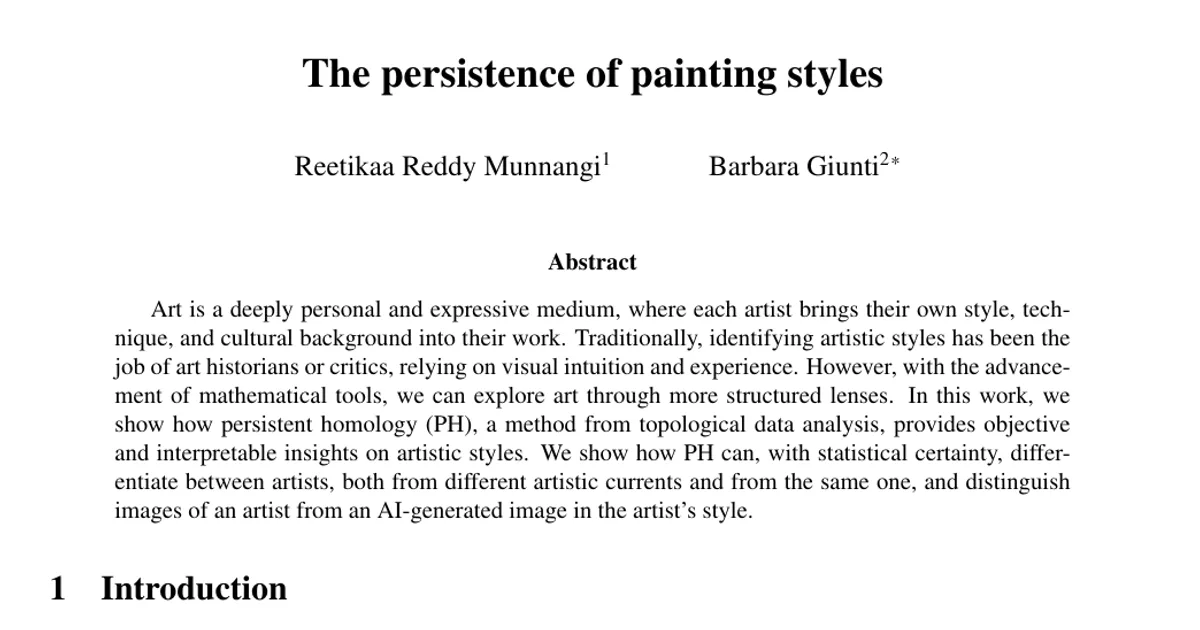
Authors’ abstract
Art is a deeply personal and expressive medium, where each artist brings their own style, technique, and cultural background into their work. Traditionally, identifying artistic styles has been the job of art historians or critics, relying on visual intuition and experience. However, with the advancement of mathematical tools, we can explore art through more structured lens. In this work, we show how persistent homology (PH), a method from topological data analysis, provides objective and interpretable insights on artistic styles. We show how PH can, with statistical certainty, differentiate between artists, both from different artistic currents and from the same one, and distinguish images of an artist from an AI-generated image in the artist's style.