Research
The Mechanics of Democratic Dominance: A System Dynamics Paradigm for Dynamic Consent Engineering
Overview Research area: Computational social science / political communication, specifically system dynamics applied to political persuasion (arXiv:2608.27509v2, physics.soc-ph). Technical level: Inte
- arXiv
- 2608.27509
- Published
- 2026-08-27
- Authors
- Muhammad Sukri Bin Ramli
AI summary
Overview
Research area: Computational social science / political communication, specifically system dynamics applied to political persuasion (arXiv:2608.27509v2, physics.soc-ph).
Technical level: Intermediate. The prose is accessible, but the framework relies on feedback-loop vocabulary (reinforcing and balancing loops, stocks, delays, carrying capacity) and presents differential equations, so some familiarity with system dynamics helps.
Scope: The paper is a purely conceptual and exploratory proposal — it offers a theoretical synthesis, symbolic formulations, and simulated reference modes, but no empirical estimation or predictive validation.
What This Paper Is About
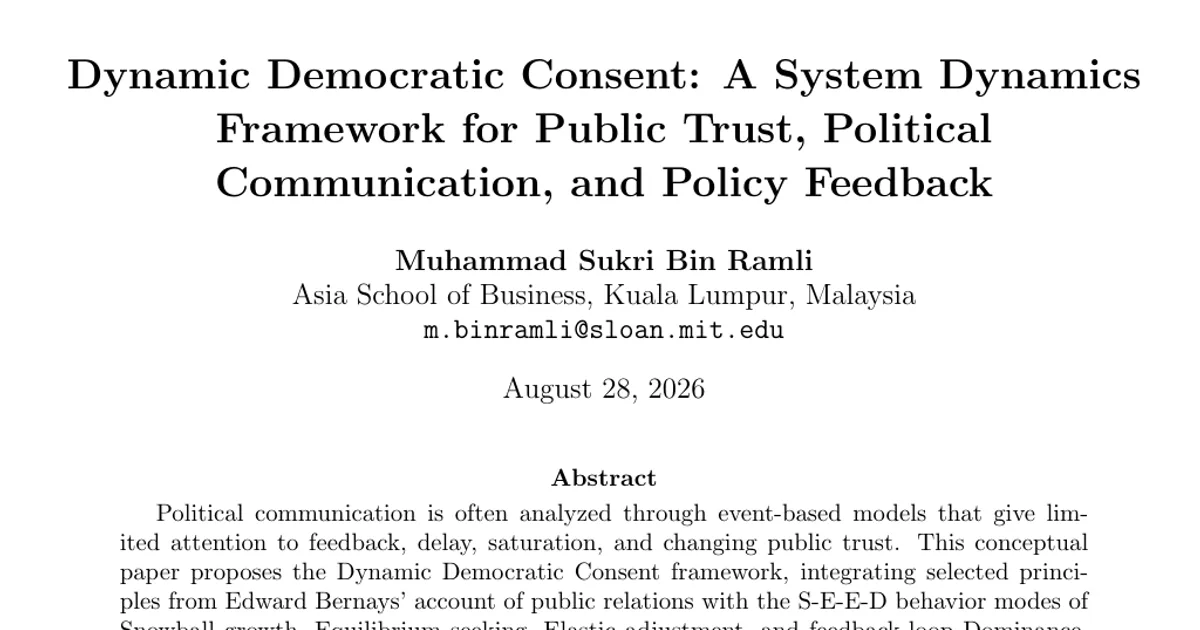
Most campaign analysis treats persuasion as a linear sequence of isolated events, assuming an advertisement, debate, or policy announcement produces a proportional and immediate shift in support. The paper argues this ignores feedback, delay, saturation, and shifting public trust, and it proposes instead to model political support as an interconnected dynamic system. Its goal is to build a shared analytical architecture — the Dynamic Democratic Consent (DDC) framework — that links political communication planning, policy feedback, institutional trust, and system-dynamics behavior modes, and to set out propositions that later empirical work could test.
Key Contributions
- The DDC framework itself. A synthesis combining selected principles from Edward Bernays' account of public relations with the S-E-E-D behavior modes of system dynamics: Snowball growth, Equilibrium seeking, Elastic adjustment, and feedback-loop Dominance.
- The expanded 4M Political Communication Resource Paradigm. An extension of Bernays' three resource constraints (Manpower, Mindpower, Money) with Media (algorithmic infrastructure) as a conditional fourth dimension, described as a dynamic amplifier influencing the perception delay constant rather than a deterministic engine.
- A structural mapping of Bernays' eight-step public relations process onto system-dynamics variables, organized into three phases — System Calibration, System Architecture, and Delay and Execution Control — with each step tied to a construct such as the reference support target, demographic carrying capacity, or perception delay.
- A four-stage political diagnostic pipeline (Current Trajectory, Loop Mapping, Policy Design, Projected Shift) plus a catalog of systemic failure modes and four normative ethical safeguards.
Main Findings
- Self-reinforcing momentum compounds, then saturates. The reinforcing loop R1 (Viral Momentum) formalizes media push raising voter sentiment, which accelerates mobilization into electorate support S(t), which generates digital shares that reinforce media reach. Unconstrained, this produces exponential growth; growth is then bounded by the balancing loop B1 (Saturation Ceiling), which operates through demographic carrying capacity K_dem and yields an S-shaped trajectory.
- Delayed perception produces oscillation. When campaign action responds to a smoothed perception stock P(t) rather than instantaneous support, the system becomes second-order. Underdamped oscillation occurs when (β·AT_p − 1)² < 4α·AT_p, meaning the delayed corrective response must be sufficiently strong relative to effective damping. The paper notes that aggressive responses to delayed polling data may contribute to overshooting and may interact with voter fatigue and opposition counter-mobilization.
- Attrition leaves a persistent shortfall. At steady state, S_eq = (α / (α + β)) · S*, so natural attrition β means support settles below the reference target unless corrective response is strong (α ≫ β) or an additional baseline support inflow exists.
- Trust adjusts the effective ceiling. The effective support ceiling is defined as K_effective(t) = K_dem [λ + (1 − λ) T(t)/100], with 0 ≤ λ ≤ 1 and T(t) the institutional trust stock on a bounded 0–100 index. Lower λ means greater sensitivity of attainable support to institutional trust; λ = 1 is the limiting case where trust does not alter demographic support capacity.
- Communication without delivery erodes trust. The balancing loop B2 (Trust Decay) formalizes Bernays' warning about unfulfilled expectations: scaling support generates publicity hype that widens the policy deficit when unbacked by governance deliverables, inducing trust erosion that dampens long-term support and increases vulnerability to overshoot and rapid decline.
- Two named failure pathologies. The Unbacked Performance Gap State, in which aggressive public relations mask unfulfilled promises, trust decays, and the effective support ceiling contracts below existing support levels, producing a drop in approval that communication adjustments alone cannot arrest. The Policy Resistance Plateau (Stagnant State), in which escalating advertising spend against compensating balancing loops — voter fatigue, media skepticism, opposition counter-mobilization — yields diminishing returns and locks approval into an underachieving plateau.
- Diagnosis plus a conceptual intervention. In the illustrative intervention scenario, a policy change at t = 20 is represented by a reduction in perception delay AT_p, a moderation of excessive reaction gain α, lower attrition β, and an elevated trust-formation rate that expands K_effective(t). Under those illustrative assumptions the trajectory moves from unstable polling oscillations to a smooth goal-seeking curve converging toward a higher sustainable support level.
- Loop dominance shifts, it does not transform. The S-shaped trajectory's inflection point marks a transfer of structural influence from R1 to B1 — in system-dynamics terminology, a change in which loop dominates, not a physical conversion of one loop into another.
- Model verification is qualitative here. Reference Mode Verification assesses whether internal loop structures qualitatively replicate behavioral modes, phase lags, inflections, and rhythms. Figure 9 is described as a synthetic benchmark illustrating the comparison procedure rather than empirical correspondence with any particular election.
Methodology in Plain English
The author does not collect or analyze data. The approach is theoretical construction: take Bernays' account of engineered public consent as the qualitative blueprint, take the S-E-E-D behavior modes from system dynamics as the mathematical architecture, and map one onto the other. Bernays' eight planning steps are aligned with specific model variables; a causal loop diagram organizes three feedback structures around the support stock S(t); and a set of simple differential equations, each isolating one mechanism (exponential growth, goal seeking, delayed perception, logistic saturation with a trust-adjusted ceiling, trust accumulation and erosion), illustrates the possible behaviors. The resulting figures are simulated reference modes — the paper states plainly that they serve an exploratory function to clarify feedback behavior, and that a subsequent stock-and-flow implementation would combine the mechanisms and evaluate their joint behavior under explicit parameter assumptions. A four-step diagnostic procedure is then proposed for applied use: describe the current trajectory, map the loops behind it, design interventions, and examine the projected shift.
Why This Matters
Impact on research. The paper targets a stated gap: political communication scholarship on framing, agenda-setting, computational propaganda, and policy feedback has developed largely separately from system dynamics, and the two have rarely been integrated into a common architecture. DDC offers a shared vocabulary and a set of testable propositions about momentum, saturation, delayed adjustment, trust erosion, and changes in loop dominance, giving later empirical studies something concrete to calibrate or falsify.
Real-world applications (as the framework describes them):
- Campaign planning across acquisition and retention phases, including deliberate management of the R1 → B1 dominance shift as a campaign matures.
- Polling interpretation and message-timing decisions, where recognizing perception delay AT_p could help avoid overcorrecting on stale data and triggering swing-voter fatigue.
- Diagnosing stalled or declining support, distinguishing an unbacked performance gap from a policy resistance plateau and pointing to policy delivery rather than additional advertising spend.
- Governance communication, where the framework's argument is that expectation alignment and substantive deliverables protect the institutional trust stock and therefore the attainable ceiling of support.
Industry relevance. The immediate audience is political consulting, campaign analytics, and public affairs, but the same loop structure (through the trust-adjusted capacity term) speaks to any organization managing reputational stock — corporate public relations, public-sector communications, and platform-adjacent messaging work. The four safeguards (transparency of message provenance and funding, protection of deliberative autonomy, prohibitions on predatory profiling or voter suppression, and preservation of contestability) also frame how practitioners and regulators might draw ethical boundaries around algorithmic micro-targeting.
Future Directions
- Specify a complete stock-and-flow model combining the modular equations, rather than the isolated reference-mode formulations presented here.
- Estimate parameters using named electoral datasets; the paper states no parameters have been econometrically estimated or calibrated.
- Test sensitivity to alternative functional forms — the simulated behavior depends on the chosen logistics for support growth and a linear trust-capacity relationship, and alternative nonlinear specifications may produce different trajectories and dominance conditions.
- Compare competing model structures and evaluate the framework across political and institutional contexts, including construct validity and measurement invariance for electorate support, perceived support, and institutional trust before parameters are estimated.
- Address endogeneity, since communication strategy, policy performance, public support, and institutional trust influence one another simultaneously, and the framework does not resolve causal identification.
- Conduct the ethical evaluation the abstract calls for, alongside comparative case testing.
Target Audience
Readers who benefit most are political communication and public opinion researchers looking for a systems-level alternative to event-based models; system dynamics practitioners interested in a political application of behavior modes and loop dominance; campaign strategists, pollsters, and public affairs professionals who want a structured way to think about timing, trust, and diminishing returns on messaging; and policy and governance scholars working on policy feedback and institutional trust. The paper is explicitly exploratory, so readers seeking empirical findings, calibrated estimates, or predictive accuracy will not find them here — the author states that empirical estimation, comparative case testing, sensitivity analysis, and ethical evaluation are required before the framework can support applied political analysis.
Authors’ abstract
Traditional frameworks of political communication operate under linear, event-driven assumptions that treat voter persuasion as a static, transactional function. This paper introduces Dynamic Consent Engineering (DCE), a novel interdisciplinary paradigm that synthesizes Edward Bernays' foundational principles of public relations with the S-E-E-D (Snowball, Equilibrium, Elasticity, Dominance) framework of system dynamics. By expanding Bernaysian operational constraints into a four-dimensional resource matrix (incorporating algorithmic media infrastructure alongside manpower, mindpower, and capital), we mathematically formalize how democratic institutions construct, optimize, and sustain political dominance. We map Bernays' classic eight-step engineering workflow directly onto non-linear feedback loops, information time lags, and demographic carrying capacities. Through rigorous modeling of systemic feedback structures, we isolate the dynamic root causes of political elasticity, policy resistance plateaus, and threshold-triggered trust collapses. Finally, we establish a four-step diagnostic pipeline and validate the framework via historical reference mode verification, demonstrating that long-term political stability depends not on ephemeral rhetoric, but on the structural synchronization of policy execution and dynamic feedback calibration.