Research
The Entropic Signature of Class Speciation in Diffusion Models
Overview Research area: Generative machine learning — specifically the theory of diffusion models, bridging information theory (conditional entropy) with statistical-physics accounts of phase transiti
- arXiv
- 2602.09651
- Published
- 2026-02-10
- Authors
- Florian Handke, Dejan Stančević, Felix Koulischer, Thomas Demeester, Luca Ambrogioni
AI summary
Overview
- Research area: Generative machine learning — specifically the theory of diffusion models, bridging information theory (conditional entropy) with statistical-physics accounts of phase transitions in sampling dynamics (stat.ML).
- Technical level: Advanced. The paper combines stochastic differential equations, Fokker–Planck formalism, high-dimensional Gaussian-mixture asymptotics, and entropy estimation in trained models.
- One-sentence scope: The paper proposes class-conditional entropy (and its time derivative) as a practical, estimable signature of the "class speciation" transition in diffusion models, validates it on Gaussian mixtures and on EDM2-XS and Stable Diffusion 1.5, and uses it to quantify how guidance redistributes semantic information over sampling time.
What This Paper Is About
Diffusion models do not resolve semantic structure evenly across the denoising process; instead they move from semantic ambiguity to class commitment within a narrow regime. Prior theory explains this as dynamical instability or symmetry breaking along class-separating directions, but there has been no simple, online quantity that detects this window in a trained model. The paper's goal is to show that the class-conditional entropy of a semantic variable given the noisy state acts as a reliable signature of these transition regimes, and that restricting it to semantic partitions lets it resolve specific decisions at different levels of abstraction.
Key Contributions
- Theory: The authors show theoretically that class-conditional entropy is an operational marker of speciation — it detects the transition in high-dimensional Gaussian mixtures and also the more general speciation times introduced by Achilli et al. (2026), including cases where classes are not separated by first moments alone.
- Estimator: They demonstrate that this entropy signal can be estimated in trained diffusion models, allowing isolation of when specific semantic elements emerge, using an iterative backward posterior-propagation procedure.
- Guidance analysis: They use the framework to analyze how guidance redistributes semantic information over time, producing a time-resolved view of guidance's effect consistent with prior findings on its time-dependent effectiveness (Kynkäänniemi et al., 2024).
- Partitioned entropy tooling: They introduce a partitioned class-conditional entropy over non-exhaustive binary class partitions, which isolates specific semantic branches that the full K-ary entropy blurs together.
Main Findings
- Entropy production has an exact decomposition: The time derivative of class-conditional entropy ∂/∂t H(Z|X_t) equals (g_t²/4) Σ_{r,s} p(Z=r) ℰ_{r,s}(t), where ℰ_{r,s}(t) depends on posterior mass γ_s and the squared gap between score fields s_r and s_s.
- Three-regime mechanism: Both posterior competition and score separation are governed by the same pairwise control parameter λ_ik(t) = ||Δ_ik(t)||²/v(t). When λ ≫ 1 the competing class's posterior weight is exponentially suppressed; when λ ≪ 1 the score gap has collapsed; contributions are only appreciable in the intermediate regime λ = O(1).
- VP speciation scale matches prior theory: For the variance-preserving process with α_t = e^{-t} and σ_t² = 1 − e^{-2t}, λ_ik(t) ≈ d·e^{-2t}, giving t_s(d) = (1/2) log d + O(1), matching the speciation time predicted by Biroli et al. (2024). In rescaled time u = t/t_s(d), entropy production localizes increasingly around u = 1 as dimension grows.
- VE-EDM behaves differently: For EDM parameterization (α_t ≡ 1, v(t) = σ_0² + t²), λ_ik(t) ≈ d/(σ_0² + t²) and t_s(d) ≈ √d, but after rescaling, λ remains of order u^{-2}, so the transition does not sharpen around u = 1 with dimension — it stays spread over an O(1) range in rescaled time, i.e. a window of width O(√d) on the original time axis. The authors state the practical significance of this difference is currently unclear.
- General class structure: Following the Achilli et al. (2026) decomposition p_0(a) = Σ_r w_r P_r(a), log-odds take the form log(w_r/w_s) + d(f_rr(t) − f_rs(t)) + fluctuation terms; speciation occurs when the deterministic free-entropy gap and the fluctuation term become comparable — precisely when entropy production peaks.
- Empirical localization on ImageNet: With EDM2-XS, entropy production is confined to an intermediate interval of diffusion, and most classes show a similar unimodal profile centered around a common noise range. Systematic class-dependent deviations exist: tiger shark is shifted toward higher noise levels and sustained over a broader interval, while paintbrush peaks at substantially lower noise.
- Guidance redistributes information: Guidance restricted to the FD_DINOv2-optimal interval shifts entropy production toward higher noise levels and suppresses it at lower ones, accelerating speciation for most classes. Guidance within the FID-optimal interval has no such strong effect because entropy production has already mostly collapsed there. Guidance applied across the full trajectory produces a pronounced shift toward high-noise stages with a relatively uniform information shift. The effect is most pronounced for classes whose unguided entropy production overlaps the guided interval (e.g. tiger shark) and largely absent for classes whose entropy production is limited to low noise.
- Attribute timing in Stable Diffusion 1.5: Low-frequency decisions such as "with blue walls" or "in black and white" exhibit early and rapid entropy decay (commitment at high noise levels), whereas localized high-frequency attributes such as a cat or a window show slower entropy collapse. In the sampled sequence, the blue-wall and black-and-white decisions appear resolved first, window structure emerges next, and all semantic decisions are made only at the final snapshot.
Methodology in Plain English
The authors treat the forward diffusion process as a noisy channel that gradually destroys the class label Z, and the reverse process as an attempt to recover it. They derive, in closed form for isotropic Gaussian mixtures, how much uncertainty about the class remains at each noise level, and they show analytically when that uncertainty collapses fastest. To move from theory to trained models, they exploit the Markov structure of the forward process together with the availability of both conditional and unconditional denoisers (Koulischer et al., 2025a): starting from a noisy state, they run the reverse trajectory and iteratively update class posteriors backward using local log-likelihood increments computed from squared reconstruction errors of the model's noise or noiseless-data predictions. The entropy is then obtained by Monte Carlo averaging over sampled trajectories. Because a one-versus-complement partition is highly imbalanced (|S_0| = 1 while |S_1| = K − 1 under equiprobable priors, and effectively infinite for text-to-image), they set priors to 0.5 regardless of the partition — yielding a Jensen–Shannon-divergence-style separability measure — and in the one-versus-complement setting they use the unconditional model as a proxy for the complement. They validate on synthetic Gaussian mixtures, EDM2-XS trained on ImageNet-512, and Stable Diffusion 1.5 trained on LAION-5B, using FID and FD_DINOv2 to identify empirically optimal guidance intervals.
Why This Matters
- Impact on research: The work supplies a missing operational link between information-theoretic descriptions of diffusion and the statistical-physics picture of symmetry breaking, giving a quantity that can be computed on real trained models rather than only analyzed in idealized settings. It also offers a concrete diagnostic that complements empirical findings on guidance's limited effectiveness in low- and high-noise regimes (Kynkäänniemi et al., 2024; Koulischer et al., 2025b).
- Real-world applications (potential, as implied by the framework):
- Scheduling guidance strength only within the noise interval where semantic commitment actually occurs, rather than across the whole trajectory.
- Diagnosing which semantic attributes a text-to-image model resolves early versus late, useful for prompt engineering and debugging.
- Auditing trained samplers for where and when class-specific features form, without retraining.
- Comparing architectures or noise schedules (e.g., VP versus VE-EDM parameterizations) by how sharply they localize semantic transitions.
- Industry relevance: Any pipeline built on classifier-free guidance — including GLIDE, Imagen, DALL·E-style systems, and latent-diffusion models such as Stable Diffusion — could in principle use a time-localized entropy probe to allocate compute and guidance more efficiently. The authors explicitly frame their results as "a principled basis for time-localized control." Note that the paper reports no deployed-system deployment or FID/quality numbers for such interventions beyond the guidance-interval experiments.
Future Directions
- Scaling to stronger text-to-image models: Extending the analysis to Stable Diffusion XL or Stable Diffusion 3, since Stable Diffusion 1.5's limited fine-detail generation and the large distributional shifts induced by prompt modifications complicate isolation of individual attributes.
- External feature detectors: Incorporating models trained specifically to detect features into the estimation pipeline, rather than relying only on the model's own conditional versus reference predictions.
- Formal theory of guidance: Establishing a more rigorous characterization of how guidance controls the magnitude and timing of entropy redistribution along the sampling trajectory — currently described as an open problem.
- Interpretation of the VP/VE-EDM discrepancy: Determining whether the failure of the VE-EDM transition to sharpen with dimension has implications for inference, training, or control.
Target Audience
Researchers and graduate students working on diffusion model theory, generative modeling, or the statistical-physics/information-theory of sampling dynamics. It is particularly relevant to those interested in guidance mechanisms, noise-schedule design, sampling efficiency, and interpretability of generative models. Practitioners who tune classifier-free guidance schedules may benefit from the empirical profiles, though the derivations assume comfort with SDEs, entropy, and high-dimensional asymptotics.
Authors’ abstract
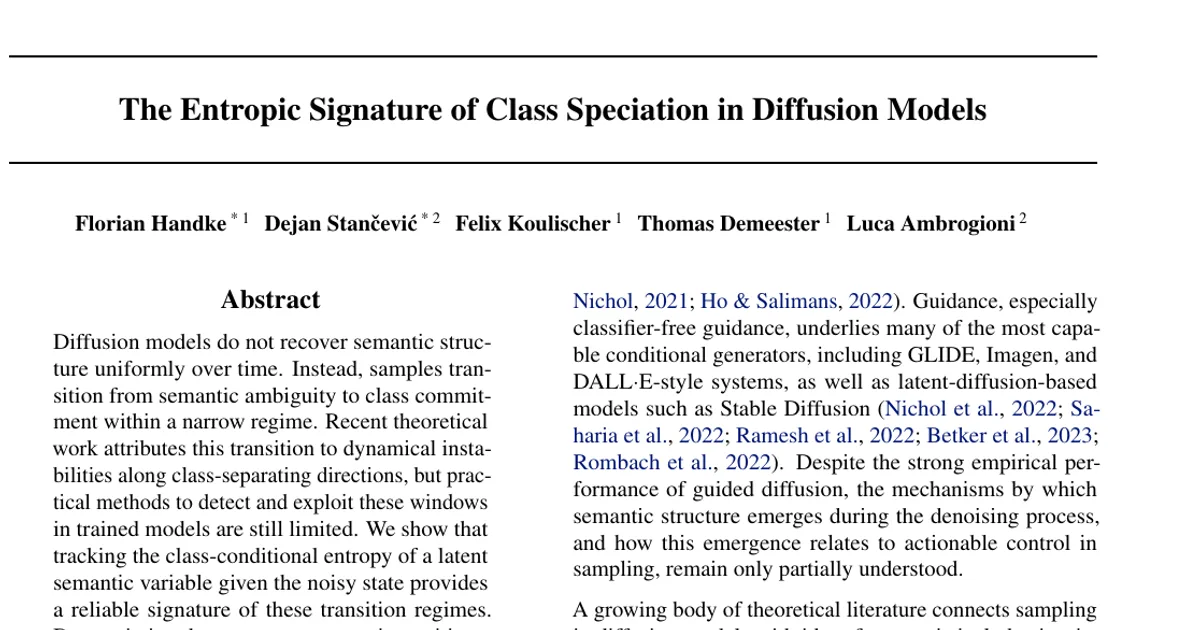
Diffusion models do not recover semantic structure uniformly over time. Instead, samples transition from semantic ambiguity to class commitment within a narrow regime. Recent theoretical work attributes this transition to dynamical instabilities along class-separating directions, but practical methods to detect and exploit these windows in trained models are still limited. We show that tracking the class-conditional entropy of a latent semantic variable given the noisy state provides a reliable signature of these transition regimes. By restricting the entropy to semantic partitions, the entropy can furthermore resolve semantic decisions at different levels of abstraction. We analyze this behavior in high-dimensional Gaussian mixture models and show that the entropy rate concentrates on the same logarithmic time scale as the speciation symmetry-breaking instability previously identified in variance-preserving diffusion. We validate our method on EDM2-XS and Stable Diffusion 1.5, where class-conditional entropy consistently isolates the noise regimes critical for semantic structure formation. Finally, we use our framework to quantify how guidance redistributes semantic information over time. Together, these results connect information-theoretic and statistical physics perspectives on diffusion and provide a principled basis for time-localized control.