Research
The Double Contingency Problem: AI Recursion and the Limits of Interspecies Understanding
Overview Research area: Artificial intelligence, specifically bioacoustic AI and cross-species communication, combined with philosophy of technology (drawing on Yuk Hui's work on recursivity, continge
- arXiv
- 2511.08927
- Published
- 2025-11-12
- Authors
- Graham L. Bishop
AI summary
Overview
Research area: Artificial intelligence, specifically bioacoustic AI and cross-species communication, combined with philosophy of technology (drawing on Yuk Hui's work on recursivity, contingency, and "cosmotechnics").
Technical level: Intermediate. The paper contains no mathematics, code, or experiments, so it is accessible in that sense, but it is conceptually dense and assumes familiarity with transformer architectures, foundation models, and philosophical vocabulary.
Scope: This is a theoretical and conceptual position paper arguing that AI systems are themselves recursive cognitive agents whose processing may systematically distort other species' communication, and proposing "inter-recursive interfaces" as an alternative design and evaluation paradigm.
What This Paper Is About
Bioacoustic AI systems (foundation models, transformer architectures, classifiers) achieve strong cross-species performance by finding statistical patterns in animal vocalizations. The paper argues this success treats AI as a neutral pattern detector, when in fact AI systems process signals through their own recursive computational loops, training objectives, and architectural biases. The goal is to reframe bioacoustic AI as an encounter between two different forms of recursive cognition and to sketch what a more respectful, "diplomatic" alternative would look like.
Key Contributions
- Names and defines the "double contingency problem." Each species' communication emerges from contingent ecological, evolutionary, and social conditions, while AI systems process those signals through their own contingent architectural and training conditions. The result is not neutral analysis but a collision between two forms of recursive cognition.
- Reframes AI systems as recursive cognitive agents rather than neutral tools. The paper defines "recursive cognition" as the looping of information back into a system's own processing—attention layers building on prior layers, optimization cycles updating parameters from prediction errors, and contextual feedback shaping future responses—and argues these are contingent, not universal, computational principles.
- Proposes "inter-recursive interfaces" based on diplomatic encounter rather than extraction. Unlike translation (which assumes eventual commensurability) or domination (which imposes one framework), diplomatic encounter maintains the autonomy of different recursive processes while enabling interaction.
- Introduces new evaluation criteria and a meta-recursive monitoring concept. The paper proposes recursive fidelity, inter-recursive stability, and diplomatic reciprocity in place of accuracy, F1-scores, and cross-species transfer, plus a monitor that tracks how a model's own recursive constraints (temporal windowing, training priors, architectural biases) may distort species-specific recursive structures. It also argues for "metrics for recursive interference," which it describes as a direction for future technical development.
Main Findings
- Pattern abstraction has limits: Transformer attention mechanisms typically operate over fixed-length windows (seconds to minutes), while the paper claims elephant contact calling sequences may unfold meaningful patterns across days or weeks of herd movement. The paper reports no quantitative measurements of this mismatch; it is an argued conceptual claim.
- Species-specific classifiers still abstract away recursion: The paper cites Pardo et al. and Oren et al., who used species-specific random forest classifiers to identify individually distinct elephant calls and marmoset vocal labels, requiring extensive contextual data including behavioral responses, spatial patterns, and family structures. It also cites Arnon et al., who applied transitional probability methods to discover emergent statistical structure in whale song over 8 years, respecting the temporal scales of cultural transmission. The paper argues that even these still analyze acoustic features abstracted from recursive ecological and social processes.
- AI architectures are contingent, not universal: Training across methods involves recursive optimization—iteratively updating parameters or refining probability estimates based on prediction errors—under specific research contexts, training datasets, optimization objectives, and evaluation metrics. The paper argues these are "not universal computational principles."
- Recursive cosmotechnics differ irreducibly across species: Drawing on Hui, the paper claims elephant infrasonic coordination involves recursive loops between individual calls, herd responses, and multi-generational social memories structured by savanna acoustic conditions and seasonal migration; whale song development involves recursive elaboration of melodic themes over time scales spanning years, coordinated with oceanic acoustic properties and social breeding contexts.
- Standard evaluation becomes inappropriate: Accuracy, F1-scores, and cross-species transfer are argued to be the wrong measures for inter-recursive interfaces, which would instead be assessed on relational sustainability and long-term ecological impacts.
- No empirical results are reported. The paper presents no experiments, datasets, benchmarks, or numerical outcomes. The author explicitly states that implementation remains uncertain, that the framework critiques current approaches without providing clear architectural alternatives, and that empirical validation is difficult.
Methodology in Plain English
This is a conceptual and argumentative paper, not an experimental one. The author proceeds by:
- Surveying existing bioacoustic AI approaches—foundation models such as NatureLM-audio (which transfers learned representations from human speech to animal vocalizations) and BioLingual (which aligns acoustic patterns with human language descriptions), plus species-specific random forest classifiers and statistical segmentation methods.
- Importing a philosophical framework from Yuk Hui about recursivity and contingency—specifically the idea of a "looping movement of returning to itself in order to determine itself, while every movement is open to contingency."
- Using that framework to argue that AI systems are recursive cognitive agents whose own contingency may interfere with reading other species' recursive structures.
- Sketching, rather than building, an alternative: inter-recursive interfaces, illustrated through a case study of African elephant infrasonic communication, where a species-facing module would model long temporal rhythms of herd life and a meta-recursive monitor would track the AI's own assumptions.
- Extending the argument to methodology and institutions—proposing participatory engagement, non-intrusive playback experiments, collaborative development with ethologists, conservation practitioners, and local communities, and new institutional arrangements.
Why This Matters
Impact on research: The paper challenges the assumption that better model internals lead to better understanding of data, which underlies standard interpretability methods (attention visualization, feature attribution) and uncertainty quantification methods (Bayesian approaches, ensemble disagreement). It argues the contribution of biosemiotics and ethology—which already recognize meaning-making as contextually embedded across species—does not cover the specific new obstacle created by AI architectures' own contingent recursivity.
Real-world applications (as proposed in the paper):
- Supporting safer migration routes through better understanding of long-distance coordination in elephants.
- Enriching conservation management by respecting existing communicative patterns rather than overriding them.
- Non-intrusive playback experiments testing whether synthesized calls aligned with a herd's recursive rhythms are ignored, incorporated, or destabilizing.
- Informing governance frameworks that address the recursive autonomy of species' communicative systems, not just AI impact on animal welfare.
Industry relevance: The paper is a critique of the dominant foundation-model paradigm—single unified models built around transferable representations—and suggests distributed systems that maintain multiple, incommensurable recursive processes with interfaces between them, plus explicit modeling of a system's own recursive constraints and biases. It also notes the framework may be incompatible with current funding and publication structures and may not scale to conservation applications requiring broad taxonomic coverage or rapid environmental monitoring.
Future Directions
- Pilot implementations: Testing inter-recursive principles in specific contexts where sustained interspecies engagement practices already exist, starting with extensive preliminary study to establish baseline recursive patterns and protocols developed with elephant welfare experts.
- Operationalizing recursive interference metrics: Developing ways to quantify when a model's processing patterns are systematically misaligned with the temporal, spatial, or social scales at which species organize communication, requiring collaboration between machine learning practitioners and ethologists.
- Architectural alternatives: The paper does not specify how inter-recursive interfaces would function computationally; it calls for architectures with meta-recursive capabilities that recognize when their own cognitive patterns interfere with understanding other forms of recursive organization.
- Institutional innovation: Creating structures that accommodate extended time scales, collaborative development processes, and evaluation based on relational sustainability rather than immediate technical performance, including partnerships with Indigenous communities, wildlife sanctuaries, and conservation organizations.
Target Audience
Readers who will benefit most are AI researchers working on bioacoustics, foundation models, or cross-species machine learning; ethologists and conservation practitioners collaborating with AI teams; philosophers and social scientists studying interspecies understanding, biosemiotics, and the epistemology of AI; and research funders or policymakers interested in how AI governance might address non-human communicative autonomy. Readers looking for concrete architectures, benchmarks, or empirical validation will not find them here—the paper explicitly identifies those as unresolved gaps.
Authors’ abstract
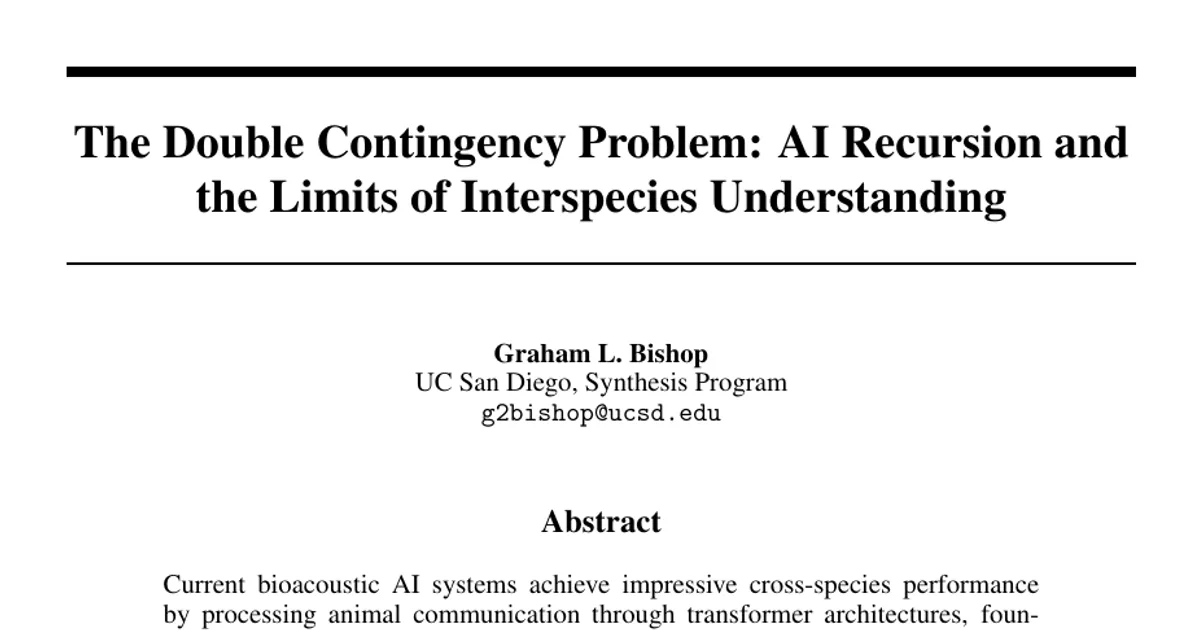
Current bioacoustic AI systems achieve impressive cross-species performance by processing animal communication through transformer architectures, foundation model paradigms, and other computational approaches. However, these approaches overlook a fundamental question: what happens when one form of recursive cognition--AI systems with their attention mechanisms, iterative processing, and feedback loops--encounters the recursive communicative processes of other species? Drawing on philosopher Yuk Hui's work on recursivity and contingency, I argue that AI systems are not neutral pattern detectors but recursive cognitive agents whose own information processing may systematically obscure or distort other species' communicative structures. This creates a double contingency problem: each species' communication emerges through contingent ecological and evolutionary conditions, while AI systems process these signals through their own contingent architectural and training conditions. I propose that addressing this challenge requires reconceptualizing bioacoustic AI from universal pattern recognition toward diplomatic encounter between different forms of recursive cognition, with implications for model design, evaluation frameworks, and research methodologies.