Research
The Attention Triangle in Audio-Video Models
Overview Research area: Generative audio-video diffusion models and the interpretability/control of cross-modal attention — specifically, how semantic information is routed between text, audio, and vi
- arXiv
- 2609.03586
- Published
- 2026-09-03
- Authors
- Sagi Polaczek, Noa Kraicer, Gal Metzer, Zhuo Ning, Ali Mahdavi-Amiri, Daniel Cohen-Or, Raja Giryes
AI summary
Overview
Research area: Generative audio-video diffusion models and the interpretability/control of cross-modal attention — specifically, how semantic information is routed between text, audio, and video tokens during denoising.
Technical level: Advanced. The paper works directly with Diffusion Transformer (DiT) cross-attention matrices, pre-softmax attention biases, and Markov-chain-style attention rollout, and assumes familiarity with diffusion sampling and multimodal conditioning.
Scope in one sentence: The paper diagnoses sound-to-source "leakage" in joint text-to-audio-video generators as a structured, bias-driven routing problem across three cross-attention edges, then proposes a training-free inference-time intervention that steers all three edges simultaneously.
What This Paper Is About
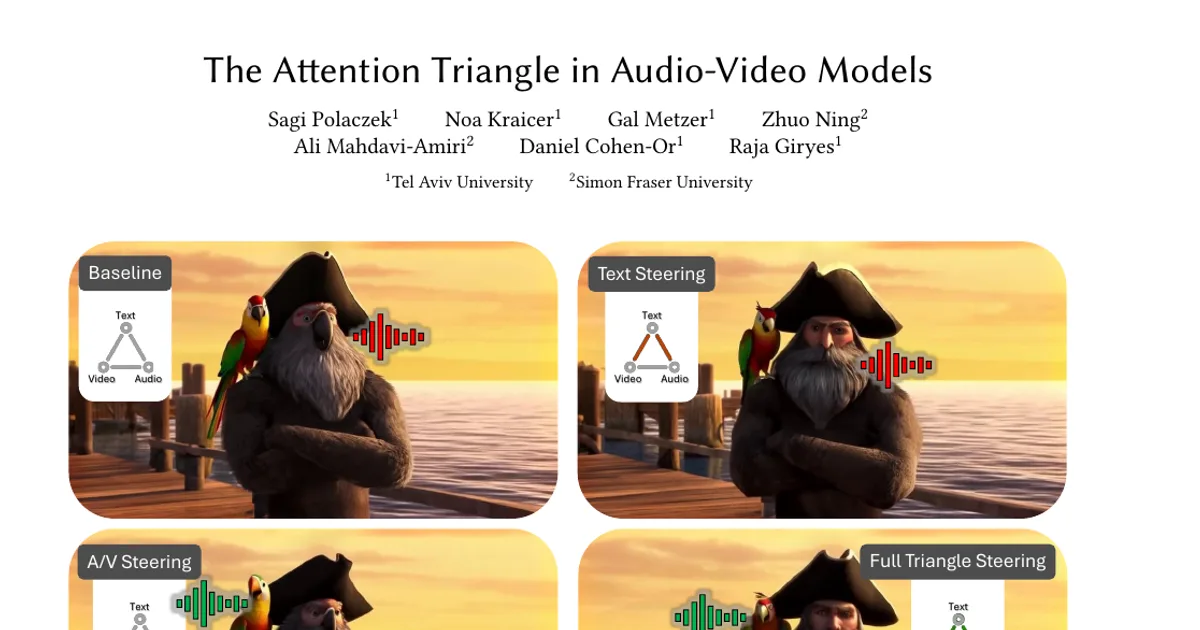
Joint audio-video diffusion models use cross-attention to coordinate text, sound, and visuals, but the same mechanism lets semantic content bleed between entities and modalities — for example, the prompt "a parrot sitting on the shoulder of a pirate, the parrot is talking" reliably produces a speaking pirate instead of a talking parrot. The authors abstract the model's conditioning pathways as an "attention triangle" of three cross-attention edges (text-video, text-audio, and audio-video) and ask which edge is responsible for these failures and whether it can be corrected at inference time without retraining. Their goal is both diagnostic (exposing how semantics are routed and mis-grounded) and corrective (a training-free steering method that restores correct appearance and correct sound attribution).
Key Contributions
-
Formalization of the attention triangle. The paper defines three cross-attention edges connecting text, audio, and video token populations and associates each with a pre-softmax additive bias matrix:
B_{T→V},B_{T→A}, and the bidirectional pairB_{A↔V}(withB_{V→A} = B_{A→V}^T). It highlights that a text attribute can reach video both directly and indirectly through audio, and vice versa. -
Evidence that the audio-video edge is the weak link. Through attention visualizations, controlled attention interventions, and ablations on LTX-2 (including its audio-free variant, which shares the same backbone), the authors identify the audio-video pathway as a major contributor to semantic leakage. They hypothesize this partly stems from audio tokens encoding temporal but not spatial position, so cross-modal correspondence leans on learned semantic compatibility rather than explicit spatial alignment.
-
Attention-derived diagnostic signals. The paper extracts first-order signals from the video-query/audio-key attention matrix
P_VAand second-order signals from an audio-mediated video-to-video rolloutP^{eff}_{VV} = P^{(ℓ)}_{VA} P^{(ℓ+1)}_{AV}, then uses these to deliberately induce leakage under controlled conditions and to isolate individual cross-modal interactions. -
A training-free, inference-time steering method. Ours-Full applies additive logit biases to all three triangle edges during denoising, using anchors derived once from the unsteered baseline pass. Partial variants — Ours-Text (text edges only) and Ours-AV (audio-video edge only) — serve as controlled ablations showing that all three edges must be steered jointly.
Main Findings
-
The audio-video edge is bidirectional. Audio can influence video generation, and video can influence audio generation; the edge is shaped by biases encoded in the model's parameters.
-
Leakage is structured, not merely attention spreading. When prompts are in tension with learned priors, cross-modal interactions can override the intended conditioning and reroute semantics toward visually canonical but incorrect outcomes.
-
Second-order audio-mediated misrouting is observable. Seeding a uniform distribution over the parrot's visual region and propagating it through
P^{eff}_{VV}moves mass from the parrot patches to the pirate after the round trip through audio; after steering, the mass returns to the parrot. The intermediate video-to-audio hop is reported as diffuse rather than peaked, which the authors attribute to the 1D-to-2D dimensional mismatch. -
Partial steering is insufficient. In the pirate-parrot example, Ours-Text restores the pirate's appearance but leaves speech on the pirate; Ours-AV correctly localizes speech to the parrot but appearance leakage persists; only Ours-Full resolves both. The same decoupling is shown for a horse-neigh prompt where the neigh should come from the knight.
-
Four recurring leakage modes are identified across open-domain scenarios: source-attribution leakage, appearance leakage, voice-characteristic leakage, and generation suppression (the requested sound is omitted entirely).
-
Source-attribution improves. Using a counterbalanced five-option Qwen3-Omni judge, Ours-Full obtains the highest mean source-attribution score of 0.1349, versus 0.1216 for native LTX-2, 0.1207 for Ovi, 0.0925 for an adapted Bounded Attention baseline, 0.1140 for Ours-Text, and 0.1302 for Ours-AV. The video-only diagnostic baseline has no audio and is not scored.
-
Broader preference evaluation favors the full method. On the VA-Judger evaluation (prompt fidelity, audiovisual consistency, audio quality, video quality, completeness), Ours-Full is preferred over every alternative with mean preference scores ranging from 57.6% to 73.3%, with all pair-bootstrap 95% confidence intervals above 50%.
-
Fidelity is largely preserved. Ours-Full attains the best VBench scores for subject consistency (0.990), background consistency (0.986), and aesthetic quality (0.604), while remaining competitive on CLAP (0.383 vs. 0.384 for the closest baseline), which the authors read as no large degradation in the measured fidelity metrics. CLAP values are reported as Native LTX-2 0.375 ± 0.187, Ovi 0.357 ± 0.187, Bounded Attention 0.384 ± 0.198, Ours-Text 0.374 ± 0.188, Ours-AV 0.384 ± 0.189, and Ours-Full 0.383 ± 0.185.
-
The source-attribution score is defined as 1 minus conditional leakage — the conditional probability that only the intended visible entity produced the audible target event.
-
Cost. Ours-Full requires one additional full denoising trajectory to extract baseline anchors, plus frame decoding and SAM3 for visual anchors, giving roughly 2.5× the cost of unsteered generation.
Methodology in Plain English
The authors treat a joint audio-video generator (LTX-2) as a three-way system in which text, audio, and video tokens talk to each other through cross-attention. Rather than editing weights, they watch what the model attends to and then nudge it.
First, they look at where the sound is "pointed." For each video location, they sum its attention to speech-active audio tokens and overlay that score on a frame. On leakage prompts, the highest scores land on the wrong subject.
Second, they chain two attention hops together — video queries looking at audio keys, then audio queries looking at video keys — to reveal indirect, audio-mediated influence between visual regions that no single attention matrix shows on its own. This exposes mass migrating from the intended source to the visually canonical one.
Third, they test by ablation. Because LTX-2 ships in audio-free and joint variants sharing the same backbone, they compare the two: failures present with audio are absent without it.
For the fix, they build masks once from an unsteered baseline pass and hold them fixed. A user annotates the intended sound source, the sound or action, and optionally a competing source in the prompt. Video regions for the intended and competing sources come from running SAM3 on baseline frames, binarized at 0.5 and resized to the latent grid. Audio "sound" regions come from aggregating audio-query/text-key attention toward the sound phrase, normalized to [0,1] and thresholded at θ_A = 0.3. From these, an agreement matrix G_VA marks which video-audio pairs should be compatible. During every denoising step, additive logit biases reinforce intended text pairings (β = 0.5), suppress conflicting ones (γ = 2.0), and penalize mismatched source-sound audio-video pairs (λ = 10). These four values are fixed across all LTX-2 experiments and not tuned per prompt. The asymmetric weighting deliberately puts more weight on suppression than on reinforcement.
Why This Matters
Impact on research. The paper reframes cross-modal leakage from "attention spreading too far" into a structured routing problem tied to specific pathway biases, and it shows that leakage can be both deliberately induced (as a diagnostic) and mitigated (as an intervention) without any training or auxiliary losses. It also extends the study of attribute leakage from the text-to-image domain into a trimodal setting where a fundamentally different failure appears: a 1D audio temporal embedding attending to a 3D spatiotemporal positional embedding.
Real-world applications. The paper does not report deployed products or dataset sizes, but its setup implies uses such as:
- Film, advertising, and game asset pipelines where a specified character must produce a specified sound, and misattribution means costly reshoots or manual editing.
- Accessibility and dubbing tools where speech must be bound to the correct on-screen speaker.
- Content-generation QA, where the attention-derived signals could act as an automatic leakage detector.
- Interactive creative tools that need prompt-specified source binding without reference inputs or retraining.
Industry relevance. The intervention is training-free and model-agnostic in its design intent, so it can be layered onto an existing frozen generator; the reported ~2.5× inference cost is the main practical trade-off. The diagnostic signals also give model builders a way to audit whether cross-modal priors are overriding user intent.
Future Directions
- Is temporal-only positional encoding the actual cause? The paper explicitly states that its interventions do not establish temporal-only positional encoding as the pathway's unique failure mechanism, leaving that as an open question.
- Reducing the 2.5× overhead. The anchor-extraction pass (a full extra denoising trajectory plus SAM3 segmentation) is the dominant cost; whether anchors can be obtained more cheaply, or reused across seeds, is not addressed.
- Eliminating reliance on user annotation. The method requires annotating the intended source, sound/action, and optional competing source in the prompt, and depends on SAM3 for visual masks where a reliable segmenter exists. Automatic anchor discovery is a natural next step.
- Generalization beyond the studied model. The quantitative evaluation is instantiated on LTX-2 (with Ovi as an external baseline comparison); whether the same triangle structure and steering recipe transfer to other dual-stream designs such as JavisDiT, SyncFlow, AV-Link, or Veo 3 is not reported.
Target Audience
Researchers and engineers working on multimodal diffusion transformers, cross-modal attention control, and audio-video generation, as well as practitioners who need reliable sound-source attribution in generative video pipelines. Readers without a background in attention mechanics or diffusion sampling will find the diagnostic formulas and bias-matrix formulations difficult, though the pirate-and-parrot and knight-and-horse examples make the core phenomenon easy to grasp.
Authors’ abstract
Audio-video diffusion models rely on cross-modal attention to coordinate text, sound, and visual content, yet this same mechanism can introduce subtle and systematic semantic leakage. We study these models by probing and analyzing the ``attention triangle,'' comprising the three cross-attention edges connecting the text, audio, and video streams, and examine how semantic information is routed across modalities during generation. Our analysis reveals that routing along the audio-video edge is bidirectional: audio can influence video generation, while video can influence audio generation. This edge is shaped by biases encoded in the model's parameters and emerges as a major contributor to leakage: when prompts are in tension with learned priors, cross-modal interactions may override the intended conditioning and reroute semantics toward visually canonical but incorrect outcomes. These effects suggest that semantic artifacts arise not merely from attention spreading beyond its intended target, but from structured, bias-driven interactions along specific pathways. Building on this perspective, we extract attention-derived signals that expose how semantics are distributed and grounded across modalities, and use them as a diagnostic tool to both analyze and deliberately incur leakage under controlled conditions. This enables us to probe the internal dynamics of cross-modal routing and isolate the role of individual interactions. We further leverage these signals to guide inference-time interventions that encourage more consistent cross-modal alignment. Extensive experiments support our analysis and demonstrate improved semantic grounding while preserving generation quality.