Research
TFusionOcc: T-Primitive Based Object-Centric Multi-Sensor Fusion Framework for 3D Occupancy Prediction
Overview Research area: 3D semantic occupancy prediction for autonomous driving, combining surround-view cameras and LiDAR through an object-centric (primitive-based) representation rather than a dens
- arXiv
- 2602.06400
- Published
- 2026-02-06
- Authors
- Zhenxing Ming, Yaoqi Huang, Julie Stephany Berrio, Mao Shan, Stewart Worrall
AI summary
Overview
Research area: 3D semantic occupancy prediction for autonomous driving, combining surround-view cameras and LiDAR through an object-centric (primitive-based) representation rather than a dense voxel grid.
Technical level: Advanced. The method builds on probabilistic modeling (Student's t-distribution, T-mixture models), superquadric shape parameterization, deformable basis-field warping, and transformer-based 3D deformable attention.
Scope: This paper proposes TFusionOcc, a framework that replaces Gaussian-based object primitives with a family of Student's t-distribution-based "T-primitives" and integrates them with a multi-stage camera-LiDAR fusion pipeline for 3D semantic occupancy prediction.
What This Paper Is About
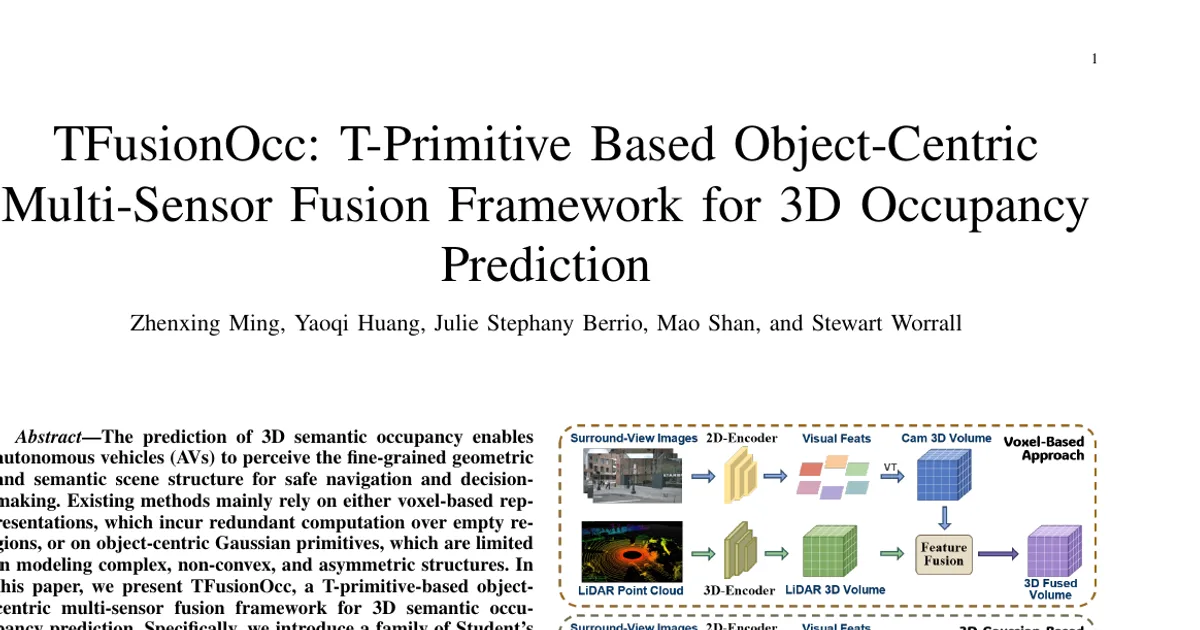
Existing multi-sensor occupancy predictors split into two camps. Voxel-based methods are accurate but waste computation on the empty regions that dominate outdoor driving scenes, while object-centric methods that use 3D Gaussian primitives are more efficient but struggle with non-convex, asymmetric, and irregular structures, and tend to be less robust to outliers and long-tailed spatial distributions. TFusionOcc's goal is to keep the efficiency advantage of object-centric modeling while closing the geometric accuracy gap against strong voxel-based methods, by introducing T-distribution primitives whose key member — a deformable T-Superquadric with inverse warping — can bend, twist, and shear to fit irregular shapes.
Key Contributions
-
A family of T-primitives. The paper introduces Student's t-distribution-based primitives: the plain T-primitive, the T-Superquadric, and a deformable T-Superquadric with inverse warping. The deformable variant is presented as the key geometry-enhancing primitive, improving representation of non-convex and asymmetric structures.
-
A unified probabilistic formulation. Occupancy and semantics are jointly modeled using the Student's t-distribution and a T-mixture model (TMM), which the authors argue improves robustness to outliers and real-world noise and alleviates the limits of Gaussian-based primitives on long-tailed spatial distributions.
-
A tightly coupled multi-sensor fusion pipeline. The pipeline includes fused-depth-guided visual feature lifting, transformer-based T-primitive-centric refinement, and a GCWSFusion module (Gate-Concatenation and Weight-Summation Fusion) for adaptive cross-modal interaction, so T-primitives can exploit camera and LiDAR cues.
-
Evaluation coverage. Extensive experiments on nuScenes are reported as achieving state-of-the-art overall performance, with additional nuScenes-C evaluations demonstrating robustness under most corruption scenarios. The paper also reports that primitive shape flexibility matters more than simply increasing the primitive count.
Main Findings
-
State-of-the-art on nuScenes: The abstract and introduction state that TFusionOcc achieves state-of-the-art overall performance on nuScenes. No numeric metric values are reported in the provided paper content.
-
Geometry flexibility beats primitive count: The authors report that the flexibility of primitive shapes is more decisive than merely increasing the number of primitives, which they frame as evidence for the importance of geometry-aware primitive design.
-
Consistent benefit from stronger primitive geometry: Results are described as consistently improving as the primitive geometry becomes stronger (plain T-primitive, then T-Superquadric, then deformable T-Superquadric with inverse warping). Specific ablation numbers are not reported in the provided content.
-
Robustness on nuScenes-C: Additional evaluations on nuScenes-C show strong robustness under most corruption scenarios. The specific corruption types and their scores are not reported in the provided content.
-
Adaptive degrees of freedom: The degrees of freedom of each T-primitive are set as ν_i = N_i − 1, where N_i is the number of voxels the primitive intersects. Primitives supported by fewer voxels retain heavier tails for robustness; those supported by more voxels produce more concentrated distributions.
-
Fused depth improves camera features: Camera depth maps are dense but less accurate, LiDAR depth maps are sparse but geometrically precise; per-pixel addition followed by clamping to [0, 1] yields denser, more reliable fused depth maps.
-
Skeleton initialization ratio: Primitive anchors total M + N, sampled from the LiDAR volume (M) and camera volume (N) at a ratio of M : N = 3 : 1, using farthest point sampling, a 5 m radius constraint, and removal of camera voxels overlapping LiDAR anchors.
-
Fusion design: The GCWSFusion module contains a weighted summation fusion part and a gated concatenation fusion part that operate on the same inputs with different fusion strategies; the weighted part produces weight values W_Lidar and W_Vis via linear layers and a softmax. This is a late-stage fusion following the earlier skeleton-merge and early-fusion stages.
Methodology in Plain English
The system takes surround-view camera images and a LiDAR point cloud as input and outputs a dense 3D semantic occupancy grid, where every grid cell is assigned a class from 0 (empty) to C (total semantic classes).
Camera branch. A 2D encoder and decoder extract multi-scale visual features at three scales. A DepthNet (built on SECONDFPN) produces a 1/8-resolution single-scale feature, then an MLP performs multi-hot per-ray depth estimation, giving depth bins spaced 0.5 m apart with each bin holding a probability in [0, 1]. This depth map is supervised using the 3D semantic occupancy label. Bilinear interpolation with a 0.5 downsampling factor is applied iteratively to produce 1/16- and 1/32-resolution depth maps. Only the 1/8-scale depth map is used to build the pseudo 3D point cloud. The pseudo point cloud is cylindrical-partitioned into a camera voxel volume.
LiDAR branch. The LiDAR point cloud is cylindrical-partitioned and encoded with a 3D encoder (Cylinder3D is given as an example) to produce LiDAR features in cylindrical coordinates. The same point cloud is projected into each camera frame to produce sparse multi-scale LiDAR depth maps.
Fusion stages. Camera and LiDAR depth maps are added per pixel and clamped to [0, 1] to give fused dense depth maps. These are encoded by an MLP, added to the camera visual features to form depth-aware visual features, and combined via an outer product to create multi-scale lifted depth-aware visual features. Separately, occupied LiDAR voxel centers act as anchors projected onto multi-scale camera features to aggregate semantics, fused with LiDAR features through an early-fusion module to give semantic-aware LiDAR features.
Primitive initialization and refinement. A skeleton merge module samples M LiDAR anchors (main structural skeleton) and N camera anchors (local detail and occluded regions). These locations initialize the T-primitives. A transformer stacks N × N blocks. Its 3D deformable attention (3DFA) operator samples 13 offsets per primitive, projects them into the lifted depth-aware visual features via extrinsic and intrinsic matrices, and aggregates visual features to update the query feature. The same 3D sampling points are used to interpolate semantic-aware LiDAR features, and both feature streams go into the GCWSFusion module. Finally, the refined T-primitives undergo a splatting operation to produce the occupancy grid.
Probabilistic modeling. Occupancy at a point is computed as one minus the product over primitives of one minus each primitive's occupancy probability (assuming conditional independence). Semantics are computed through weighted aggregation over the T-mixture model, using softmax-normalized semantic vectors and l1-normalized opacity values. The shape itself comes from the primitive type: a Student-t kernel for the plain primitive, a superquadric implicit function with shape exponents ε_1 and ε_2 for the T-Superquadric, and inverse warping by 24 basis field functions with learnable scalers in [−1, 1] for the deformable variant. Those 24 bases provide constants, linear terms, basic shears, taper, full shear, twist, bending, quadratics, radial bulge, and smooth corner deformation.
Why This Matters
Research impact. The paper reframes object-centric occupancy prediction around a heavier-tailed, more flexible primitive family rather than Gaussian splatting alone, and provides a unified T-mixture formulation covering both geometry and semantics. It also makes the argument that primitive expressiveness, not primitive count, drives accuracy — a design principle that affects how future object-centric methods allocate capacity.
Real-world applications.
- Autonomous vehicle perception and downstream planning, where irregular and partially occluded structures (the paper's stated motivation) are common.
- Robust perception under sensor corruption, relevant to adverse weather or degraded sensing; nuScenes-C evaluation targets corruption scenarios.
- Compact scene representation for compute- or memory-constrained onboard hardware, since object-centric modeling avoids dense processing of empty space.
- Multi-modal perception stacks that need camera semantics and LiDAR geometric precision combined, as in the paper's early-fusion, skeleton-merge, and late-fusion stages.
Industry relevance. Occupancy prediction is a core component of autonomous driving perception stacks, and the paper's emphasis on efficiency, cross-modal fusion, and corruption robustness addresses three of the practical constraints that deployment teams face. The authors state that code will be released at a public GitHub repository, which supports reproducibility and adoption.
Future Directions
- The provided content does not report per-class, per-range, or efficiency (latency, memory) numbers, so the precise magnitude of the accuracy-efficiency trade-off relative to voxel-based and Gaussian-based baselines remains unquantified here.
- The corruption scenarios on nuScenes-C where robustness was not strong are not enumerated; identifying and addressing those failure modes is a natural next step.
- The adaptive degrees-of-freedom rule ν_i = N_i − 1 ties each primitive's distribution shape to its voxel support; whether other support definitions or learnable ν would help is left open.
- The 24 manually specified basis field functions define the deformation space; whether learned or larger basis sets would further improve non-convex shape fitting is not explored in the reported content.
- Temporal fusion and multi-task learning appear in related work (for example GraphGSOcc, DAOcc, Doracamom) but are not part of the described TFusionOcc pipeline, leaving their combination with T-primitives as an open question.
Target Audience
Researchers and graduate students working on 3D scene understanding, autonomous driving perception, and multi-sensor fusion; engineers building occupancy prediction or object-centric representation modules for AV perception stacks; and readers interested in probabilistic mixture models applied to explicit 3D shape primitives. A working familiarity with 3D occupancy prediction and probabilistic modeling is assumed, given the density of distributional notation and superquadric parameterization.
Note on scope: the paper content provided here is truncated before the experimental tables, so no numeric benchmark values, dataset split sizes, or per-scenario scores can be reported.
Authors’ abstract
The prediction of 3D semantic occupancy enables autonomous vehicles (AVs) to perceive the fine-grained geometric and semantic scene structure for safe navigation and decision-making. Existing methods mainly rely on either voxel-based representations, which incur redundant computation over empty regions, or on object-centric Gaussian primitives, which are limited in modeling complex, non-convex, and asymmetric structures. In this paper, we present TFusionOcc, a T-primitive-based object-centric multi-sensor fusion framework for 3D semantic occupancy prediction. Specifically, we introduce a family of Students t-distribution-based T-primitives, including the plain T-primitive, T-Superquadric, and deformable T-Superquadric with inverse warping, where the deformable T-Superquadric serves as the key geometry-enhancing primitive. We further develop a unified probabilistic formulation based on the Students t-distribution and the T-mixture model (TMM) to jointly model occupancy and semantics, and design a tightly coupled multi-stage fusion architecture to effectively integrate camera and LiDAR cues. Extensive experiments on nuScenes show state-of-the-art performance, while additional evaluations on nuScenes-C demonstrate strong robustness under most corruption scenarios. The code will be available at: https://github.com/DanielMing123/TFusionOcc