Research
Teaching and Evaluating LLMs to Reason About Polymer Design Related Tasks
Overview Research area: Natural Language Processing / AI for Science (AI4Science), specifically large language models for polymer chemistry and materials design. Technical level: Advanced. The paper a
- arXiv
- 2601.16312
- Published
- 2026-01-22
- Authors
- Dikshya Mohanty, Mohammad Saqib Hasan, Syed Mostofa Monsur, Size Zheng, Benjamin Hsiao, Niranjan Balasubramanian
AI summary
Overview
Research area: Natural Language Processing / AI for Science (AI4Science), specifically large language models for polymer chemistry and materials design.
Technical level: Advanced. The paper assumes familiarity with LLM training and alignment (finetuning, LoRA, chain-of-thought distillation), chemistry notations such as SMILES and IUPAC names, and benchmark evaluation metrics (ROUGE-L, MAE, Pearson correlation, Kendall's Tau).
Scope in one sentence: The paper builds PolyBench, a >125K-task training and test benchmark for polymer design-related reasoning, plus a knowledge-augmented chain-of-thought distillation method, and shows that 7B–32B models trained on it beat similar-sized baselines and remain competitive with closed-source frontier LLMs.
What This Paper Is About
Polymer design requires choosing monomers, planning synthesis procedures, and checking whether a proposed polymer meets desired structural and property targets — a search space that grows exponentially and makes lab work costly or infeasible. Current LLMs, including chemistry-aligned ones, are ineffective here because they lack polymer-specific knowledge and because existing polymer training data covers only narrow, single-property tasks. The paper's goal is to create a large, broad-coverage, scientifically grounded benchmark with explicit reasoning traces so that LLMs can be trained and evaluated on the full multi-constraint nature of polymer design.
Key Contributions
-
A large grounded benchmark. PolyBench is a natural-language benchmark of more than 125K polymer design-related tasks, curated from real experimental and synthetic data sources and informed by polymer scientists, using tools such as RDKit. The underlying knowledge base draws on more than 13 million data points.
-
Task design and organization across six categories. Tasks span basic understanding to complex design: Structural Understanding, Conceptual Knowledge, Property Prediction, Property Comparison & Ranking, Advanced Property Reasoning, and Synthesis & Design, using five query formats (open-ended questions, ranking, multiple-choice, numerical predictions, and SMILES generation).
-
Knowledge-augmented reasoning distillation. A data-grounded distillation framework prompts teacher models (GPT-4o and Claude-3.5-Sonnet) with correct background information such as polymer profiles and reaction details, plus reasoning strategy outlines informed by subject-matter experts, and then verifies the traces through automated fact-checking and manual review.
-
Systematic benchmarking and diagnostic analysis. The paper evaluates off-the-shelf, chemistry-domain-aligned, and frontier models, tests generalization on external polymer benchmarks, and uses diagnostic sub-question probes to quantify whether failures come from missing foundational knowledge (a skill gap) or from an inability to compose those skills (a compositionality gap).
Main Findings
-
PolyBench is difficult for current LLMs. Off-the-shelf base models fare poorly across all tasks, especially when SMILES representations are required, indicating limited exposure to polymer notation during pretraining.
-
General chemistry alignment does not transfer to polymers. Chemistry-aligned models (Llamole-8B, LlaSMol-8B, ether0-24B, ChemLLM-7B) underperform on almost all PolyBench tasks. ChemLLM-7B trained on PolyBench consistently outperforms its base version, indicating polymer-specific supervision is what closes the gap.
-
Design tasks challenge even frontier models. GPT-4o, GPT-5.4, and Sonnet-4.6 perform strongly on several foundational tasks but struggle on synthesis and design tasks requiring chemically valid SMILES that satisfy property, structure, and synthesis requirements simultaneously.
-
PolyBench training substantially improves performance. Trained models achieve the best results across all tasks compared to similar-sized off-the-shelf and domain-aligned baselines, with the 14B and 32B variants showing the biggest gains. For example, Qwen-2.5-14B + CoT reaches 0.87 Exact Match on Structural Understanding versus 0.70 without CoT, and Phi-4-14B reaches 0.82 SMILES Similarity on Design & Synthesis versus 0.23 for the off-the-shelf Phi-4-14B.
-
Chain-of-thought gains scale with model size. For the smaller models (Qwen-2.5-7B and ChemLLM-7B), CoT improves performance on 3 and 6 of 13 metrics respectively. For the larger Qwen-2.5-14B, Phi-4-14B, and Qwen-2.5-32B, CoT improves 8 to 12 of 13 metrics.
-
CoT helps compositional tasks more than precise numeric ones. Gains are clearest in Advanced Property Reasoning, which requires reasoning over multiple properties, and limited in Property Prediction, where success depends on mapping structure to a numeric value. The authors suggest CoT there mainly adds verbosity.
-
Generalization to external polymer benchmarks. Evaluated on Block Polymers, ChemData, Llamole, and PolyReal on a Likert 1–7 scale, PolyBench-trained models outperform off-the-shelf and domain-aligned baselines across all benchmarks. PolyBench models lead on Block Polymers and are competitive on Llamole, while ChemData (mostly MCQ and single-word/sentence QA) and PolyReal remain more favorable to frontier models.
-
Evidence of a compositionality gap rather than a knowledge gap. Using Phi-4-14B+CoT on diagnostic sub-questions, the model often answers atomic sub-questions correctly in isolation (high sub-question precision) but has low recall of needed steps in its own reasoning, and composing everything into a satisfying solution stays brittle even when given sub-questions or sub-questions plus gold answers as context.
-
LLM-as-a-Judge is validated. Trends from LLM-as-a-Judge and ROUGE-L agree, judge scores correlate strongly with human scores, and probing for length and stylistic bias shows a non-monotonic length-score relationship, so verbose responses do not earn higher scores.
-
Distilled CoT quality. On a stratified sample of 300 examples from training and validation sets, 80.67% of traces were fully correct (score 5 on a 1–5 Likert scale); the remaining 19.33% showed dominant errors, chiefly missing steps and incomplete reasoning. Separately, GPT-5 fact-checking of a validation subset achieved about 80% accuracy in identifying correct reasoning chains.
Methodology in Plain English
The researchers first gathered polymer data from multiple experimental and synthetic sources, including experimentally validated property databases and structural, topological, and reaction datasets. They standardized everything: RDKit canonicalized all SMILES strings, and polymer scientists helped establish common units (Kelvin, g/cm³, MPa^1/2). Duplicate entries were removed by comparing canonical SMILES.
For each polymer they built a standardized "polymer profile" combining its structural representation, experimentally reported properties, and computed structural attributes from RDKit, such as molecular weight, rotatable bonds, ring counts, hydrogen bonding features, and functional group identifiers.
Tasks were then created in two ways. Programmatic generation converted profile entities directly into natural-language QA with constrained answer formats. Distilled generation used Claude-3.5-Sonnet, chosen after preliminary prompting experiments and manual evaluation, prompted with the polymer profile and category-conditioned instructions to produce more open-ended QA pairs grounded in the same data. Splits were applied before task generation so that polymers do not overlap across train, dev, and test sets, supporting out-of-distribution evaluation.
To teach reasoning rather than just answers, they used knowledge-augmented distillation with three parts: knowledge injection (adding the polymer profile so the teacher explains provided evidence instead of recalling facts), reasoning structure (high-level guidance to decompose the task and justify before answering), and automated verification with GPT-5 plus manual review. The teacher models were GPT-4o and Claude-3.5-Sonnet, producing (instruction, question, CoT, solution) tuples.
Evaluation covered the held-out PolyBench test set and four external testbeds, with 1780 test cases after removing questions whose polymers overlapped with PolyBench. Fine-tuning used LoRA with r = 16 and alpha = 32 for 3 epochs on Qwen-2.5-7B, Qwen-2.5-14B, Qwen-2.5-32B, Phi-4-14B, and ChemLLM-7B. Metrics included ROUGE-L and LLM-as-a-Judge for open-ended QA, Pearson correlation and MAE for numeric tasks, Exact Match for counting, accuracy for MCQ, Kendall's Tau for pairwise ranking, and SMILES Similarity and Validity from RDKit, with Synthetic Accessibility reported in the appendix.
Why This Matters
This work gives the polymer informatics community a shared training and evaluation resource where none broadly existed, and it offers a general blueprint for building science-domain LLMs: ground the teacher in real data, distill structured reasoning, and diagnose failures with sub-question probes.
Real-world applications:
- Accelerating polymer discovery. Screening candidate polymers by multi-property targets before committing to expensive laboratory synthesis.
- Synthesis planning support. Retrieving and ranking monomer-to-polymer reaction pathways, drawing on data such as the PN2S and Organic Materials Generator sources used to build the benchmark.
- Expert-assistive reasoning. Providing chemists with inspectable step-by-step justifications for proposed designs, since PolyBench includes explicit CoT traces.
- Reducing experimental cost. Narrowing an exponential search space of experimental parameters and candidate structures, which the paper notes makes laboratory studies costly and sometimes infeasible.
Industry relevance: Materials, plastics, coatings, and specialty chemical companies that rely on polymer R&D can use domain-aligned small and mid-sized models — which the paper shows are competitive with frontier LLMs here — instead of depending on expensive closed-source APIs. The release terms (CC BY-NC 4.0 for the dataset, MIT for Phi-4 and Apache 2.0 for Qwen model weights) are oriented toward non-commercial research use.
Future Directions
- Reduce CoT noise and teacher hallucination. The limitations section notes that LLM-generated reasoning traces can propagate teacher misinterpretations into the aligned model, motivating better verification or filtering.
- Add modalities beyond text. The paper notes PolyBench is text-only and that incorporating images or graphical molecular information could improve downstream performance and enable multimodal polymer models.
- Extend to agentic and tool-use settings. Neither PolyBench nor the evaluation was designed for multi-step agents using tools such as polymer coding frameworks, which the authors identify as a significant limitation.
- Cover synthesis planning and lab actions. The current tasks stop short of lab synthesis planning and action data, leaving a gap between proposed designs and executed experiments.
- Test broader generalization. Since the benchmark reflects currently available open-source data, extending coverage to new polymer classes, properties, and their conjunctions remains open.
Target Audience
Researchers working on LLM alignment, reasoning distillation, and evaluation methods; AI4Science and materials informatics practitioners; computational chemists and polymer scientists interested in machine-learning tools for design and synthesis; and industrial R&D teams evaluating whether smaller domain-tuned models can substitute for frontier LLM APIs on polymer tasks.
Authors’ abstract
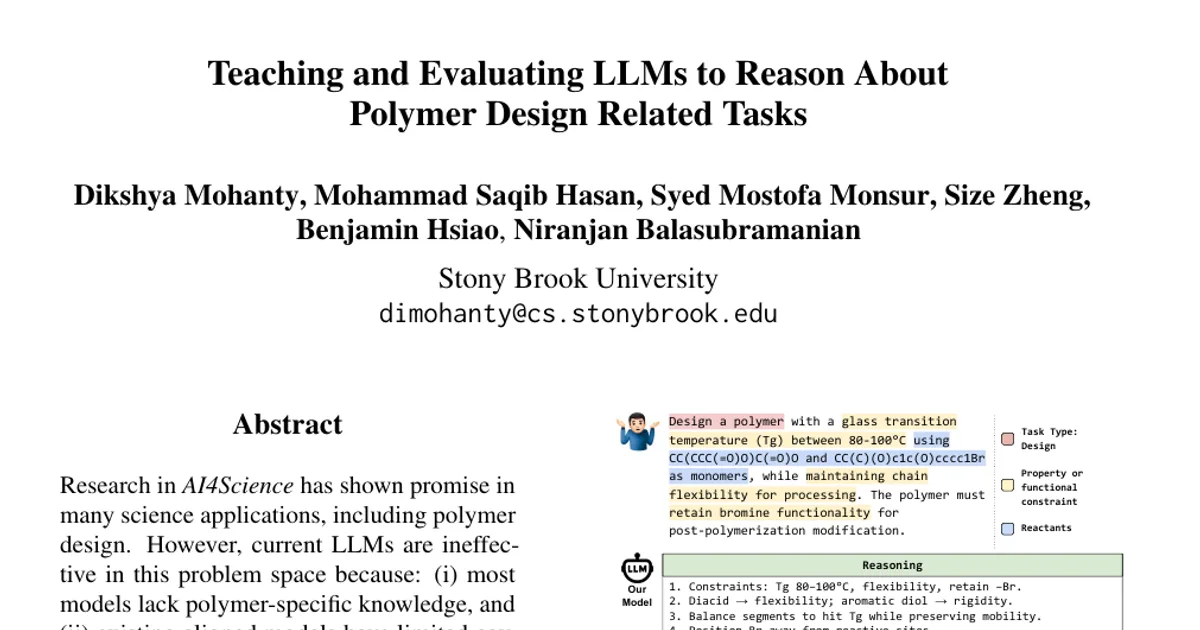
Research in AI4Science has shown promise in many science applications, including polymer design. However, current LLMs are ineffective in this problem space because: (i) most models lack polymer-specific knowledge, and (ii) existing aligned models have limited coverage of knowledge and capabilities relevant to polymer design. Addressing this, we introduce PolyBench, a large-scale training and test benchmark dataset of more than 125K polymer design-related tasks, leveraging a knowledge base of more than 13 million data points obtained from experimental and synthetic data sources to ensure broad coverage of polymers and their properties. For effective alignment using PolyBench, we introduce a knowledge-augmented reasoning distillation method that augments this dataset with structured CoT. Furthermore, tasks in PolyBench are organized from simple to complex analytical reasoning problems, enabling generalization tests and diagnostic probes across the problem space. Experiments show that small- and mid- sized language models (SLMs) with 7B to 32BB parameters, trained on PolyBench, outperform similar-sized models and remain competitive with closed-source frontier LLMs on PolyBench's test dataset, while demonstrating performance gains on external polymer benchmarks. Dataset and associated code available at https://github.com/StonyBrookNLP/PolyBench.