Research
TCAP: Tri-Component Attention Profiling for Unsupervised Backdoor Detection in MLLM Fine-Tuning
Overview Research area: AI security — backdoor defense for Multimodal Large Language Models (MLLMs) adapted through Fine-Tuning-as-a-Service (FTaaS). Technical level: Advanced. The paper assumes famil
- arXiv
- 2601.21692
- Published
- 2026-01-29
- Authors
- Mingzu Liu, Hao Fang, Runmin Cong
AI summary
Overview
- Research area: AI security — backdoor defense for Multimodal Large Language Models (MLLMs) adapted through Fine-Tuning-as-a-Service (FTaaS).
- Technical level: Advanced. The paper assumes familiarity with transformer attention, mixture models, and backdoor attack/defense terminology.
- Scope: The paper identifies a "tri-component attention allocation divergence" as a universal backdoor fingerprint in MLLMs and builds an unsupervised poisoned-sample filter (TCAP) on top of it, evaluated across three MLLMs, five benchmark datasets, five visual attack methods, and two textual-trigger settings.
What This Paper Is About
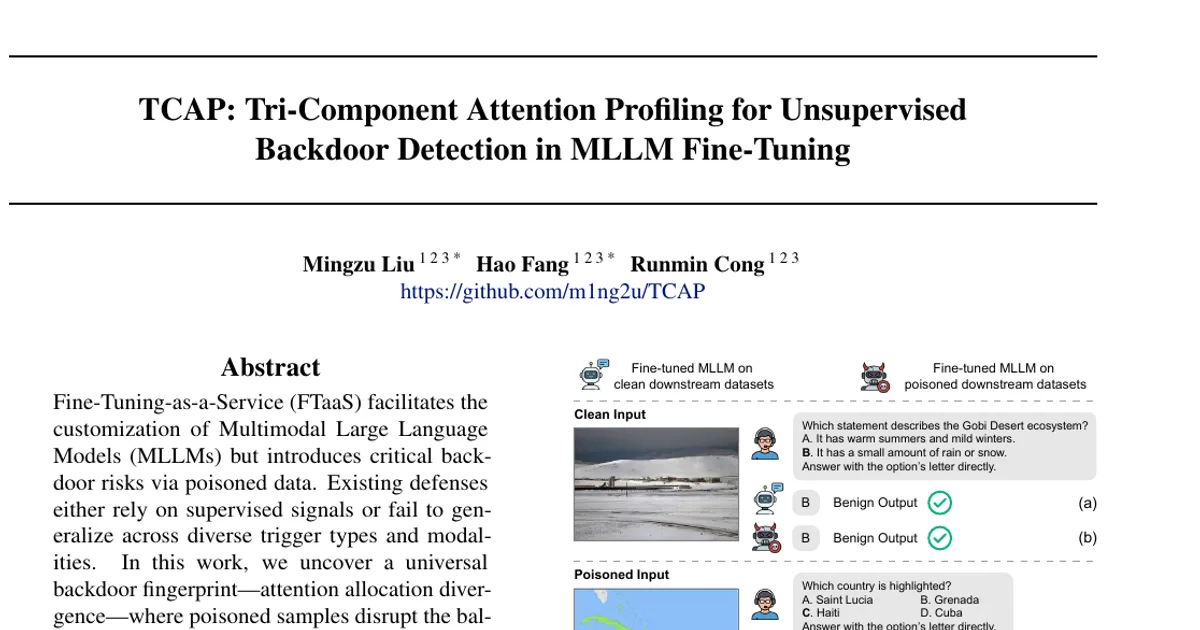
When users fine-tune MLLMs on their own data through FTaaS, attackers can hide poisoned samples in that data, planting a backdoor that stays dormant until a trigger appears. Existing defenses either need clean reference data or supervised labels, or they only work on localized visual patches — the unsupervised method BYE relies on visual attention collapsing into a small region, which does not happen with globally spread triggers. The paper decomposes attention from the first generated token into three parts — system instructions, vision inputs, and user textual queries — and shows that backdoors disturb the balance among them no matter what the trigger looks like, then uses that signal to filter poisoned samples.
Key Contributions
- Discovering a universal fingerprint. Through fine-grained attention decomposition, the authors identify "attention allocation divergence," where triggers disrupt the balanced distribution of attention across system instructions, vision inputs, and user queries regardless of trigger morphology or modality.
- A tri-component profiling framework (TCAP). An unsupervised defense that sanitizes training data by profiling component-wise statistics, with Gaussian Mixture Model (GMM) fitting to isolate trigger-responsive attention heads, working without clean reference data or external supervision.
- EM-based vote aggregation for cleaning. Selected heads cast votes that are merged with an Expectation-Maximization (EM) / Dawid-Skene model, treating heads as noisy annotators to produce a final poisoned-sample probability.
- Broad empirical validation. Experiments across InternVL2.5-8B, LLaVA-NeXT-8B, and Qwen3-VL-8B, five datasets, five visual attack types, and textual triggers, showing near-zero Attack Success Rate while largely preserving Clean Performance.
Main Findings
- Two complementary anomaly types appear in deeper layers. Some heads show "System-Suppressed, Vision-Amplified" behavior, shifting attention toward trigger regions while suppressing system instructions; other heads show "System-Amplified, Vision-Suppressed" behavior, decoupling from the visual input and hyper-focusing on system instructions. The paper describes this division of labor as the backdoor fingerprint.
- Entropy-based detection (BYE) fails on global triggers. The paper argues analytically that patch-based triggers satisfy a much tighter entropy upper bound than global triggers, so global triggers such as Blend do not produce an entropy drop. Under Blend on LLaVA-NeXT, BYE reaches Clean Performance 0.00 and ASR 100.00 on ScienceQA and PhD, which the paper attributes to the entropy rise causing BYE to discard clean samples while keeping poisoned ones.
- Strong defense on the Blend attack (Table 1). On DocVQA with Qwen3-VL, TCAP limits ASR to 0.33% while retaining CP of 90.57%, versus Vanilla FT (CP 89.07, ASR 98.93). On SEED-Bench with Qwen3-VL, TCAP reports CP 81.27 and ASR 0.37. On ScienceQA, TCAP reaches ASR 0.15 (InternVL2.5), 0.05 (LLaVA-NeXT), and 15.62 (Qwen3-VL).
- Clean performance is largely preserved. On ScienceQA with InternVL2.5, TCAP reports CP 96.93 against Vanilla FT's 96.88; on DocVQA with InternVL2.5 it reports CP 60.10 against Vanilla FT's 57.17. SampDetox, by contrast, drops CP sharply (for example 75.31 on ScienceQA with InternVL2.5) because of its noise injection.
- Consistent detection across visual attack types (Table 2, ScienceQA). TCAP reports Precision/Recall/F1 of 100.00/100.00/100.00 on BadNet with InternVL2.5 and 97.22/95.66/96.43 with Qwen3-VL. BYE's F1 on BadNet is 97.87 for InternVL2.5 but 6.71 for LLaVA-NeXT and 25.05 for Qwen3-VL, which the paper reads as evidence that newer capable models do not necessarily show the localized attention collapse BYE assumes.
- Trigger-responsive heads, layers, and adaptive components all matter (Table 3, Blend). Full TCAP achieves F1 of 98.34 (InternVL2.5), 98.85 (LLaVA-NeXT), and 95.04 (Qwen3-VL). Removing head selection drops these to 43.02 / 22.31 / 15.33; removing the layer filter gives 67.21 / 31.94 / 11.02; removing adaptive GMM components gives 65.57 / 48.53 / 54.25; removing EM-based voting gives 51.70 / 63.10 / 63.01.
- Generalization to textual triggers (Table 4). With a "Hello!" prefix trigger on ScienceQA, TCAP reaches ASR 0.00 and F1 100.00 on all three MLLMs. On the PhD dataset with the HiddenKiller attack, it reports CP 83.73 and ASR 23.93 with F1 87.57 (InternVL2.5), CP 85.90 and ASR 6.77 with F1 92.95 (LLaVA-NeXT), and CP 90.07 and ASR 0.00 with F1 99.94 (Qwen3-VL) — using the same pipeline with no modification for text.
- Clean and poisoned samples separate visually. Joint distributions of a System-Suppressed head and a System-Amplified head place clean samples in a dense central cluster and poisoned samples in distinct outlier regions, with marginal histograms showing the anomalies isolate backdoor traces.
Methodology in Plain English
The authors run the fine-tuned MLLM on its training data and watch where attention goes at a single, well-defined moment: the first generated response token, and how it distributes weight back over all preceding tokens. Each input is split into three parts — the system instructions (system prompts, role references, special tags), the image tokens, and the user's query text — and, for every attention head in every decoder layer, the raw attention weights are summed within each part to give a three-number allocation vector.
The reasoning is that system instructions are fixed and cannot be manipulated by an attacker, so the amount of attention a head spends on them is a stable reference. For each head, the authors normalize the system-attention values across training samples and fit Gaussian Mixture Models with the number of components varying from 1 to 5, selecting the best structure by an information-theoretic criterion (the paper cites Akaike 1974). Components are grouped into a minority "target" group and a "background" group, and a Separation Score — the reciprocal of the overlapping area between the two groups' densities, plus a stability constant — measures how cleanly they divide. Heads in the last L_sens layers are ranked by this score, and the top H_sens become the trigger-responsive head set.
For detection, each sensitive head votes on whether a given sample is anomalous, based on whether the posterior probability mass on the target components exceeds a threshold. Rather than simple majority voting, the votes are combined through an EM procedure using the Dawid-Skene model, which treats heads as independent noisy annotators with a confusion matrix each; samples whose final posterior probability of being poisoned exceeds 0.5 are removed, producing a purified dataset used for retraining. The whole pipeline needs no clean reference data and no labels.
Experimental setup, for context: models are InternVL2.5-8B, LLaVA-NeXT-8B, and Qwen3-VL-8B, all adapted with LoRA on poisoned datasets; datasets are ScienceQA (6,218 training / 2,017 test samples), PhD (the paper describes a subset of 10,000 training and 3,000 test images from a benchmark containing 14,648 daily images, 750 counter-common-sense images, and 102,564 VQA triplets), DocVQA, Recap-COCO, and SEED-Bench; the poisoning rate is 10% with a unified target output of "Backdoor Attack!"; attack implementations follow the BackdoorBench framework. Metrics are Clean Performance (accuracy for multiple-choice or boolean VQA, ANLS for phrase-based generative VQA, CIDEr for captioning), Attack Success Rate, and Precision/Recall/F1. The DocVQA dataset description and the trigger visualization details appear in Appendix A.1 and A.2, which are not included in the truncated content.
Why This Matters
Impact on research. The paper reframes backdoor defense from spotting visual oddities to reading internal information routing, and it argues that the signal holds across trigger type and modality — a claim that, if it generalizes, makes defenses less dependent on which attack an attacker happens to choose.
Real-world applications.
- Securing FTaaS pipelines where customers upload domain data and cannot inspect model internals, by filtering the data before retraining.
- Medical diagnostics built on adapted MLLMs, where a dormant trigger could steer outputs in a high-stakes setting.
- Autonomous systems and embodied agents that rely on multimodal perception, where a physical trigger in the environment could hijack behavior.
- Document and enterprise question-answering deployments, where a poisoned document pipeline could silently redirect answers.
Industry relevance. The defense is described as unsupervised and free of clean reference data, which matters for practitioners who do not have an untouched copy of the training set. The authors report that it preserves Clean Performance close to Vanilla FT on several benchmarks, addressing the common objection that defenses degrade model quality. Source code is released at https://github.com/m1ng2u/TCAP.
Future Directions
- Closing the gap on harder settings. On PhD with HiddenKiller, InternVL2.5 still shows ASR 23.93 and Qwen3-VL on ScienceQA with Blend shows ASR 15.62, so residual attack success remains an open target.
- Reducing or removing the need for a fine-tuned model and inference pass. TCAP profiles attention over training samples after fine-tuning has already happened; whether the same fingerprint can be read earlier in training is not addressed here.
- Finding the right settings automatically. The last
L_senslayers and topH_sensheads are selected by ranking the Separation Score; the paper does not report an analysis of sensitivity to those counts, which is a natural next question. - Extending beyond detection to removal or repair. The current pipeline flags and discards samples, then retrains; whether attention divergence could directly guide model repair (rather than data filtering) is left open.
Target Audience
Researchers and engineers working on AI security, backdoor attacks and defenses, and the safety of fine-tuned multimodal models will get the most from this paper. It is also relevant to practitioners operating FTaaS or model-customization platforms who need a data-cleaning step that does not require labeled poisoned data or a clean reference set, and to readers interested in interpreting transformer attention as a diagnostic tool. Readers without a background in attention mechanisms, mixture models, or EM will likely find sections 3 and 4 demanding.
Authors’ abstract
Fine-Tuning-as-a-Service (FTaaS) facilitates the customization of Multimodal Large Language Models (MLLMs) but introduces critical backdoor risks via poisoned data. Existing defenses either rely on supervised signals or fail to generalize across diverse trigger types and modalities. In this work, we uncover a universal backdoor fingerprint-attention allocation divergence-where poisoned samples disrupt the balanced attention distribution across three functional components: system instructions, vision inputs, and user textual queries, regardless of trigger morphology. Motivated by this insight, we propose Tri-Component Attention Profiling (TCAP), an unsupervised defense framework to filter backdoor samples. TCAP decomposes cross-modal attention maps into the three components, identifies trigger-responsive attention heads via Gaussian Mixture Model (GMM) statistical profiling, and isolates poisoned samples through EM-based vote aggregation. Extensive experiments across diverse MLLM architectures and attack methods demonstrate that TCAP achieves consistently strong performance, establishing it as a robust and practical backdoor defense in MLLMs.