Research
Task-Sufficient Contraction: Source Selection for Machine Information Interfaces
Overview Research area: Information theory and rate-distortion theory, with connections to goal-oriented communication, semantic compression, and task-aware source coding (cs.IT). Technical level: Adv
- arXiv
- 2610.08884
- Published
- 2026-10-06
- Authors
- Joss Armstrong
AI summary
Overview
Research area: Information theory and rate-distortion theory, with connections to goal-oriented communication, semantic compression, and task-aware source coding (cs.IT).
Technical level: Advanced. The abstract assumes familiarity with rate-distortion theory, regret, Information Bottleneck, quantization, and convex/affine optimization concepts.
Scope: The paper defines and characterizes "Task-Sufficient Contraction" — conditions under which a task alone can certify a reduced source that preserves an entire downstream problem family before any encoder, rate, or distortion target is fixed.
What This Paper Is About
Normally, deciding how much to compress a source requires knowing the downstream operating point: which encoder, codebook, rate, and distortion target will be used. This paper asks whether a declared task, on its own, can certify a smaller source before any of those choices are made — and when that reduction is exact rather than merely a heuristic. The goal is to identify precisely which state merges are safe, so that a receiver's task gets what it needs without the sender having to preserve or align full internal representations.
Key Contributions
-
Formalizes Task-Sufficient Contraction. Introduces the property that a task-fixed source reduction preserves the complete downstream problem family, so the later problem can be solved on the reduced source with the same result as on the full source.
-
A regret-based merging rule for machines with fixed actions and loss. Identifies a consumer-specific reduced source obtained by merging states only when every available action has identical regret in both states.
-
A result for finite action sets. Shows that this reduced source preserves the complete one-step rate-regret curve, despite the reduction being fixed before the distortion target is chosen.
-
An exact characterization for quadratic loss on affine feasible-action sets. The canonical reduced source is the projection onto the directions in which feasible actions can differ; under a fixed energy budget this becomes centered load, while keeping only the optimal water-filled action is shown to be too coarse.
-
A taxonomy of contraction types. Uses earlier Information Bottleneck, semantic rate-distortion, and goal-oriented quantization results to distinguish exact, architecture-conditioned, approximate, failed, and corrected contractions.
Main Findings
-
Task-declared reduction can precede the operating point: A declared task can sometimes certify a reduced source before an encoder, codebook, rate, distortion target, or optimizer has been chosen.
-
Exact contraction preserves results: When the contraction is exact, solving the later problem on the reduced source gives the same result as retaining the full source.
-
Regret-equality is the merging criterion: For a machine with a fixed action set and fixed loss, states may be merged only when every available action carries the same regret in both — that condition defines the consumer-specific source.
-
Rate-regret curve is preserved for finite action sets: With finite action sets, substituting the reduced source preserves the complete one-step rate-regret curve, even though the reduction is decided before the distortion target is selected.
-
Quadratic loss has a geometric characterization: On affine feasible-action sets, the canonical reduced source is the projection onto the directions along which feasible actions can differ.
-
Energy budget sharpens the picture: Under a fixed energy budget, that projection becomes centered load, and retaining only the optimal water-filled action is too coarse a reduction.
-
Not all contractions succeed: Existing Information Bottleneck, semantic rate-distortion, and goal-oriented quantization results are used to separate exact contractions from architecture-conditioned, approximate, failed, and corrected ones.
-
Implication for heterogeneous machines: The framework suggests a way for machines with differing internal representations to exchange exactly what a receiving task requires, without first aligning those representations.
Methodology in Plain English
The work is theoretical rather than empirical. It defines a property — task-sufficient contraction — and then asks under what mathematical conditions a reduction of the source satisfies it. The central move is to treat the downstream problem not as one fixed setup but as a family of problems (varying encoder, rate, distortion target, optimizer), and to require that the reduced source work correctly across that whole family.
For machines that must choose among a fixed set of actions under a fixed loss, the analysis uses regret as the quantity that decides whether two states can be safely merged: merge only when no available action can tell them apart. This yields a consumer-specific reduced source. The analysis is then specialized to finite action sets, where the claim is about preserving the full one-step rate-regret curve.
A second line of analysis handles quadratic loss on affine feasible-action sets, where the answer takes a geometric form — a projection onto the directions in which feasible actions can actually differ. Imposing a fixed energy budget turns that projection into centered load, and the paper contrasts this with the cruder alternative of keeping only the optimal water-filled action. Finally, the paper places its results alongside prior Information Bottleneck, semantic rate-distortion, and goal-oriented quantization work to sort existing approaches into exact, architecture-conditioned, approximate, failed, and corrected contractions.
Why This Matters
Impact on research. The paper reframes task-aware compression as a question about when a reduction is provably safe rather than how well a particular heuristic performs. The five-way taxonomy (exact, architecture-conditioned, approximate, failed, corrected) gives a vocabulary for comparing results that previously came from different communities — Information Bottleneck, semantic rate-distortion, and goal-oriented quantization — and it separates reductions that are certified by the task from those that quietly depend on architectural choices.
Real-world applications:
-
Distributed sensing and edge systems: Sensors could send only the task-relevant reduction of their observations, deferring the choice of encoding rate or fidelity target until later.
-
Multi-agent and heterogeneous systems: Agents with different internal representations could exchange task-sufficient summaries without first aligning their state spaces.
-
Goal-oriented communication: Links could be designed around what a receiving task needs rather than around reconstruction fidelity, which is exactly the setting the paper's regret-based rule addresses.
-
Resource-constrained inference: Under a fixed energy or bit budget, the centered-load characterization offers a principled way to decide what to keep and what to drop.
Industry relevance. Any pipeline where the same data feeds different downstream consumers at different operating points — model serving, sensor networks, robotics, networked control — could benefit from a task-certified reduction decided once and reused. The result that the reduction survives across the whole rate-regret curve is what makes such a "decide once" design plausible.
Future Directions
-
Multi-step and sequential tasks. The finite-action-set result covers the one-step rate-regret curve; whether the contraction remains sufficient over longer horizons is not addressed in the abstract.
-
Beyond quadratic loss and affine action sets. The exact geometric characterization is specific to these conditions; what replaces the projection for other losses or non-affine feasible sets is open.
-
Contractions that are not exact. The abstract lists architecture-conditioned, approximate, failed, and corrected contractions, implying a need for a general account of when near-contractions are acceptable and what guarantees they retain.
-
Operational realization for heterogeneous machines. The abstract proposes exchanging task-sufficient information without aligning representations; turning this into a concrete protocol and understanding its costs in practice is a natural next step.
Target Audience
Researchers and graduate students in information theory, rate-distortion and semantic communication, and goal-oriented quantization, as well as those working on task-aware compression and distributed or multi-agent learning. Readers looking for empirical benchmarks or applied system results will not find them here — the contribution is conceptual and theoretical, and the abstract reports no experiments or numerical results.
Authors’ abstract
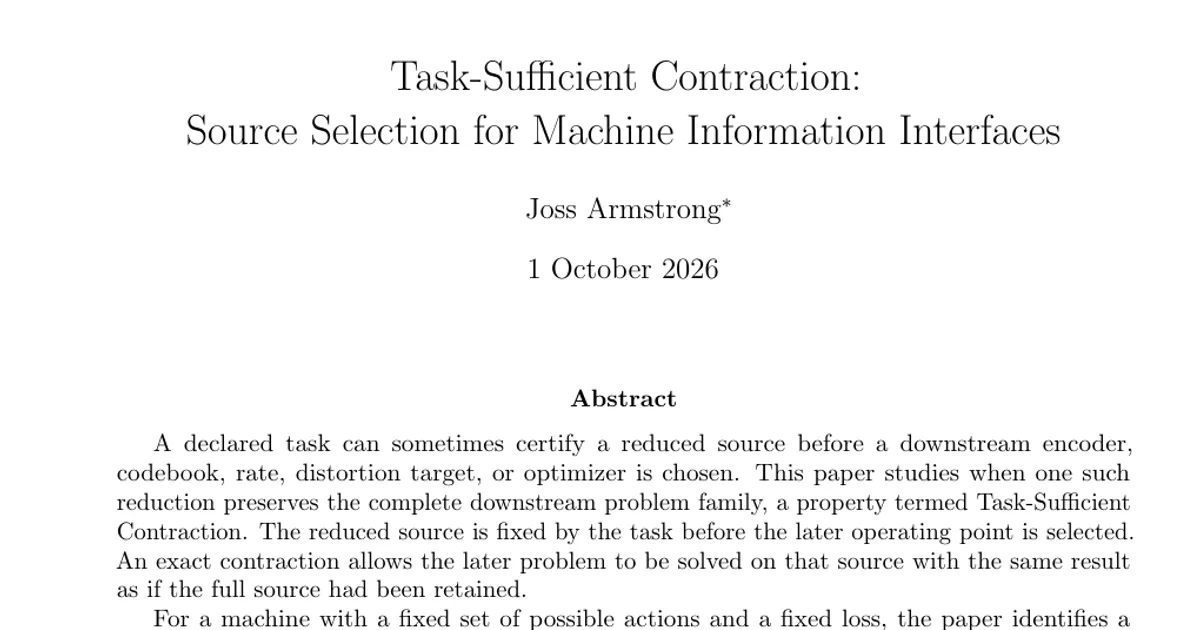
A declared task can sometimes certify a reduced source before a downstream encoder, codebook, rate, distortion target, or optimizer is chosen. This paper studies when one such reduction preserves the complete downstream problem family, a property termed Task-Sufficient Contraction. The reduced source is fixed by the task before the later operating point is selected. An exact contraction allows the later problem to be solved on that source with the same result as if the full source had been retained. For a machine with a fixed set of possible actions and a fixed loss, the paper identifies a consumer-specific source by merging states only when every available action has the same regret in both. For finite action sets, replacing the richer source by this reduced source preserves the complete one-step rate-regret curve, even though the reduction is fixed before the distortion target is chosen. A second result gives an exact characterization for quadratic loss on affine feasible-action sets: the canonical reduced source is the projection onto the directions in which feasible actions can differ. Under a fixed energy budget, this becomes centered load, while retaining only the optimal water-filled action is too coarse. Earlier Information Bottleneck, semantic rate-distortion, and goal-oriented quantization results are then used to distinguish exact, architecture-conditioned, approximate, failed, and corrected contractions. The framework suggests a way for heterogeneous machines to exchange what a receiving task needs without first aligning their full internal representations.