Research
TagaVLM: Topology-Aware Global Action Reasoning for Vision-Language Navigation
Overview Research area: Vision-Language Navigation (VLN) for embodied agents, combining large Vision-Language Models (VLMs) with topological mapping. Technical level: Advanced — assumes familiarity wi
- arXiv
- 2603.02972
- Published
- 2026-03-03
- Authors
- Jiaxing Liu, Zexi Zhang, Xiaoyan Li, Boyue Wang, Yongli Hu, Baocai Yin
AI summary
Overview
- Research area: Vision-Language Navigation (VLN) for embodied agents, combining large Vision-Language Models (VLMs) with topological mapping.
- Technical level: Advanced — assumes familiarity with transformer self-attention, multimodal instruction tuning, and VLN benchmarks such as R2R and Matterport3D.
- Scope: The paper proposes TagaVLM, an end-to-end framework that injects topological graph structure directly into a VLM's attention layers to enable global action reasoning and path correction on the R2R benchmark.
What This Paper Is About
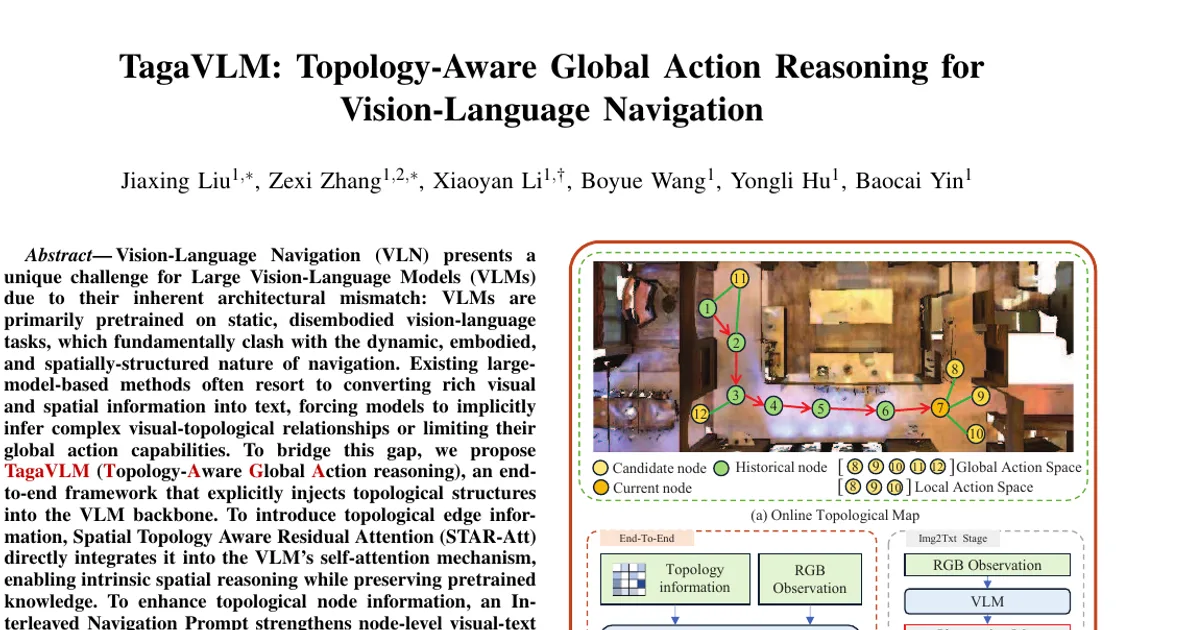
VLMs are pretrained on static, disembodied image-text tasks, but navigation is dynamic, embodied, and inherently spatial, creating a mismatch. Prior large-model-based VLN methods often convert visual observations into text and feed them to a language model, which loses fine-grained visual detail and limits the agent to choosing among only locally connected viewpoints. TagaVLM's goal is to embed the online topological map directly into the VLM architecture so the model can reason about the whole observed environment and correct its own mistakes.
Key Contributions
- TagaVLM framework: An end-to-end VLN framework that architecturally embeds topological structures into the VLM backbone rather than describing them in text.
- Interleaved Navigation Prompt (INP): An input structure that mirrors the graph's node layout, inserting each node's visual features next to its own textual description and node ID, strengthening node-level visual-text alignment.
- Spatial Topology Aware Residual Attention (STAR-Att): A replacement for standard multi-head self-attention that injects edge-level distance information as a learnable, per-head residual attention bias, while preserving pretrained knowledge.
- Evidence that inductive bias can beat scale: The 0.5B-parameter version (TagaVLM-0.5B) achieves competitive results, and the 7B version outperforms much larger proprietary models, showing targeted architectural priors can be more effective than brute-force model scaling for embodied spatial reasoning.
Main Findings
- State-of-the-art among large-model-based methods on R2R: With the Qwen2 7B backbone, TagaVLM reaches SR of 51.09% and SPL of 47.18 in unseen environments, an absolute improvement of 3.39% in SR and 9.08 in SPL over MapGPT (GPT-4V).
- Val seen results (7B): TL 10.16, NE 4.71, OSR 64.15, SR 55.53, SPL 53.05.
- Small model is competitive: TagaVLM-0.5B (Qwen2 0.5B) reaches SR 45.72 and SPL 41.91 on val unseen, and SR 53.48 and SPL 50.4 on val seen, outperforming most large-model-based methods despite far fewer parameters.
- STAR-Att helps on its own: Replacing standard multi-head self-attention with STAR-Att raises SR from 17.28% to 26.14% (an 8.86% gain) on the R2R val unseen split, with no other components added.
- Text-based topological maps are weaker than STAR-Att: Adding text-based topological map prompts (in the style of MapGPT) improves SR by only 0.94% over the baseline, while STAR-Att reaches SR 42.06 versus 39.76 in that setting.
- INP gives the largest single gain: Adding the Interleaved Navigation Prompt on top of STAR-Att improves SR by 12.26% and SPL by 14.8, and the paper states this structured sequence is what unlocks STAR-Att's full potential.
- Global action space beats local action space: Under STAR-Att alone, global actions improve SR by 5.83% and SPL by 6.82 over local actions, enabling backtracking and fault tolerance.
- Augmented data helps generalization: Using 500K augmented SAP samples from HM3D in the first training stage raises the final configuration to SR 45.72, SPL 41.91, OSR 55.09, NE 5.57, TL 9.8.
- Qualitative path correction: In the successful case study, the agent chose a wrong direction at Step 1, then at Step 2 used global action reasoning to backtrack from Node_2 to Node_1 and move to candidate Node_5, eventually reaching the destination (near the "black chairs" and "refrigerator" landmarks) at Step 6.
Methodology in Plain English
The agent navigates a discrete graph where each node is a navigable viewpoint and each edge is a traversable connection. As it moves, it builds an online topological map containing historical nodes, candidate (observed but unvisited) nodes, and the current node. Historical and current nodes are represented by panoramic images built from 36 views; candidate nodes are represented by the view from which they were observed, and views from multiple observations are concatenated.
Each node's image is encoded by a frozen SigLIP visual encoder and mapped by a two-layer MLP projector into the language model's input space. Rather than dumping all images at one end of the text prompt, the Interleaved Navigation Prompt places each node's visual tokens directly next to that node's textual description and ID, so the model sees aligned pairs.
The key architectural change is STAR-Att: the pairwise distance matrix between nodes is expanded into a token-level affinity matrix, and this is added as a bias term to the attention scores in every multi-head self-attention layer. Because it is a residual, learnable bias, the model can weigh spatial proximity against its pretrained semantic knowledge instead of being rigidly constrained.
At each step, the action space includes the stop action plus all observed but unvisited candidate nodes, not just immediate neighbors. If the model selects a non-adjacent node, a shortest-path search computes the low-level trajectory. Training uses a single-step action prediction task derived from R2R, with teacher forcing and cross-entropy loss on the predicted node index, in a two-stage schedule: 12,500 pretraining steps on mixed R2R and augmented HM3D data, then 5000 fine-tuning steps on R2R.
Why This Matters
- Impact on research: The paper argues that architectural inductive bias, not just parameter count, drives embodied spatial reasoning, and offers a concrete alternative to two-stage vision-to-text pipelines that lose visual information.
- Real-world applications:
- Service robots following natural-language instructions in unseen buildings.
- Assistive and delivery robots that must recover from wrong turns rather than getting stuck.
- Warehouse or facility inspection agents that build maps online while interpreting spoken goals.
- Any embodied assistant needing backtracking and global re-planning when instructions are ambiguous.
- Industry relevance: The 0.5B-parameter result suggests that well-designed open-source models can be fine-tuned for a specific embodied task more cheaply than relying on very large proprietary models accessed via black-box APIs.
Future Directions
- Scaling training to larger datasets to close the data gap with methods like NaviLLM, which uses over 1000K trajectories and an additional 60K QA samples.
- Enriching STAR-Att with more complex geometric priors beyond pairwise node distances.
- Extending the framework from discrete graph navigation to continuous control on physical robots.
- Investigating whether the topology-aware attention approach transfers to other embodied or spatially structured multimodal tasks.
Target Audience
Researchers and engineers working on Vision-Language Navigation, embodied AI, multimodal large models, and robot instruction following, particularly those interested in efficient architectural priors as an alternative to model scaling. The paper is most useful to readers already familiar with transformer attention and VLN benchmarks.
Authors’ abstract
Vision-Language Navigation (VLN) presents a unique challenge for Large Vision-Language Models (VLMs) due to their inherent architectural mismatch: VLMs are primarily pretrained on static, disembodied vision-language tasks, which fundamentally clash with the dynamic, embodied, and spatially-structured nature of navigation. Existing large-model-based methods often resort to converting rich visual and spatial information into text, forcing models to implicitly infer complex visual-topological relationships or limiting their global action capabilities. To bridge this gap, we propose TagaVLM (Topology-Aware Global Action reasoning), an end-to-end framework that explicitly injects topological structures into the VLM backbone. To introduce topological edge information, Spatial Topology Aware Residual Attention (STAR-Att) directly integrates it into the VLM's self-attention mechanism, enabling intrinsic spatial reasoning while preserving pretrained knowledge. To enhance topological node information, an Interleaved Navigation Prompt strengthens node-level visual-text alignment. Finally, with the embedded topological graph, the model is capable of global action reasoning, allowing for robust path correction. On the R2R benchmark, TagaVLM achieves state-of-the-art performance among large-model-based methods, with a Success Rate (SR) of 51.09% and SPL of 47.18 in unseen environments, outperforming prior work by 3.39% in SR and 9.08 in SPL. This demonstrates that, for embodied spatial reasoning, targeted enhancements on smaller open-source VLMs can be more effective than brute-force model scaling. The code will be released upon publication.Project page: https://apex-bjut.github.io/Taga-VLM