Research
Tacit-TTS: From Autoregressive Decoding to Masked Prediction for Efficient Transcript-Free Voice Cloning
Overview Research area: Speech synthesis, specifically zero-shot voice cloning (arXiv category eess.AS). Technical level: Advanced. The paper assumes familiarity with autoregressive vs. non-autoregres
- arXiv
- 2609.38658
- Published
- 2026-09-29
- Authors
- Jian Chen, You Zhang, Mark Vinton
AI summary
Overview
- Research area: Speech synthesis, specifically zero-shot voice cloning (arXiv category eess.AS).
- Technical level: Advanced. The paper assumes familiarity with autoregressive vs. non-autoregressive decoding, masked prediction, knowledge distillation, flow matching, reflow, semantic codec tokens, and standard TTS metrics (WER, CER, speaker similarity, MOS predictors).
- One-sentence scope: Tacit-TTS is a zero-shot voice cloning system distilled from the autoregressive model IndexTTS2 that swaps autoregressive semantic decoding for masked non-autoregressive generation, adds training-free acoustic length estimation, and accelerates its renderer with reflow distillation, yielding competitive cloning quality at roughly an order-of-magnitude lower generation cost without needing a reference transcript.
What This Paper Is About
High-quality voice cloning systems often rely on autoregressive (AR) semantic modeling, which produces strong zero-shot cloning and expressive variation but decodes one token at a time, making inference slow. Non-autoregressive (NAR) systems are much faster, but most require a transcript of the reference speech at inference time and need the target output length decided up front, which breaks down for unsupported languages or references without lexical content (babble, gibberish). The paper's goal is a system that keeps the cloning quality of a strong AR teacher while removing both the sequential decoding bottleneck and the reference-transcript requirement.
Key Contributions
- Masked non-autoregressive replacement for the teacher's AR stage. The autoregressive text-to-semantic (T2S) stage of IndexTTS2 is replaced with a masked non-autoregressive generator, accelerating that stage by 26.5×, and the downstream flow-matching renderer is further accelerated via ReFlow distillation.
- Transcript-free NAR generation via training-free length control. Because NAR decoding needs a target length before generation, the authors estimate speaking pace directly from the reference audio and combine it with the syllable count of the target text, avoiding both a reference transcript and a learned duration predictor.
- Distillation of both discrete and continuous teacher representations. The student is trained with a masked-prediction head over semantic codes plus a residual-recovery head that reconstructs the continuous latent representation the downstream renderer expects, without access to the teacher's original large-scale training corpus.
- Demonstrated robustness on cross-lingual and non-lexical references. Tacit-TTS is evaluated with references from eight other languages, infant babble, and synthetic gibberish, settings where transcript-dependent systems often degrade or fail due to unreliable ASR transcripts.
Main Findings
- Zero-shot quality on four test sets. On LibriSpeech test-clean (English, n=2544) Tacit-TTS reaches SS 0.875 and WER 5.54; on SeedTTS test-en (n=1088) SS 0.849 and WER 2.34; on SeedTTS test-zh (n=2020) SS 0.829 and CER 1.71; on AISHELL-1 test (n=1000) SS 0.804 and CER 2.21. The teacher IndexTTS2 scores 0.870/3.115, 0.860/1.521, 0.865/1.008, and 0.843/1.516 respectively, and the paper frames these as a reference upper bound rather than a competitor.
- Best English speaker similarity among deployable systems. Tacit-TTS attains the highest speaker similarity among evaluated non-teacher baselines on both English datasets, while remaining competitive on content accuracy.
- Weaker Mandarin results, attributed to speaker imbalance. The paper notes the training data contains 2342 English speakers and 397 Chinese speakers, and suggests this imbalance may partly explain the weaker Mandarin results.
- Generation speed. Beyond the abstract's claim of over 10× faster than IndexTTS2 for utterances longer than 5 seconds, the per-stage timing on 32 utterances (8 per test set, outputs averaging about 5 s) gives a T2S latency drop from 5274 ms to 199 ms (26.5×) and an S2A drop from 875 ms to 310 ms, so combined generation falls from 6149 ms to 509 ms, a 12.1× speedup. Total pipeline latency falls from 6632 ms to 977 ms, with overall speed rising from 0.813 to 4.76 seconds of audio per second of compute.
- Speedup varies with utterance length. Speedup grows from 9.0× at four seconds to a peak of 14.9× around thirty seconds, then narrows to 13.8× at 62 s and 11.8× at 125 s as the O(n²) self-attention in the non-autoregressive stages catches up. IndexTTS2's real-time factor is roughly flat at approximately 1.1.
- Cross-lingual cloning. Averaged over eight reference languages (Japanese, Korean, German, Spanish, Russian, Arabic, Hindi, Yoruba; three references per language, 10 English and 10 Chinese target sentences from SeedTTS), Tacit-TTS reaches SS 0.789 with 0.10% WER on English targets and SS 0.692 with 1.90% CER on Chinese targets, with error rate below 3.4% across all eight languages. IndexTTS2 scores 0.807/0.19% and 0.712/1.40% respectively. Transcript-dependent baselines degrade sharply: F5-TTS 0.663/24.56% and 0.622/25.01%; CosyVoice2 0.692/45.95% and 0.680/62.41%; SparkTTS 0.611/47.27% and 0.578/60.42%; MaskGCT 0.701/20.16% with a 33.3% failure rate and 0.700/28.26% with a 33.3% failure rate, averaging over only six languages because it fails on all Russian and Arabic references.
- Non-lexical cloning. With infant-babble references, Tacit-TTS reaches SS 0.603 with WER 3.24 (English targets) and SS 0.595 with CER 5.79 (Chinese targets), versus IndexTTS2's 0.484/4.76 and 0.425/1.34. With synthetic-gibberish references, Tacit-TTS reaches SS 0.781 with WER 1.07 and SS 0.846 with CER 1.82, versus IndexTTS2's 0.810/0.14 and 0.880/1.23. Both transcript-free systems generate speech for all references, while transcript-dependent baselines (SparkTTS, CosyVoice2, MaskGCT, F5-TTS) show much lower similarity and error rates as high as 99.00%.
- Perceptual quality (Appendix C). Tacit-TTS scores UTMOS 4.009 / DNSMOS 3.289 on LibriSpeech test-clean, 3.578 / 3.072 on SeedTTS test-en, 2.890 / 3.297 on SeedTTS test-zh, and 2.419 / 3.159 on AISHELL-1 test, staying close to IndexTTS2 (4.051 / 3.319, 3.572 / 3.077, 2.926 / 3.303, 2.486 / 3.285). The authors caution that these predictors sometimes score systems above ground truth.
- Duration fidelity. The paper evaluates the length estimator using Pearson correlation between generated and ground-truth durations rather than exact duration error, reporting correlation comparable to other systems, with details deferred to Appendix F.
- Model size reduction. The 527M-parameter autoregressive T2S Transformer is replaced by a 269M-parameter non-autoregressive masked generator; the T2S replacement accounts for the model-size reduction and most of the latency improvement.
- Small distillation budget. T2S distillation uses 874k samples (about 2k hours from 2739 unique reference speakers), and the S2A coupling set contains 8k pairs (about 36 hours) — substantially smaller than the 55k hours used by IndexTTS2.
- Default configuration. 12 T2S unmasking steps, 8 reflow S2Mel steps, and the transcript-free DSP length estimator with a clamp of 12 codes per syllable; 12 T2S steps chosen because gains from 8→12 are consistent while 16 gives marginal gains, and 8 S2Mel steps because speaker similarity keeps improving from 4 to 8.
Methodology in Plain English
The system keeps the two-stage recipe used by recent voice cloning models: a text-to-semantic module turns the target text plus a reference voice into semantic tokens, and a semantic-to-audio module turns those tokens into a waveform.
The first architectural change is in stage one. Instead of generating semantic tokens one at a time, the student model starts from a fully masked semantic sequence and predicts all masked positions in parallel over a fixed number of iterations, committing the most confident predictions each round and refining the rest. The number of forward passes is therefore fixed and independent of output length, unlike autoregressive decoding, which scales linearly with output length.
The second change is how the model knows how long the output should be. Because parallel decoding needs a target length up front, the authors estimate it from the reference audio's speaking pace: they trim silence from the reference, count acoustic "syllable" proxies from prominent energy peaks in voiced regions (using frame-level RMS energy at a 30 ms window and 10 ms hop, YIN for voicing, and a minimum 100 ms spacing between peaks), and combine that pace with a syllable count taken from the target text (one syllable per Chinese character, a rule-based estimator for English, summed for mixed text). The resulting length is clamped and given a minimum of 8 to avoid degenerate outputs, with κ=0.92 for Mandarin and κ=1 otherwise.
Training does not use the teacher's original corpus. Instead, the authors generate training data by feeding reference voices paired with content-independent target text through IndexTTS2, storing only the semantic tokens and latent features. A single Transformer trunk serves two heads: a masked-prediction head over semantic codes (trained with a cosine-scheduled mask ratio quantized into 16 buckets and injected through adaptive layer normalization) and a residual-recovery head that reconstructs the continuous component of the teacher's representation beyond the discrete code embeddings.
For the renderer, the pretrained flow-matching model is first fine-tuned on the student's own output distribution, then reflow is applied: the fine-tuned renderer is run with its original multi-step solver, the noise-to-mel pairs it actually produces are recorded, and the renderer is trained on those model-induced couplings to straighten its transport path. This reduces the renderer from roughly 25 Euler steps to 4–8.
Why This Matters
- Research impact. The paper shows a practical route to keeping the quality of a large autoregressive teacher while changing the decoding paradigm, using a distillation budget far smaller than the teacher's original training corpus (about 2k hours versus 55k hours). It also reframes transcript dependence as a first-class failure mode rather than an implementation detail, and demonstrates that a training-free, DSP-based length estimator can replace learned duration predictors in a transcript-free NAR pipeline.
- Real-world applications:
- Multilingual dubbing and speech translation, where the reference speaker's language may not be supported by the ASR front end.
- Personalized virtual agents and accessibility or assistive tools that need fast, on-demand voice cloning at interactive latency.
- Cloning from non-lexical or atypical references, such as vocalizations from pre-linguistic speakers or speech from people with speech impairments.
- Long-form content generation (audiobooks, narration), where the measured speedup peaks around paragraph length.
- Industry relevance. The efficiency gains are measured on a single NVIDIA A100 GPU in a common environment, and the largest benefit appears in the regime where non-autoregressive generation helps most. Reducing generation cost by roughly an order of magnitude while shrinking the generative module from 527M to 269M parameters is directly relevant to serving costs and latency budgets. The paper's ethics statement also flags that transcript-free cloning lowers the barrier to cloning from arbitrary recordings, and recommends consent requirements plus safeguards such as audio watermarking and synthetic-speech detection.
Future Directions
- Closing the Mandarin gap. The paper attributes weaker Mandarin performance partly to speaker imbalance (2342 English versus 397 Chinese speakers) and does not resolve it, leaving language balance in distillation data as an open issue.
- Long-utterance efficiency. Speedup narrows past roughly a minute (13.8× at 62 s, 11.8× at 125 s) as the O(n²) full self-attention in the non-autoregressive stages catches up, suggesting attention efficiency as a next target.
- Duration estimation. The training-free estimator is evaluated only via Pearson correlation (Appendices F), and the paper notes learned duration predictors as an alternative it deliberately avoids; whether a hybrid would improve duration fidelity remains open. The paper also mentions that the duration-fidelity analysis is reported in the appendix without giving values in the main text.
- Safety and deployment. The ethics statement raises the need for safeguards (watermarking, synthetic-speech detection) that the paper does not implement.
Target Audience
Researchers and engineers working on speech synthesis, zero-shot voice cloning, and efficient generative model deployment. It is most useful to readers already comfortable with autoregressive versus masked/parallel decoding, flow matching and reflow, and standard TTS evaluation metrics, and to practitioners evaluating the latency cost of cloning systems in production. Readers looking for a beginner-level introduction to voice cloning will find the method sections dense.
Authors’ abstract
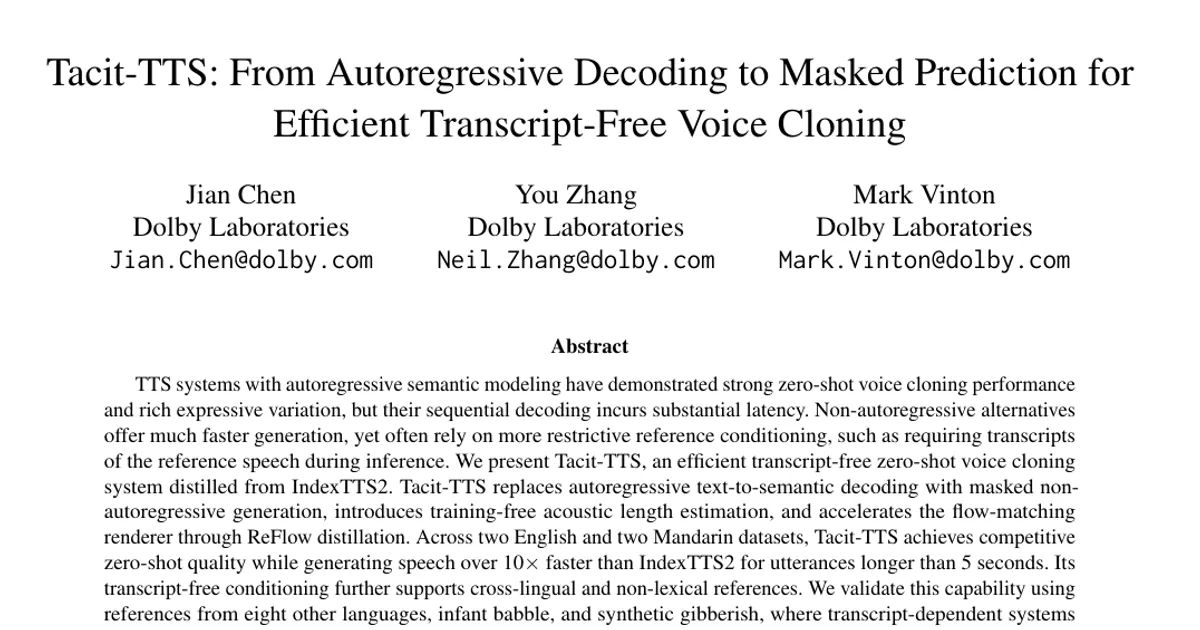
TTS systems with autoregressive semantic modeling have demonstrated strong zero-shot voice cloning performance and rich expressive variation, but their sequential decoding incurs substantial latency. Non-autoregressive alternatives offer much faster generation, yet often rely on more restrictive reference conditioning, such as requiring transcripts of the reference speech during inference. We present Tacit-TTS, an efficient transcript-free zero-shot voice cloning system distilled from IndexTTS2. Our model replaces autoregressive text-to-semantic decoding with masked non-autoregressive generation, introduces training-free acoustic length estimation, and accelerates the flow-matching renderer through ReFlow distillation. Across two English and two Mandarin datasets, Tacit-TTS achieves competitive zero-shot quality while generating speech over 10x faster than IndexTTS2 for utterances longer than 5 seconds. Its transcript-free conditioning further supports cross-lingual and non-lexical references. We validate this capability using references from eight other languages, infant babble, and synthetic gibberish, where transcript-dependent systems often degrade or fail due to unreliable ASR transcripts.