Research
TABX: A High-Throughput Sandbox Battle Simulator for Multi-Agent Reinforcement Learning
Overview Research area: Multi-agent reinforcement learning (MARL) environments and benchmarking, specifically a hardware-accelerated battle simulator built in JAX. Technical level: Intermediate. The p
- arXiv
- 2602.01665
- Published
- 2026-02-02
- Authors
- Hayeong Lee, JunHyeok Oh, Byung-Jun Lee
AI summary
Overview
Research area: Multi-agent reinforcement learning (MARL) environments and benchmarking, specifically a hardware-accelerated battle simulator built in JAX.
Technical level: Intermediate. The paper assumes familiarity with MARL terminology (centralized training with decentralized execution, value decomposition, unsupervised environment design) but the motivation and design principles are accessible without it.
Scope (one sentence): The paper introduces TABX, a JAX-based, reconfigurable multi-agent battle sandbox, and uses it to run controlled studies of centralized value learning, sparse-reward exploration, and zero-shot generalization.
What This Paper Is About
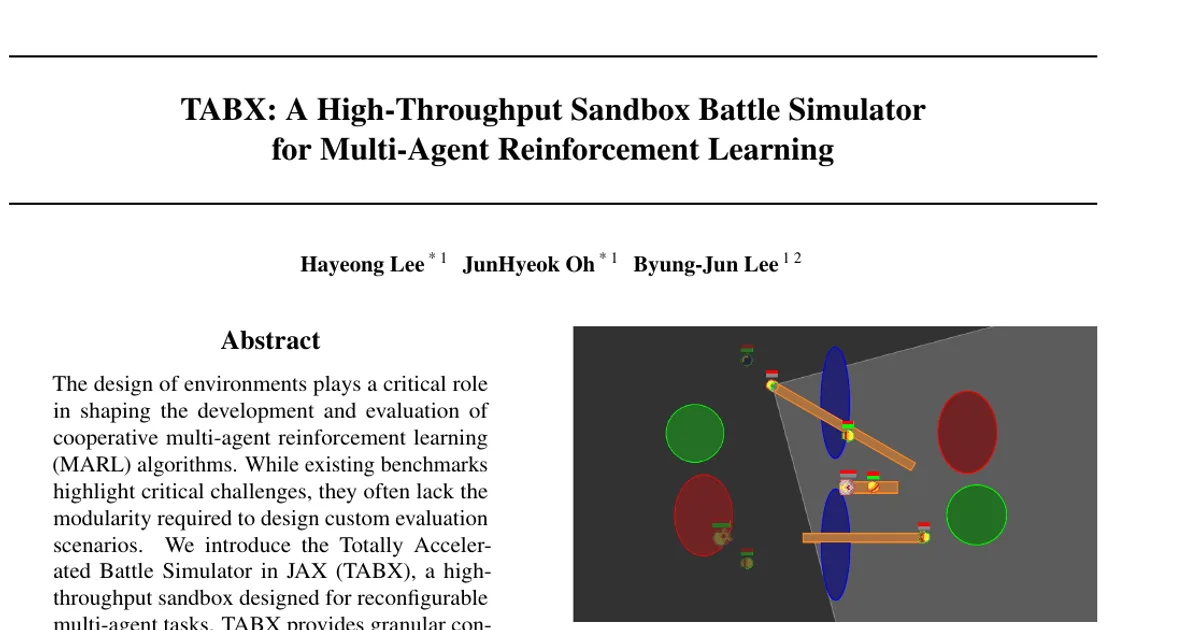
Most existing MARL benchmarks are built around fixed, static scenario sets, so testing an algorithm across many different conditions usually means maintaining several incompatible environment implementations or editing simulation code. This makes systematic comparison of MARL algorithms across diverse conditions costly and pushes empirical evaluation toward a narrow set of configurations. TABX (Totally Accelerated Battle Simulator in JAX) is a battle-style multi-agent environment where units, terrain zones, opponent heuristics, and physical dynamics are all exposed as reconfigurable parameters, so new evaluation scenarios can be created through configuration files or a graphical editor rather than code changes.
Key Contributions
- A high-throughput JAX-based battle simulator. TABX runs hardware-accelerated on GPUs with large-scale parallel environment sampling, and the authors provide a suite of representative baseline implementations to support standardized benchmarking and reproducible research.
- A customizable framework with no code modification required. Units, terrain, heuristic policies, and physical dynamics can be dynamically reconfigured, supported by a graphical scenario editor and a collection of predefined scenarios.
- Demonstrations of systematic MARL analysis. The authors show how controlled variation over environment parameters enables study of information-dependent value learning, sparse-reward exploration in long-horizon tasks, and zero-shot generalization.
- A recompilation-free design. Environmental parameters can be reset across episodes without JIT re-compilation, which the authors show yields substantially higher effective throughput than SMAX when scenarios are frequently reconfigured.
Main Findings
- Neither centralized nor independent learning dominates. MAPPO and IPPO both perform strongly across most scenarios, but IPPO outperforms MAPPO in crossfire, vsrangers, and ambush, indicating that the benefit of centralized value learning depends on the structure of partial observability and available state information. This is consistent with prior findings that centralized critics can suffer from poor generalization or misleading value estimates.
- QMIX outperforms IQL across multiple scenarios. The authors attribute this to QMIX's monotonic mixing network, which enforces a structured relationship between individual and joint value functions aligned with the Individual-Global-Maximum (IGM) principle.
- Some scenarios are markedly harder than others. ribbon and grid pose significant challenges due to disjoint partial observability and complex spatial interactions, and scenarios in TABX overall exhibit significant sample complexity.
- Value estimation error tracks scenario structure. Comparing learned value functions against a Monte Carlo estimate of the true value obtained via extensive rollouts, centralized value learning achieves substantially lower estimation error in scenarios that require global information (clover, ribbon), while offering limited or no advantage when local observations suffice (crossfire, vsrangers). A correlation analysis yields a strong negative correlation between value error and episode return (Pearson r = -0.82).
- Sparse-reward exploration benefits from intrinsic motivation. In the long-horizon pingpong and encirclement scenarios, RND (added to MAPPO using an intrinsic reward based on the global state representation) shows significant performance gains in both. In pingpong, RND achieves meaningful win rates after 15M environment steps; in encirclement, RND shows faster initial progress but high variance, while MAPPO with entropy coefficient σ = 0.01 reaches comparable win rates after approximately 20M environment steps.
- Zero-shot generalization to unseen unit specifications is unsolved. Across UED baselines, performance improves during training in all settings, and most methods gain significantly in terrain-zone-variant tasks. However, all evaluated baselines struggle to generalize to unseen unit specifications, yielding average win rates below 50%. Replay-based methods perform comparably to each other across both free parameter categories but significantly underperform relative to Domain Randomization in unit-specification evaluations.
- Health is the dominant generalization bottleneck. In isolated ablations over individual unit attributes, agents trained with only health variation achieve substantially lower win rates than those trained with speed or attack damage variation alone. Health induces a substantially wider effective difficulty range, creating a broad regret landscape that interacts poorly with UED's adaptive curriculum.
- Throughput scales near-log-linearly with parallel environments. TABX maintains stable scaling across different unit counts. Against SMAX over 100 distinct randomly generated scenario resets (including JIT-compilation overhead at each reset), TABX consistently achieves substantially higher throughput that is largely invariant to the number of units.
- The speed advantage comes from avoiding recompilation, not from a simpler simulation. In a fixed-configuration comparison with no scenario resets, TABX can be slower than SMAX for smaller numbers of parallel environments and larger team sizes, reflecting the higher per-step cost of its richer dynamics.
- MAPPO is the strongest competitor in policy-vs-policy play. When policies trained with MAPPO, IPPO, QMIX, and IQL compete pairwise for both teams, MAPPO achieves the strongest average performance across opponents.
Methodology in Plain English
TABX puts teams of simulated units into combat on a 2D field. Each unit sees only a fan-shaped region in the direction it is facing, so agents must rotate and move to find enemies. Rather than selecting a target, attacks and heals affect whatever sits inside a spatial "hurtbox" aligned with the unit's heading. Units come in nine types (four melee, three ranged, two supporters) and choose among seven discrete actions: four directional movements, one attack (or heal, for supporters), and two rotations.
Around this core, the authors expose four categories of parameters that can be changed between episodes without touching or recompiling the simulation code: unit specifications (such as health and attack damage), terrain zones (lava for periodic damage, bushes for asymmetric concealment, swamps for velocity attenuation), heuristic policy parameters that control how scripted opponents behave, and physical dynamics such as step size, collision tolerances, and coefficients of restitution. Heuristic opponents come in expertise levels (random, novice, medium) and are assigned functional roles (Assassin, Ranger, Healer) derived programmatically from a unit's kinematic and combat parameters.
To test the environment, the authors designed scenarios around specific research questions rather than reusing fixed benchmarks. For value learning, they contrast scenarios where local observations suffice with scenarios requiring global information, then measure the gap between the learned value function and a rollout-based Monte Carlo value estimate. For exploration, they build long-horizon tasks where any hit on the enemy requires high precision and entering enemy range incurs sustained negative reward, then compare MAPPO at several entropy coefficients against MAPPO augmented with RND. For generalization, they train with five UED algorithms (Domain Randomization, PLR, Robust PLR, ACCEL, SFL) using MAPPO as the base learner, sampling levels over unit specifications and zone layouts, then evaluate zero-shot transfer. All results are averaged over five random seeds with shaded regions indicating standard error; opponents use a medium-level heuristic in the MARL benchmarks and a novice-level heuristic in the UED unit- and zone-variation experiments.
Why This Matters
Impact on research. The paper argues that the overhead of maintaining multiple incompatible environment implementations pushes MARL evaluation toward a few favored configurations, making it hard to reliably analyze algorithm strengths and weaknesses across conditions. TABX offers a single, recompilation-free codebase where task distributions can be varied per episode, which the authors demonstrate is practical at scale. The finding that all evaluated UED baselines fall below 50% average win rate on unseen unit specifications, and that health specifically is the bottleneck, points to a concrete open problem: scaling UED to high-dimensional, agent-level parameter spaces where the number of free parameters grows with the number of agents.
Real-world applications (as framed by the authors' abstractions — the impact statement explicitly disclaims any real-world combat interpretation):
- Training and evaluating coordination algorithms for teams of autonomous agents operating under partial observability.
- Benchmarking robustness and zero-shot generalization when agent capabilities or environmental conditions change between training and deployment.
- Studying exploration in long-horizon settings where reward signals are sparse and initially unfavorable.
- Serving as infrastructure for curriculum-learning and unsupervised environment design research.
Industry relevance. The throughput results target the practical bottleneck of large-scale training: environment stepping and, in GPU-accelerated simulators, recompilation when scenarios change. A simulator that reconfigures without JIT re-compilation and scales near-log-linearly across parallel environments reduces the wall-clock cost of running broad hyperparameter and robustness sweeps. The paper reports measurements on a single NVIDIA RTX 4090 and an AMD Ryzen Threadripper PRO 7975WX (32 cores), hardware typical of research labs rather than large clusters.
Future Directions
- High-dimensional unit-level UED. The authors identify scaling UED to agent-level parameter spaces, where free parameters scale with the number of agents, as an open challenge for multi-agent curriculum learning.
- Transfer from single-agent to multi-agent control. The paper proposes agents first acquiring low-level control skills in single-agent settings before deployment in multi-agent environments, which could disentangle individual control from multi-agent cooperation.
- Hierarchical decomposition of cooperative tasks. Listed as a promising direction for future work with TABX.
- Extended environment components. Planned additions include terrain obstacles that restrict unit line-of-sight, structural elements such as fortifications and defensive walls, pixel-based observations for representation learning, and active unit-specific skills beyond static interaction variations.
Target Audience
MARL researchers who need to evaluate algorithms across many environment configurations rather than a single fixed benchmark; benchmark and simulator developers interested in JAX-based, recompilation-free environment design; and researchers working on unsupervised environment design, zero-shot generalization, or exploration in long-horizon multi-agent tasks. Practitioners looking for a configurable GPU-accelerated testbed, including those who prefer specifying scenarios through a graphical editor rather than code, will also find the framework directly usable.
Authors’ abstract
The design of environments plays a critical role in shaping the development and evaluation of cooperative multi-agent reinforcement learning (MARL) algorithms. While existing benchmarks highlight critical challenges, they often lack the modularity required to design custom evaluation scenarios. We introduce the Totally Accelerated Battle Simulator in JAX (TABX), a high-throughput sandbox designed for reconfigurable multi-agent tasks. TABX provides granular control over environmental parameters, permitting a systematic investigation into emergent agent behaviors and algorithmic trade-offs across a diverse spectrum of task complexities. Leveraging JAX for hardware-accelerated execution on GPUs, TABX enables massive parallelization and significantly reduces computational overhead. By providing a fast, extensible, and easily customized framework, TABX facilitates the study of MARL agents in complex structured domains and serves as a scalable foundation for future research. Our code is available at: https://github.com/ku-dmlab/TABX.