Research
SwarmRSI: Recursive Self-Improvement through Evolving Scientific Agent Swarm
Overview Research area: Artificial intelligence — LLM-based scientific agents, automated scientific discovery, and recursive self-improvement (RSI) of agent systems. Technical level: Advanced. The pap
- arXiv
- 2610.20431
- Published
- 2026-10-14
- Authors
- Qianru Meng, Xi Zhang, Konstantinos Papakostas, Congfeng Cao, Wenxiang Hu, Tianyi Lu, Xiao Zhang, Lun Zhou, Zaiqiao Meng, Zhaochun Ren, Xiaohui Yan, Yougang Lyu
AI summary
Overview
Research area: Artificial intelligence — LLM-based scientific agents, automated scientific discovery, and recursive self-improvement (RSI) of agent systems.
Technical level: Advanced. The paper assumes familiarity with LLM agent architectures, evolutionary search operators (mutation, crossover, rebase), multi-armed-bandit scheduling, and bioinformatics benchmarks.
Scope: The paper introduces SwarmRSI, a framework in which a swarm of scientific agents improves its own research by evolving the hypotheses, programs and experimental evidence that later agents inherit, evaluated on OpenProblems, NatureBench and MLE-Bench Lite (118 scientific coding and machine-learning engineering tasks) with DeepSeek-V4-Pro and Gemini 3.1 Pro Preview.
What This Paper Is About
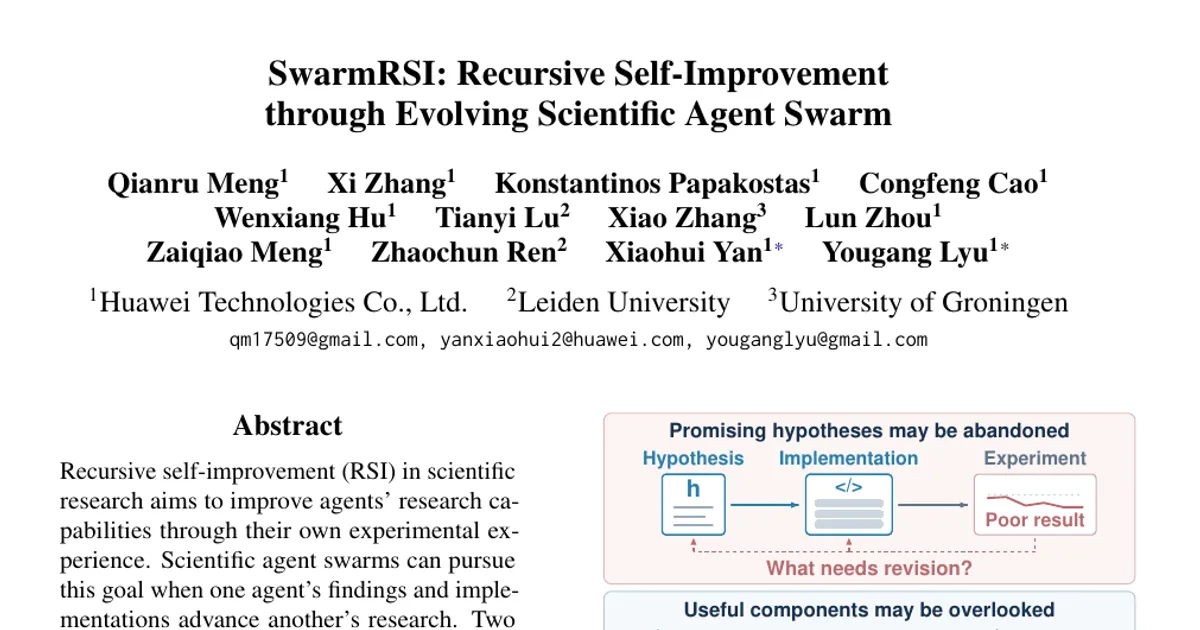
Scientific agents can, in principle, get better at research by learning from their own experiments — but two obstacles block this. First, when an experiment fails, it is unclear whether the hypothesis was wrong or the code implementing it was broken. Second, a program that shows no overall gain can still contain a useful component that another agent needs later. SwarmRSI addresses both by making the inherited research state — hypotheses, programs, evidence and unresolved needs — the object that evolves, so that every experiment (successful, failed, or without gain) changes what the next agent starts from.
Key Contributions
-
A reformulation of recursive self-improvement for scientific agent swarms. Instead of improving a single agent's code, policy or workflow, the paper formulates RSI as evolving inheritable research states: each experiment updates the hypotheses, programs and evidence later agents begin with.
-
The SwarmRSI framework, built from three mechanisms: Feedback-Guided Swarm Mutation (agents use other agents' feedback to decide whether to revise a hypothesis — an H-mutation — or keep it and repair the program — a P-mutation), Complementary Swarm Recombination (rebase: apply a retained hypothesis to another agent's valid program base; crossover: combine program components that win on different instances), and Recursive Swarm Evolution (every outcome, including failures and non-improving attempts, returns to a shared graph that guides which state is updated next).
-
State-of-the-art empirical results on OpenProblems and NatureBench, with the highest Match-SOTA rate among compared methods, plus the highest Any-Medal rate reported among hypothesis and program evolution agents with the same backbone on MLE-Bench Lite.
-
Evidence that inherited states drive the results and cross into real biology. About 77% of final best NatureBench programs in one DeepSeek-V4-Pro seed descend from a rebase, a crossover or a feedback-triggered update, and biologists reproduced two of the evolved programs for follow-up analyses of intestinal and splenic immunity.
Main Findings
-
OpenProblems (six single-cell analysis tasks). SwarmRSI with Gemini 3.1 Pro Preview reaches an average score of 76.2, the highest reported in the paper's comparisons; with DeepSeek-V4-Pro it reaches 74.2, against 67.1 for TusoAI on the same backbone. For reference, the human expert average listed is 57.2 and ChatGPT with GPT-5 is 56.5. Scores are normalized and scaled by 100, averaged over three seeds for rows marked with a dagger.
-
NatureBench (all 90 scientific coding tasks, six domains). SwarmRSI achieves a 44.4% Match-SOTA rate with both DeepSeek-V4-Pro and Gemini 3.1 Pro Preview, the highest among compared methods. With DeepSeek-V4-Pro it exceeds Claude Code with the same backbone by 21.1 percentage points in Match-SOTA, Arbor by 7.8 pp and AIDE by 16.7 pp, with the Arbor and AIDE gaps reported as statistically significant (McNemar test, p < 0.05; 95% paired bootstrap confidence intervals).
-
MLE-Bench Lite (22 low-complexity competitions). SwarmRSI wins a medal (Any-Medal) on 81.8% of tasks with both DeepSeek-V4-Pro and Gemini 3.1 Pro Preview, above Arbor (77.3% with DeepSeek-V4-Pro) and MLEvolve (72.7% with DeepSeek-V4-Pro). It uses fewer tokens than TusoAI and Arbor.
-
Both mutation modes matter. On all 90 NatureBench tasks, removing H-mutation lowers Match-SOTA by 10.0 pp and removing P-mutation by 13.3 pp; program repair contributes more, and the authors state the two modes are complementary.
-
Recombination carries real gains. Disabling rebase and crossover lowers Match-SOTA by 6.7 pp and drops Surpass-SOTA from 15.6% to 7.8%. In one DeepSeek-V4-Pro seed over all 90 NatureBench tasks, about 77% of final best programs descend from at least one rebase, crossover or feedback-triggered update.
-
The shared graph and adaptive scheduling are load-bearing. Match-SOTA falls by 7.8 pp without the shared graph and by 8.9 pp replacing adaptive H/P selection with fixed H/P alternation; the latter also causes the largest drop in mean g (from 12.8 to 4.6, scaled by 100).
-
Failure recovery is markedly better than the baselines. Later refinement turns 35% of failed implementations into new best valid programs, versus 12% for AIDE and 5% for Arbor. Of SwarmRSI's proposed hypotheses, 62% lead to an improvement, against 17% for Arbor.
-
Feedback-conditioned updates are more productive. In one NatureBench seed with DeepSeek-V4-Pro, updates triggered by performance feedback or unresolved implementation requests reach a 28.4% rate of new bests, against 21.9% over all updates.
-
Inherited states transfer across tasks. After three generations of source tasks, the inherited state raises mean g on 12 held-out NatureBench tasks from 12.01 to 21.89 and Match-SOTA from 41.7% to 86.1% over cold start.
-
Most annotated failures are faithful experiments that simply did not help. Of 644 annotated failed attempts from 35 SwarmRSI trajectories, 93.3% are faithful interventions without gains and 6.7% are implementation or execution problems (two annotators, Cohen's κ = 0.92). A valid score can still hide an implementation problem — on task 00838, downstream code overwrites a proposed amino-acid substitution that evaluation never tests.
-
Biological reproduction. On the contrastiveVI task, the evolved program removes from each infected cell the mean of its healthy neighbours before reducing residuals. On the Haber intestinal instance, measured enterocyte RNA shows higher MHC-II scores in helminth day-10 than Salmonella infection (means 1.17 and 0.34), and the reproduced representation is locally more coherent than RNA PCA in the two helminth day-10 sources for MHC-II (Spearman's ρ after covariate adjustment 0.77 and 0.69 versus 0.65 and 0.40). On the CytoCommunity task, the evolved program raises g from 0.045 to 0.102 and matches expert neighbourhood groupings for spleen tissue across three images, where 20–21% of B cells in the manually annotated marginal zone occupy myeloid/erythroid-rich neighbourhoods.
Methodology in Plain English
The researchers treat a swarm of scientific agents as a population that shares one growing memory. Each agent, when it acts, assembles a "state" from that shared graph: hypotheses, programs, experimental evidence, and unresolved needs contributed by every agent so far. The graph deliberately keeps failed attempts and attempts without gain, because the hypothesis–program edges and reuse relations are what make partial results findable later.
Three mechanisms operate on these states. In Feedback-Guided Swarm Mutation, an agent reads other agents' results to decide what kind of fix is needed: if an implementation failed, it keeps the hypothesis and repairs the program (a P-mutation); if results diverge across instances, it revises the hypothesis (an H-mutation). In Complementary Swarm Recombination, an agent takes a hypothesis that was never properly realized and re-implements it on another agent's working program base (rebase), or it looks at which programs win on which dataset or subtask and pulls the winning components from several of them into one new program (crossover), keeping the parent's components elsewhere.
Recursive Swarm Evolution decides what to do next. It maintains two frontiers — active hypotheses and valid program representatives — and scores each with a discounted upper-confidence-bound index that combines recent improvement per token spent (discount factor 0.9), an exploration term (weight 0.5), and a "request pressure" term capturing unresolved needs that a frontier could address (weight 0.25, saturating at 4). Untried and long-waiting frontiers take priority. After each attempt, a code audit and a scientific audit check execution, task compliance, and whether the intended change was actually implemented (flagging unchanged source or identical submitted outputs); those flags gate whether a hypothesis gets credit. Every outcome updates the graph, from which the next agent assembles its state. Search runs until the budget is exhausted, then returns the best valid program found.
Why This Matters
The paper's core claim is that a swarm improves its own research capability by changing what its members inherit, not by fine-tuning a model or tuning a workflow. That reframes how self-improving scientific systems can be built: failures become informative signal rather than dead ends, and mediocre programs become parts suppliers.
Real-world applications suggested by the work:
- Single-cell and spatial biology pipelines. The evolved programs handle denoising, batch integration, spatially variable gene identification, decomposition and visualization, and were reproduced by biologists for enterocyte immune-expression and spleen tissue-architecture analyses.
- Machine-learning engineering under competition-style constraints. On MLE-Bench Lite the system produces medal-winning submissions on 81.8% of the 22 low-complexity competitions, suggesting use in automated model construction and submission workflows.
- Cross-domain scientific coding assistance. NatureBench spans protein biology, cellular omics, physical modeling, molecular design, relational reasoning and biomedical modeling, so the same framework is applied across six scientific domains.
- Reuse of partial and negative results in long-running research campaigns. The mechanism that turns 35% of failed implementations into new best programs is directly relevant to any setting where experiments are expensive and failure is common.
Industry relevance: the work comes from Huawei Technologies Co., Ltd. with academic collaborators at Leiden University and University of Groningen, and the authors compare against commercial coding agents (Claude Code, Codex, Gemini CLI) and domain-specific scientific agents (Biomni, TusoAI). The reported token efficiency relative to TusoAI and Arbor matters for the cost of running long scientific searches.
Future Directions
-
Pushing the fraction of hypotheses that convert into improvements. SwarmRSI already turns 62% of proposed hypotheses into improvements versus 17% for Arbor; the remaining gap and the 93.3% faithful-but-unproductive failures suggest room for better hypothesis evaluation.
-
Closing the residual implementation-fidelity gap. 6.7% of annotated failures are implementation or execution problems, and task 00838 shows a valid score can hide an untested intervention — a target for stronger auditing.
-
Broadening biological and cross-domain validation. Only two evolved programs were reproduced by biologists, so the scope of external scientific validation is narrow relative to the 118 tasks evaluated.
-
More seeds and backbones. The RSI statistics on NatureBench (about 77% of final best programs descending from reuse) are reported from one DeepSeek-V4-Pro seed, and MLE-Bench Lite values marked with a dash are unreported, leaving these claims open to broader replication.
Target Audience
Researchers and engineers working on LLM agents for scientific discovery, automated machine-learning engineering, and evolutionary or self-improving agent architectures; benchmark designers evaluating scientific coding agents; and computational biologists interested in whether agent-evolved analysis programs hold up under expert reproduction and follow-up immune analyses. Readers need a working grasp of agent search, ablation methodology and evaluation metrics such as Match-SOTA, Surpass-SOTA and medal rates to get the most from the results.
Authors’ abstract
Recursive self-improvement (RSI) in scientific research aims to improve agents' research capabilities through their own experimental experience. Scientific agent swarms can combine evidence and implementations from different research directions to guide their agents' subsequent experiments. However, poor experimental results can leave unclear whether to revise a hypothesis or its implementation, while overall program scores can hide components useful to other agents. To address these challenges, we introduce SwarmRSI, a framework that evolves scientific agent swarms for recursive self-improvement. We devise Feedback-Guided Swarm Mutation to refine hypotheses and their implementations using experimental feedback from other agents. We also propose Complementary Swarm Recombination to reuse retained hypotheses and complementary program components across agents, allowing partial results to support new research. Recursive Swarm Evolution integrates both mechanisms into a feedback loop, using new experimental evidence to guide subsequent research. Experiments on OpenProblems, NatureBench and MLE-Bench Lite demonstrate SwarmRSI's state-of-the-art (SOTA) performance. Further evaluations show that accumulated research experience improves performance on held-out tasks. Biologists also reproduce its programs for follow-up biological analyses.