Research
Superpositional Gradient Descent: Harnessing Quantum Principles for Model Training
Overview Research area: Quantum-inspired optimization for deep learning — specifically, an optimizer for training transformer-based large language models that injects quantum-circuit-derived perturbat
- arXiv
- 2511.01918
- Published
- 2025-11-01
- Authors
- Ahmet Erdem Pamuk, Emir Kaan Özdemir, Şuayp Talha Kocabay
AI summary
Overview
Research area: Quantum-inspired optimization for deep learning — specifically, an optimizer for training transformer-based large language models that injects quantum-circuit-derived perturbations into classical gradient updates.
Technical level: Intermediate. The math is compact and readable, but comfort with gradient descent, Adam-style optimizers, and basic quantum gate notation (Hadamard, rotation gates, CNOT) helps.
Scope: The paper proposes, formalizes, and empirically tests "Superpositional Gradient Descent" (SGD) — a hybrid quantum-classical optimizer implemented with PyTorch and Qiskit — on a small synthetic text classification task and on fine-tuning of Llama-3.2-1B-Instruct on GSM8K.
Note on naming: the authors abbreviate their method as SGD, which collides with the conventional meaning of "stochastic gradient descent." Throughout this summary, SGD refers to Superpositional Gradient Descent unless stated otherwise.
What This Paper Is About
Classical optimizers such as Adam and AdamW can get stuck in poor local minima or need many iterations when navigating the high-dimensional, non-convex loss landscapes of transformer models. The authors ask whether the quantum principle of superposition — a system existing in multiple states at once — can be borrowed, purely in simulation, to help a classical optimizer explore more diverse parameter configurations. Their goal is a hybrid update rule that adds a small quantum-circuit-driven perturbation to standard momentum-based updates and measurably speeds convergence.
Key Contributions
-
A new optimizer formulation. The paper defines Superpositional Gradient Descent as a hybrid update rule combining Adam-style momentum normalization with a quantum-inspired perturbation term controlled by a weight λ.
-
A sine-based perturbation function. The perturbation applies
sin(π · θ_i)to gradient components for the firstn_qubitsparameters (and zero elsewhere), motivated as an analogue of constructive and destructive interference in quantum wave functions, intended to help escape shallow local minima. -
A quantum-enhanced transformer attention mechanism. Standard scaled dot-product attention is augmented with a term Φ derived from a parameterized quantum circuit (Hadamard gates, Ry and Rz rotations, CNOT entanglement), increasing the attention scores' representational flexibility.
-
Hybrid implementation and empirical evaluation. The method is implemented in PyTorch and Qiskit (TorchConnector, statevector simulator, and Qiskit Aer with GPU acceleration for larger models) and benchmarked against Adam on synthetic text classification and against AdamW on GSM8K fine-tuning of Llama-3.2-1B-Instruct.
Main Findings
-
Text classification accuracy: Superpositional Gradient Descent with λ = 0.5 achieves the highest final accuracy of 93.8% ± 0.7%, outperforming standard Adam by 2.3 percentage points.
-
Convergence speed: The same configuration reaches the target accuracy of 90% in 4.6 epochs on average, versus 7.4 epochs for Adam — a 37.8% reduction in training time.
-
Four-way comparison: The text classification experiment compared standard Adam, Adam with quantum-inspired moment updates, Superpositional Gradient Descent with λ = 0.1, and Superpositional Gradient Descent with λ = 0.5. The paper reports no numeric results for the "Adam with quantum-inspired moment updates" baseline.
-
LLM fine-tuning loss: On GSM8K after one epoch with Llama-3.2-1B-Instruct, mean loss was 0.2097 for λ = 0.5 and 0.2098 for λ = 0.1, versus 0.2188 for AdamW (Table I).
-
Relative loss reduction: λ = 0.1 gives a 4.11% reduction in loss relative to AdamW; λ = 0.5 raises this slightly to 4.16%. The authors describe the gap as marginal and suggest diminishing returns with higher quantum weighting.
-
Computational cost trade-off: The optimizer requires roughly 35% more time per epoch than Adam because of quantum circuit simulation, but total time to reach 90% accuracy is 16% lower, since fewer iterations are needed.
-
Stated limitations: The authors explicitly say scalability and hardware constraints limit adoption of the approach.
Methodology in Plain English
The authors take the standard Adam update — momentum divided by the square root of the second moment — and add a second term multiplied by a weight λ. That extra term is computed by pushing the current parameter value through a sine function and multiplying by the gradient, but only for the first few parameters (those indexed below n_qubits); all remaining parameters get zero perturbation. The sine creates a wave-like push that alternates between amplifying and dampening the gradient as a parameter moves through its range, which the authors liken to quantum interference.
Separately, they modify the transformer's attention layer: instead of computing attention purely from query-key dot products, they run the attention scores through a small simulated quantum circuit — Hadamard gates, learned Ry and Rz rotations, and CNOT gates entangling adjacent qubits — and add the resulting amplitudes to the attention logits before the softmax.
Both parts run entirely on classical hardware via Qiskit simulation; no quantum computer is used. The classification experiments used a small transformer (64-dimensional embeddings, 4 attention heads, 2 layers, feed-forward dimension 128, dropout 0.1) with batch size 32, learning rate 1×10⁻³, and a 4-qubit, depth-2 circuit, trained in FP32 on an NVIDIA A100. The fine-tuning experiments used Llama-3.2-1B-Instruct (1.2B parameters, context length 2048) on GSM8K with batch size 1, learning rate 2×10⁻⁵, 500 warmup steps, linear decay to zero, weight decay 0.01, gradient clipping 1.0, and mixed FP16 precision on an NVIDIA A100.
Why This Matters
Impact on research. The paper argues that quantum principles can improve classical training even without quantum hardware, by treating superposition as a source of structured exploration noise. It sits at the intersection of quantum computing and deep learning and offers a concrete, testable template for quantum-inspired optimizers rather than a purely conceptual argument.
Real-world applications (as motivated by the paper's framing):
- Faster fine-tuning of open-weight LLMs on reasoning datasets such as GSM8K.
- Reducing wall-clock time in training pipelines where iteration count, not per-step cost, is the bottleneck.
- Hybrid quantum-classical model design, where simulated circuits augment attention layers.
- Deployment scenarios on classical GPUs where quantum-inspired perturbations substitute for unavailable quantum processors.
Industry relevance. The headline trade-off — about 35% higher per-epoch cost but 16% lower time-to-target-accuracy — is directly relevant to teams weighing compute budgets against convergence speed. The paper is candid that scalability and hardware constraints currently block broader adoption, and no results are reported for models larger than 1.2B parameters.
Future Directions
-
Scaling to larger models. The authors name scaling beyond the 1.2B-parameter Llama-3.2-1B-Instruct setting as a primary next step; current evidence covers only one small LLM and one small synthetic task.
-
More sophisticated quantum circuit designs. The circuit used here is deliberately shallow (depth 2, Ry and Rz gates, adjacent-qubit CNOTs, 4 qubits); the paper calls for exploring richer circuit architectures.
-
Implementation on real quantum processors. All experiments rely on Qiskit's statevector simulator and the Aer GPU-accelerated simulator, so a natural open question is whether the approach behaves the same way on physical quantum hardware.
-
Resolving the cost-effectiveness question at scale. The reported 35% per-epoch overhead versus the 16% end-to-end time saving raises an unresolved question about where, if anywhere, the crossover point favors the method — the paper reports diminishing returns between λ = 0.1 and λ = 0.5 but does not report a study of larger λ values or larger qubit counts beyond noting they raise cost.
Target Audience
Machine learning researchers working on optimization methods for large models; quantum computing researchers interested in near-term hybrid quantum-classical applications; and graduate students or advanced undergraduates in either field looking for a self-contained example of how quantum-inspired ideas can be expressed as a small change to an existing optimizer. Practitioners seeking a drop-in replacement for AdamW should note that the paper reports only a 4.11–4.16% loss reduction on one fine-tuning dataset, with a substantial simulation overhead — the results are a proof of concept, not a production recipe.
Authors’ abstract
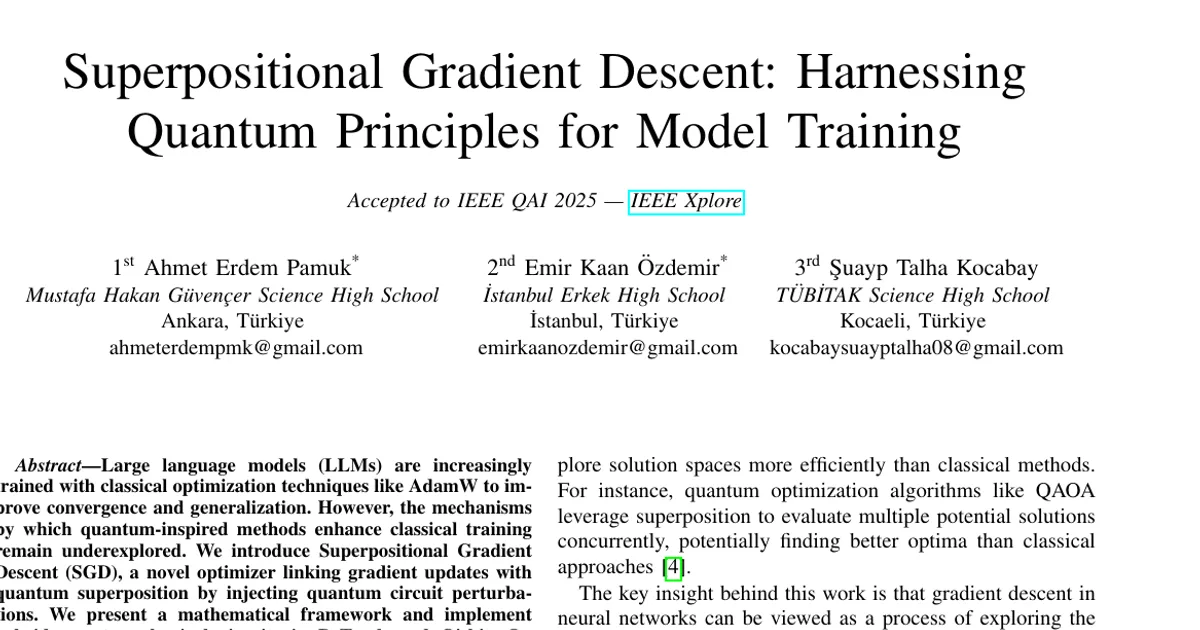
Large language models (LLMs) are increasingly trained with classical optimization techniques like AdamW to improve convergence and generalization. However, the mechanisms by which quantum-inspired methods enhance classical training remain underexplored. We introduce Superpositional Gradient Descent (SGD), a novel optimizer linking gradient updates with quantum superposition by injecting quantum circuit perturbations. We present a mathematical framework and implement hybrid quantum-classical circuits in PyTorch and Qiskit. On synthetic sequence classification and large-scale LLM fine-tuning, SGD converges faster and yields lower final loss than AdamW. Despite promising results, scalability and hardware constraints limit adoption. Overall, this work provides new insights into the intersection of quantum computing and deep learning, suggesting practical pathways for leveraging quantum principles to control and enhance model behavior.