Research
Stuck on Shuffle: On Attribute-Object Binding in Vision-Language Models
Overview Research area: Computer vision and multimodal representation learning — specifically compositional reasoning in vision–language embedding models, with a focus on attribute–object binding. Tec
- arXiv
- 2610.22602
- Published
- 2026-10-15
- Authors
- Netanel Y. Tamir, Michael Green, Issar Tzachor, Or Shimshi, Dvir Samuel, Or Patashnik, Rami Ben-Ari
AI summary
Overview
Research area: Computer vision and multimodal representation learning — specifically compositional reasoning in vision–language embedding models, with a focus on attribute–object binding.
Technical level: Intermediate. Readers should be comfortable with contrastive image–text embeddings (CLIP-style models), retrieval metrics such as mAP and Hit@1, and the idea of a shared embedding space, but the paper's argument is accessible without deep mathematics.
Scope: The paper introduces SABER, a controlled synthetic benchmark for measuring whether vision–language embeddings preserve which attribute belongs to which object across all four image/text modality pairings, and shows that finetuning a multimodal embedder on synthetic text alone substantially improves this binding.
What This Paper Is About
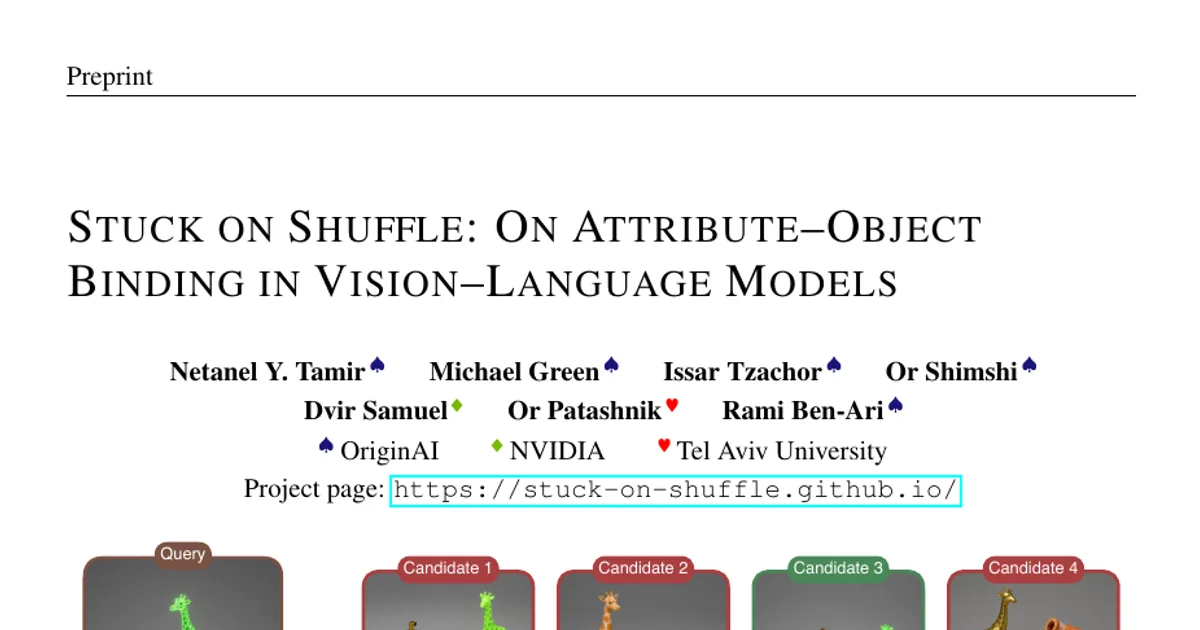
Multimodal retrieval systems embed images and text into a shared space and match them by similarity, but their embeddings often behave like "bag-of-words" matchers: they notice that a golden cannon and a tie-dye submarine are present without reliably encoding that "golden" goes with the cannon and "tie-dye" with the submarine. Existing benchmarks only partially test this, covering one modality pairing, small attribute vocabularies (often just color), or simple two-object swaps. The paper builds a broader benchmark (SABER) to expose the full extent of these failures, then asks whether binding can be fixed cheaply using only synthetic text supervision rather than costly curated images.
Key Contributions
- SABER benchmark. A controlled synthetic benchmark of 4-way multiple-choice questions that isolates attribute–object binding by holding the object and attribute sets fixed while varying their assignment. It covers all four modality pairings (text→text, text→image, image→text, image→image), 232 everyday objects, 50 visual attributes across 6 semantic categories, and scenes with 2 to 10 objects — totaling 1,800 queries, 7,200 candidates, and 9,000 image–caption pairs.
- Dual evaluation protocols. Each SABER item is scored both as a 4-way MCQ and as large-gallery retrieval against all 7,200 candidates, with retrieval split into independent queries (one valid positive) and nested chain queries (multiple valid positives, where a later, larger scene containing all query bindings also counts as correct).
- A text-only finetuning recipe. 200,000 synthetic triplets (query, binding-preserving positive, binding-conflicting hard negative) generated with Gemma 4, used to finetune Qwen3-VL-Embedding-2B and Qwen3-VL-Embedding-8B with LoRA plus LiNeS — with no image supervision at any point.
- Evidence that binding gains transfer. Evaluation on 9 existing attribute-binding benchmarks (12 retrieval settings), plus negation (NegBench) and instance retrieval, while checking that general multimodal performance on MMEB-v3 is preserved.
Main Findings
- Binding failures are widespread. On SABER, CLIP-style dual encoders and MLLM-based embedders both show substantial failures across all four modality pairings and all scene sizes. Among pretrained models, Qwen3-VL-Embedding-8B was strongest with a mean MCQ accuracy of 52.5% and mean retrieval mAP of 71.9% (independent) and 38.3% (nested).
- Text-only finetuning produces large gains. The finetuned 8B model reaches 84.2% mean MCQ accuracy, up from 52.5%, with 99.3% on text→text, 69.0% on text→image, 74.1% on image→text, and 94.3% on image→image. Despite no visual training data, it gains 34.1, 37.8, and 9.4 points on text→image, image→text, and image→image respectively.
- Smaller model improves too but less. The finetuned 2B model reaches 56.4% mean MCQ accuracy versus 40.8% for its pretrained counterpart, an average gain of 15.6 points.
- Retrieval improves as well. The finetuned 8B model reaches 91.1% mean mAP on independent retrieval (a 19.2-point gain) and 54.1% on nested retrieval versus 38.3%. The finetuned 2B model reaches 73.8% and 39.5% respectively.
- CLIP-style models fail differently. For all models except the CLIP ViT-B/32 variants, the correct candidate and its three binding-swapped distractors occupy the top four retrieved positions in over 90% of queries, so retrieval reduces to the same comparison as the MCQ. For CLIP-based models this happens in only 27–53% of queries, with the failure concentrated in cross-modal pairings — unrelated scenes are retrieved instead.
- Containment is a separate unsolved problem. In nested retrieval, candidates containing only a subset of the query bindings outrank the exact match in only 3.3–17.1% of comparisons on average, but candidates containing all query bindings plus extra ones outrank the exact match in 33–39% of cases. Recognizing valid supersets is harder than rejecting swapped bindings.
- Gains generalize to prior benchmarks. The finetuned 8B model outperforms every baseline in all 12 settings across 9 benchmarks, improving 15.4 points on average over Qwen3-VL-Embedding-8B, including 22.8 points on SugarCrepe++ text→text, 33.9 points on ColorSwap text→image, and 25.6 points on CLEVR image→text. The finetuned 2B model improves 8.2 points on average.
- Small gains extend to ten-object scenes. Improvements hold even at scene sizes larger than the two- or three-pair bindings seen during finetuning.
- General capability is largely preserved. On 182 non-audio MMEB-v3 tasks, aggregate performance changes by −0.5 points (2B) and +0.5 points (8B) relative to the pretrained models, with gains on agent tasks and small declines on image, video, and text tasks.
- Negation improves as a side effect. On NegBench, finetuning improves overall accuracy by 9.3 points on COCO and 10.5 points on PASCAL VOC 2007, driven mainly by hybrid cases that require assigning negation to the correct object. A variant trained after removing the 7.1% of finetuning examples containing negation terms retains nearly all gains, indicating transfer rather than direct exposure.
- Instance retrieval improves too. Across eight image–image settings and one text–image setting, the finetuned 8B model improves by +2.1 to +9.9 mAP, and improves in all 38 fine-grained ILIAS categories with a mean gain of 8.5 points (e.g., ILIAS 58.5 → 68.4).
Methodology in Plain English
The researchers first build a benchmark that removes confounds. They pick a set of objects and a set of attributes, pair them into a short templated caption ("a sandy snowboard and a pink cherry"), and then generate four candidates. One keeps the original pairings; the others keep the same objects and attributes but shuffle which attribute goes with which object. Because every candidate contains the same words, a model cannot succeed by recognizing concepts alone — it must encode the pairing. Images are synthesized with GPT Image 2 using neutral CLEVR-style scenes with consistent attribute appearance across the five images of an item, and all images are manually inspected. Half the items are arranged into nested chains from two to ten objects, where each successive query adds one binding while keeping earlier ones, which creates multiple valid positives for retrieval.
They then test a range of models: CLIP ViT-B/32 and its compositional variants (LABCLIP, TripletCLIP, READ-CLIP), PE-Core-bigG-14-448, LamRA-Ret, and Qwen3-VL-Embedding at 2B and 8B.
For the fix, they generate 200,000 text triplets with Gemma 4. Each query states two or three attribute–object pairs; the positive places those bindings in a natural sentence; the hard negative is produced by permuting attributes or objects so it differs only in the assignments. Attributes are chosen to stay plausible for every object and pair order is randomized to block shortcuts. They finetune Qwen3-VL-Embedding with a standard triplet loss on these text triples only, using LoRA, then apply LiNeS to rescale layer-wise updates and limit forgetting. The hypothesis is that an MLLM shares parameters across modalities, so updating them from text should also change how images are embedded.
Why This Matters
Research impact. The paper reframes compositional precision as a distinct axis of embedding quality that deserves its own evaluation, and shows that a capability can be improved in one modality by supervising another — a result with implications for how multimodal models are trained and for how benchmarks should be designed (modality coverage, vocabulary breadth, number of bindings per sample).
Real-world applications.
- E-commerce search: matching a query like "red linen shirt and blue denim jacket" to the right product images, where colors and materials must not be swapped between items.
- Digital asset and stock media retrieval: finding an image with a specific combination of attributes among thousands of similar candidates.
- Visual product and instance recognition: distinguishing specific instances (a particular shirt in a given color) rather than just categories, relevant to cataloging and counterfeit detection.
- Accessibility and content description: generating and verifying captions where attribute–object assignment must be correct for the description to be useful.
Industry relevance. The method avoids the expensive and noisy pipeline of generating controlled image–text training pairs; text is cheap to generate at scale, permits precise hard negatives, and broadens the range of attributes (including non-visual ones) that can be supervised. The finding that a general-purpose embedder can be specialized with LoRA plus a small text corpus, without losing much on a 182-task multimodal suite, is directly useful for teams that need domain-specific retrieval quality without retraining from scratch.
Future Directions
- Containment and superset matching. Nested retrieval shows that models struggle to prefer an exact match over a larger scene containing extra bindings; the paper leaves this as an open challenge distinct from swap discrimination.
- Beyond synthetic scenes. The stated limitation is that SABER is synthetic and generated images may contain unintended variation in appearance, layout, object size, or orientation beyond the intended binding changes; extending to natural images with equally controlled bindings remains open.
- Scaling and composition breadth. The finetuning data permutes bindings among only two or three pairs, yet gains extend to ten-object scenes — whether more complex training compositions, or other compositional operations beyond attribute swaps (relations, word order), yield further improvements is untested.
- Architectural alternatives. The paper uses a standard single-vector embedding and inference procedure; whether binding supervision composes with late-interaction or pairwise-scorer approaches is not explored.
Target Audience
Researchers and engineers working on multimodal retrieval, vision–language representation learning, and embedding model training; practitioners who need reliable compositional matching in production search or recommendation systems; and benchmark designers interested in controlled evaluation of compositional reasoning. Readers new to the area will still follow the core argument, since the benchmark design and the main results are presented in terms of accuracy and mAP rather than model internals.
Authors’ abstract
Retrieval is a fundamental task in multimodal systems: given an image or text query, the goal is to find the most relevant images or texts in a collection, often using a shared embedding space. Reliable retrieval requires these embeddings to capture not only which concepts are present, but also how they are composed. One key compositional challenge is attribute--object binding: encoding which attributes belong to which objects. Existing benchmarks provide a limited view of this capability, typically covering a subset of modality pairings, simple two-object swaps, or small attribute sets. Consequently, it remains unclear how robustly current models preserve attribute--object bindings across different modality pairings and more complex settings. We therefore introduce SABER, a controlled benchmark for evaluating attribute--object binding across all four image and text modality pairings, spanning diverse attribute types and scenes with up to ten objects. Evaluating models on SABER reveals substantial binding failures in both CLIP-style dual encoders and recent MLLM-based embedders. These findings motivate us to ask how binding can be improved efficiently. While multimodal supervision may be effective, collecting suitable images is difficult and costly. Text, on the other hand, is well suited to binding supervision: it is cheap to generate, supports a broader range of attributes and enables precisely controlled hard negatives. We thus finetune an MLLM-based embedder exclusively on synthetic attribute-binding text. Despite the absence of image supervision, the gains transfer to cross-modal and image--image retrieval while preserving general multimodal embedding performance. Our model achieves SOTA results on SABER while also improving on negation and instance-retrieval benchmarks, demonstrating broader benefits of our binding-focused supervision.