Research
Step-Tagging: Toward controlling the generation of Language Reasoning Models through step monitoring
Overview Research area: Natural Language Processing / efficient inference for Language Reasoning Models (LRMs), specifically black-box monitoring of reasoning traces for dynamic early stopping. Techni
- arXiv
- 2512.14332
- Published
- 2025-12-16
- Authors
- Yannis Belkhiter, Seshu Tirupathi, Giulio Zizzo, John D. Kelleher
AI summary
Overview
Research area: Natural Language Processing / efficient inference for Language Reasoning Models (LRMs), specifically black-box monitoring of reasoning traces for dynamic early stopping.
Technical level: Intermediate. The paper is readable without deep mathematics, but it assumes familiarity with LLM reasoning traces, classification metrics (Micro/Macro-F1, Fleiss' and Cohen's kappa), and inference-time efficiency trade-offs.
Scope: One sentence: The paper introduces Step-Tagging Early-Stopping (ST-ES), a lightweight sentence-classifier framework that labels reasoning step types in real time and uses the count of specific step types (especially verification and self-reflection) as an interpretable, black-box stopping criterion that cuts token generation by 20-50% on reasoning benchmarks.
What This Paper Is About
Language Reasoning Models solve hard problems by generating long chains of multi-step reasoning, but they over-generate verification and self-reflection steps, making inference slow and expensive. Existing efficiency approaches either use fixed token budgets decided before generation, or require access to the model's internal states (white-box or gray-box), so they cannot adapt to the reasoning text as it is being produced. This paper asks whether the type of reasoning step, detected from generated text alone, can serve as a reliable and interpretable signal for when to stop generation.
Key Contributions
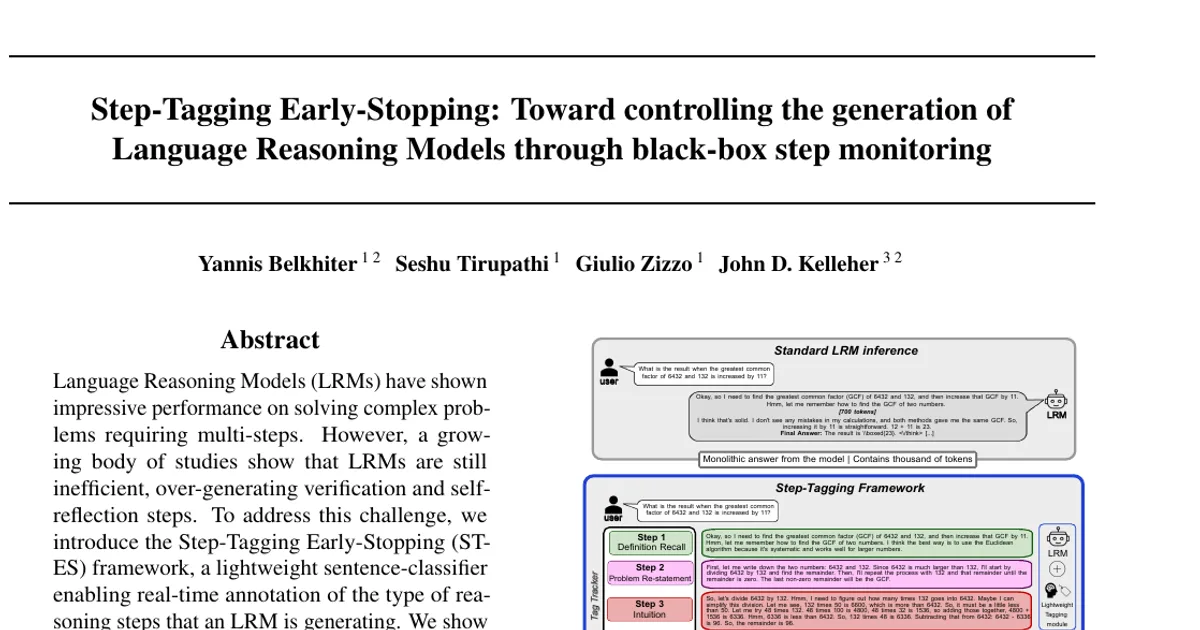
- Step-Tagging module. An online, lightweight sentence classifier that identifies the nature of each reasoning step generated by an LRM, enabling systematic monitoring of reasoning traces in a full black-box setting (no model internals, no proxy models).
- Step-Tagging Early-Stopping (ST-ES). An interpretable early-stopping framework that halts token generation based on the type and running count of reasoning steps, calibrated per model and problem complexity, framed as a constraint on the frequency of a chosen step type given a threshold delta.
- ReasonType taxonomy. A 13-category taxonomy of reasoning step types (including early behaviors such as Problem Re-statement and later stages such as Verification and Exploration), constructed by prompting GPT-4o-mini on sampled reasoning traces and manually merging overlapping labels.
- Empirical validation. Evaluation on three open-source LRMs (DeepSeek-R1-Distill-Llama-8B, DeepSeek-R1-Distill-Qwen-14B, QwQ-32B) across five reasoning datasets (MATH500, GSM8K, AIME, GPQA-Diamond, MMLU-Pro), reporting 20-50% token reduction while maintaining comparable accuracy to standard generation.
Main Findings
- Step type carries useful efficiency signal. The ST-ES curves systematically match or outperform the token-count baseline across configurations: for an equivalent token count, ST-ES achieves higher accuracy. This holds across the three models and the datasets studied.
- Each step type offers a distinct accuracy/token trade-off. Late reasoning step types such as Verification or Self-Talk stand above early types such as Problem Re-statement. On MATH500 with DS-Qwen14B, Verification with tau = 5 reaches 85% of the accuracy with only 50% of the token count.
- Verification and self-reflection are the best stopping targets. The paper reports that ST-ES criteria based on verification or self-reflection steps almost systematically beat the token-count baseline, and that these step types with delta < 10 offer satisfying efficiency trade-offs across datasets and models.
- Results are less stable on AIME and GPQA. The curves are described as noisier on these benchmarks, likely due to a lower number of samples and higher token counts relative to other datasets.
- Step-taggers are accurate and transferable. Binary BERT classifiers (bert-base-uncased with a single hidden layer) achieve Micro-F1 from 0.88 to 0.99 across models and datasets. Macro-F1 is lower, notably 0.69 on average for Heuristics, a rare step type representing less than 1.5% of labels. Scores remain high for Verification and Formula Substitution, including on unseen dataset and model configurations (DS-Llama8B, QwQ-32B, GSM8K, AIME, MMLU).
- Prompt-guided baselines are strong but ST-ES is competitive. Simple instructions to models reduce tokens by 20% to 60% across configurations, with better results on QwQ-32B and larger token reductions for system-prompt variants on the DeepSeek models. ST-ES outperforms most prompt-guided baselines for both DeepSeek models; on MATH500 (DS-Llama8B), ST-ES at 85% target accuracy achieved roughly the same token reduction as the zero-shot and three-example system prompts (around 30%) while achieving higher accuracy.
- Cross-domain generalization. On AIME, GPQA-Diamond and MMLU-Pro with DS-Qwen14B, all ST-ES configurations lie on the Pareto front, offering 30 to 55% token reduction with +2% to -5% accuracy for moderate configurations.
- Overall accuracy impact. Across the reported test results, ST-ES achieved up to 20-50% token-count saving with minimal accuracy loss, described as from +2% to -12% accuracy.
- GPT-4o-mini is a reliable annotator. On 1,000 reasoning steps from DeepSeek-R1-Distill-Qwen-14B on MATH500, GPT-4o-mini achieved a Fleiss' kappa of 0.780 across five repeated runs. Inter-model Cohen's kappa was 0.601 with GPT-4o, 0.457 with Llama-3-3-70b, and 0.392 with Mixtral-8x22B. GPT-4o's own Fleiss' kappa was 0.799, Llama-3-3-70b 0.722, and Mixtral-8x22B 0.587.
- Taxonomy labels are semantically meaningful (ablation). Models trained on Original ReasonType labels had lower, smoothly decreasing training loss and Macro average Precision and Recall between 0.76 and 0.90; models trained on shuffled labels had near-constant higher loss and Precision/Recall for the positive class between 0.00 and 0.06.
- Taxonomy generalizes to other models. Step-taggers trained on Phi-4-reasoning and Qwen3-30B-A3B-Thinking-2507 achieved macro-F1 of 0.7 to 0.98 and 0.63 to 0.87 for Phi-4 on MATH500 and GSM8K respectively, and 0.72 to 0.84 and 0.76 to 0.90 for Qwen3-30B-A3B. Lower macro-F1 on Exploration is attributed to its low representation (around 1% of labels).
- Annotation cost is significant. GPT-4o-mini annotation took roughly 0.83 to 0.88 seconds per step, with total runtimes such as 84,861 seconds for 96,270 steps on MATH500 with DS-Llama-8B and 97,494 seconds for 117,283 steps on MATH500 with QwQ-32B.
Methodology in Plain English
The researchers begin by splitting model outputs into reasoning steps using the delimiter "\n\n". To decide what kinds of steps exist, they generate 100 reasoning traces from the MATH500 training set using DeepSeek-R1-Distill-Llama-8B and QwQ-32B (20 samples per difficulty level for each model), yielding a pool of 6,897 reasoning steps (3,840 with 162 unique tags for DS-Llama-8B and 3,057 with 179 unique tags for QwQ-32B). Each step is passed to GPT-4o-mini with an open-ended prompt asking for step-type labels; the authors manually merge overlapping labels into the 13-category ReasonType taxonomy.
Because labeling every step with GPT-4o-mini at inference time is too slow, they instead use GPT-4o-mini to label a training corpus of reasoning traces, then train far lighter binary BERT classifiers (one per step type, rather than a single multi-class model, to handle class imbalance). Training data comes from the MATH500 and GPQA training splits generated by DS-Qwen14B with seed 42, and evaluation includes held-out configurations to test transfer.
For early stopping, they define a constraint: generation continues while the running count of a chosen step type is at or below a threshold delta, and stops when the count is exceeded. After stopping, the model is prompted for its current best answer with an additional budget of 100 tokens, an approach borrowed from Muennighoff et al. (2025). They sweep delta from 0 to 20 in the analysis, compare against a token-count baseline (with delta from 1 to 100-500), and against prompt-guided baselines: zero-shot user and system prompts, and few-shot system prompts with 1 and 3 examples.
Inference uses fixed random seeds with deterministic decoding: five seeds for GSM8K and MATH500 across all three model sizes, and a single seed on AIME, GPQA and MMLU with the 14B model. Answers are graded with Math-Verify for mathematics and MCQ-Prompting for knowledge and reasoning benchmarks. The AIME, GPQA and MMLU evaluations use full datasets of 90, 198 and 1,400 samples respectively, while MATH500 and GSM8K training sets used 1,000 and 3,000 samples.
Why This Matters
Impact on research. The work reframes LRM efficiency as a monitoring problem: instead of guessing a token budget in advance or inspecting hidden states, it shows that interpretable, text-level step categories can drive stopping decisions. It also supplies a reusable taxonomy and an open ablation methodology for validating step-level labels, and it connects to the growing literature on white-box (DEER) and gray-box (EAT) dynamic stopping by offering a strictly black-box alternative.
Real-world applications.
- Deploying reasoning models under latency or cost constraints, where a fixed token reduction of 20-50% translates directly into lower inference bills.
- Serving reasoning models behind APIs, where black-box compatibility matters because providers do not expose internals.
- Auditing or debugging long reasoning traces by seeing which step types a model produces, since the tagging layer annotates the flow as it happens.
- Building user-facing controls that let a system trade accuracy against response length per query or per difficulty level.
Industry relevance. The framework needs only generated text, so it can sit in front of any open-source reasoning model that exposes its reasoning trace, without model modification. The authors report that training costs of ST-ES are fully recovered by efficiency gains (Appendix F), and that trained tagging modules approximate GPT-4o-mini annotation (Appendix G), which matters for teams that want to avoid per-step calls to a large proprietary annotator. The paper's affiliations (Trinity College Dublin, IBM Research Europe, ADAPT) and funders (6G-XCEL under EU Horizon Europe grant 101139194; ADAPT under Research Ireland Grant 13/RC/2106 II) indicate direct relevance to applied research and infrastructure settings.
Future Directions
- Apply ST-ES to other taxonomies. The authors note ReasonType may not be optimal and call for testing ST-ES against taxonomies from Galichin et al. (2025), Marjanović et al. (2026), Minegishi et al. (2025), and Venhoff et al. (2025).
- Make delta dynamic. ST-ES currently requires calibration to pick the step type and threshold value, and models are described as sensitive to delta. Future work should experiment with dynamic delta to make the criterion more agnostic.
- Reduce calibration burden. Finding the best per-model, per-complexity configuration remains manual, and the authors flag this as a practical limitation.
- Broaden domain coverage. The paper suggests the OpenThoughts-114k dataset could help overcome domain dependency by providing more diverse model behaviors, though at high processing cost.
Target Audience
Researchers and practitioners working on efficient inference, inference-time scaling, and reasoning model deployment will get the most from this paper. It is also useful for engineers who need a black-box, drop-in efficiency layer for open-source reasoning models, and for scientists studying step-level reasoning traces, model behavior taxonomies, or LLM-as-annotator reliability, since the appendices provide detailed validation of annotation consistency and taxonomy robustness.
Authors’ abstract
The field of Language Reasoning Models (LRMs) has been very active over the past few years with advances in training and inference techniques enabling LRMs to reason longer, and more accurately. However, a growing body of studies show that LRMs are still inefficient, over-generating verification and reflection steps. To address this challenge, we introduce the Step-Tagging framework, a lightweight sentence-classifier enabling real-time annotation of the type of reasoning steps that an LRM is generating. To monitor reasoning behaviors, we introduced ReasonType: a novel taxonomy of reasoning steps. Building on this framework, we demonstrated that online monitoring of the count of specific steps can produce effective interpretable early stopping criteria of LRM inferences. We evaluate the Step-tagging framework on three open-source reasoning models across standard benchmark datasets: MATH500, GSM8K, AIME and non-mathematical tasks (GPQA and MMLU-Pro). We achieve 20 to 50% token reduction while maintaining comparable accuracy to standard generation, with largest gains observed on more computation-heavy tasks. This work offers a novel way to increase control over the generation of LRMs, and a new tool to study behaviors of LRMs.