Research
Stemming Hallucination in Language Models Using a Licensing Oracle
Overview Research area: Natural Language Processing / trustworthy AI, specifically hallucination mitigation through architectural (neuro-symbolic) rather than statistical means. Technical level: Inter
- arXiv
- 2511.06073
- Published
- 2025-11-08
- Authors
- Simeon Emanuilov, Richard Ackermann
AI summary
Overview
Research area: Natural Language Processing / trustworthy AI, specifically hallucination mitigation through architectural (neuro-symbolic) rather than statistical means. Technical level: Intermediate — the abstract assumes familiarity with language model generation, fine-tuning, retrieval-augmented generation, and knowledge graphs, though the core idea is explained conceptually. Scope: The paper proposes and evaluates a deterministic "Licensing Oracle" that validates generated claims against structured knowledge graphs, claiming perfect abstention precision and zero false answers in a comparison against several existing mitigation strategies.
What This Paper Is About
Language models produce fluent, syntactically coherent text that can still be factually wrong, and this work treats that hallucination problem as one that statistical remedies may not fully solve. The authors propose the Licensing Oracle: a component embedded directly in the model's generation process that checks candidate claims against structured knowledge graphs and permits only validated claims to be emitted. The goal is to determine whether enforcing truth constraints architecturally can outperform approaches based on data scaling, fine-tuning, or retrieval.
Key Contributions
- Introduces the Licensing Oracle, described as an architectural solution that inserts a deterministic validation step into the generative process, constraining output to claims that pass formal validation against structured knowledge graphs.
- Frames the problem as architectural rather than statistical, explicitly contrasting the approach with methods that rely on data scaling or fine-tuning.
- Reports a comparative evaluation against four reference methods: baseline language model generation, fine-tuning for factual recall, fine-tuning for abstention behavior, and retrieval-augmented generation (RAG).
- Claims a necessity-and-sufficiency argument for domains with structured knowledge representations, asserting that such architectural innovations offer guarantees that statistical methods cannot match, and positions the framework as groundwork for truth-constrained generation more broadly.
Main Findings
- Statistical and retrieval methods improve but do not solve the problem: The abstract states that although RAG and fine-tuning improve performance, they fail to eliminate hallucinations.
- Perfect abstention precision: The Licensing Oracle reportedly achieved an abstention precision (AP) of 1.0, meaning that when it declined to answer, it did so appropriately in every reported case.
- Zero false answers: The reported false answer rate (FAR-NE) was 0.0, meaning no invalid claims were produced according to the paper's evaluation.
- High but not perfect factual accuracy: Factual responses were reported at 89.1% accuracy, so the oracle is not claimed to answer everything correctly — the abstract does not explain what happens in the remaining cases beyond the abstention and false-answer figures.
- Domain-limited guarantee: The claimed guarantees apply specifically to fact-based domains that have structured knowledge representations; the abstract does not extend the guarantee to open-ended or unstructured knowledge settings.
- Broader framing: The authors position the framework as a foundation for truth-constrained generation in future AI systems rather than as a general-purpose fix.
- Missing detail: The abstract gives no information about model sizes, the specific knowledge graphs used, dataset composition, evaluation scale, or the mechanics of the validation procedure.
Methodology in Plain English
The authors build a validation layer that sits inside the model's generation pipeline. Rather than trusting the model's own probability estimates, candidate claims are checked deterministically against a structured knowledge graph — the oracle "licenses" a claim only if the knowledge graph supports it. If a claim cannot be licensed, the system abstains instead of asserting it. To judge whether this works better than existing practice, the authors ran experiments comparing the oracle against a plain language model, two fine-tuned variants (one trained for factual recall, one trained to abstain), and retrieval-augmented generation. The comparison is reported using abstention precision, a false answer rate, and factual accuracy. The abstract does not describe how claims are parsed or decomposed for validation, how the knowledge graph is queried, or how the experiments were set up beyond naming the comparison arms.
Why This Matters
Impact on research: The paper argues that hallucination may be an architectural deficiency rather than purely a data or training shortfall, and that in structured-knowledge domains deterministic validation can provide guarantees that scaling, fine-tuning, and retrieval cannot. If the reported results hold, it reframes hallucination mitigation as a systems-design problem, strengthening the case for neuro-symbolic and verification-first generation pipelines.
Potential real-world applications (all contingent on the structured-knowledge requirement the abstract states):
- Factual question answering over curated enterprise or institutional knowledge bases.
- Regulated domains such as healthcare or finance, where emitting an unsupported claim is costlier than declining to answer, making the abstention behavior the key selling point.
- Customer-facing systems built on product catalogs, policy documents, or other structured internal data.
- Compliance, audit, and record-keeping contexts where every generated statement needs traceable backing.
Industry relevance: The value proposition is a system that abstains rather than guesses, which is attractive where incorrect statements carry legal, financial, or safety consequences. The trade-off is dependency on a structured knowledge graph, which limits applicability to organizations that already maintain one or are willing to build it. The abstract offers no latency, cost, or deployment analysis.
Future Directions
- Extending beyond structured knowledge: The abstract explicitly notes the oracle is designed for fact-based domains with structured knowledge representations; generalizing to unstructured or open-domain knowledge remains open.
- Reconciling the 89.1% figure with the zero-false-answer claim: The abstract does not explain what happens to the roughly one-in-ten factual responses that are inaccurate, nor how the abstention and false-answer metrics were defined.
- Combining approaches: Whether the oracle complements RAG, fine-tuning, or abstention training — rather than replacing them — is not addressed.
- Knowledge graph limitations: Questions of coverage, staleness, contested facts, and maintenance cost are not covered and would determine practical viability.
- Reproduction and benchmarking: The abstract provides no dataset, model, or knowledge graph details, so independent verification and standardized benchmarking are natural next steps.
Target Audience
Researchers working on hallucination, factuality, and neuro-symbolic or verification-based generation; engineers designing factual QA and enterprise assistants over structured data; knowledge graph practitioners interested in how graphs can constrain model output; and evaluation or trust-and-safety teams assessing whether architectural guarantees are a viable alternative to statistical mitigation. Readers looking for empirical specifics — datasets, model configurations, or cost analysis — will not find them in the abstract.
Authors’ abstract
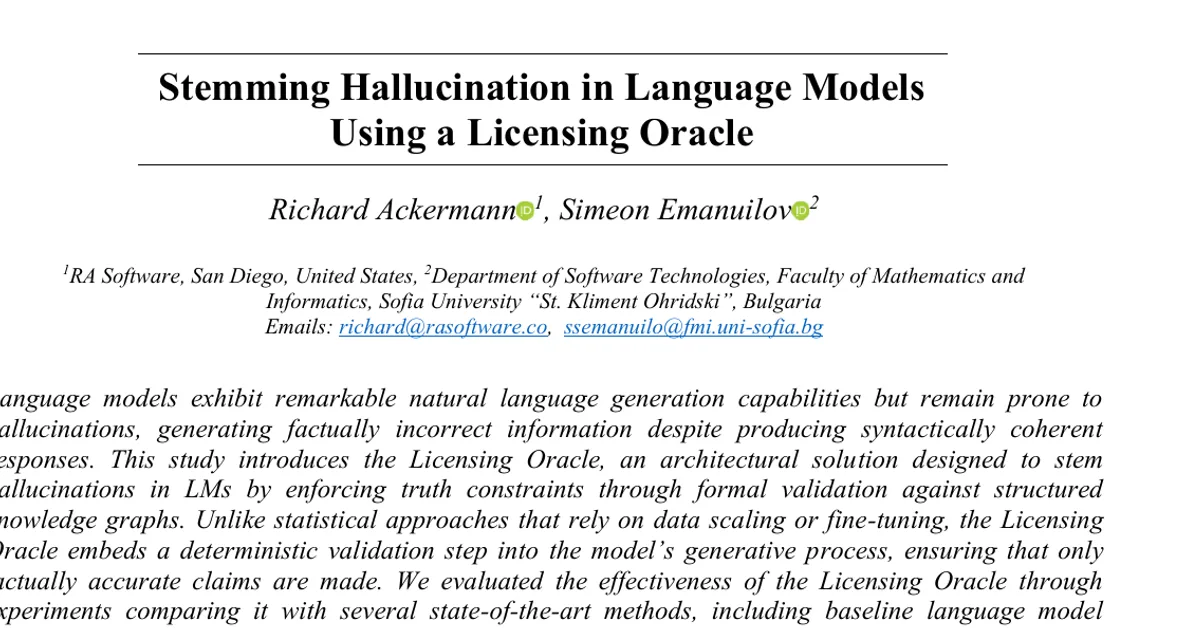
Language models exhibit remarkable natural language generation capabilities but remain prone to hallucinations, generating factually incorrect information despite producing syntactically coherent responses. This study introduces the Licensing Oracle, an architectural solution designed to stem hallucinations in LMs by enforcing truth constraints through formal validation against structured knowledge graphs. Unlike statistical approaches that rely on data scaling or fine-tuning, the Licensing Oracle embeds a deterministic validation step into the model's generative process, ensuring that only factually accurate claims are made. We evaluated the effectiveness of the Licensing Oracle through experiments comparing it with several state-of-the-art methods, including baseline language model generation, fine-tuning for factual recall, fine-tuning for abstention behavior, and retrieval-augmented generation (RAG). Our results demonstrate that although RAG and fine-tuning improve performance, they fail to eliminate hallucinations. In contrast, the Licensing Oracle achieved perfect abstention precision (AP = 1.0) and zero false answers (FAR-NE = 0.0), ensuring that only valid claims were generated with 89.1% accuracy in factual responses. This work shows that architectural innovations, such as the Licensing Oracle, offer a necessary and sufficient solution for hallucinations in domains with structured knowledge representations, offering guarantees that statistical methods cannot match. Although the Licensing Oracle is specifically designed to address hallucinations in fact-based domains, its framework lays the groundwork for truth-constrained generation in future AI systems, providing a new path toward reliable, epistemically grounded models.