Research
StateSpace-SSL: Linear-Time Self-supervised Learning for Plant Disease Detection
Overview Research area: Computer vision for agriculture — self-supervised representation learning for plant disease detection, combining Vision Mamba state-space models with multi-crop teacher–student
- arXiv
- 2512.09492
- Published
- 2025-12-10
- Authors
- Abdullah Al Mamun, Miaohua Zhang, David Ahmedt-Aristizabal, Zeeshan Hayder, Mohammad Awrangjeb
AI summary
Overview
- Research area: Computer vision for agriculture — self-supervised representation learning for plant disease detection, combining Vision Mamba state-space models with multi-crop teacher–student self-distillation.
- Technical level: Advanced. The paper assumes familiarity with self-supervised learning pipelines (SimCLR, BYOL, DINO), Vision Transformers, and state-space sequence models.
- Scope: The paper proposes StateSpace-SSL, a linear-time self-supervised pretraining framework built on a Vision Mamba encoder, and evaluates it against CNN- and transformer-based SSL baselines on three plant disease datasets (arXiv:2512.09492v2, from Griffith University and CSIRO Data61).
What This Paper Is About
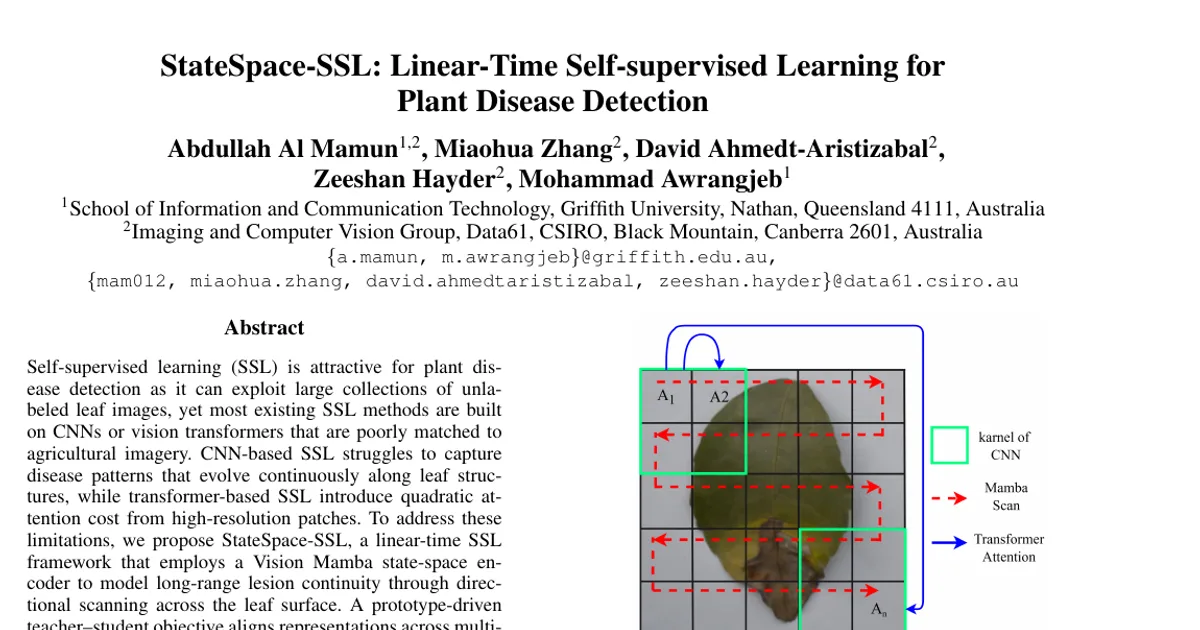
Plant disease detection benefits from self-supervised learning because it can exploit large pools of unlabeled leaf images, but existing SSL methods use either CNNs — whose local receptive fields miss disease patterns that spread continuously along leaf structures — or transformers, whose attention cost grows quadratically with token count and becomes expensive on high-resolution leaf images with multi-crop augmentation. The goal is an SSL framework that captures long-range lesion continuity across the leaf while scaling linearly rather than quadratically.
Key Contributions
- A self-supervised learning framework, StateSpace-SSL, that uses a Vision Mamba (VM) state-space encoder to capture long-range dependencies in leaf imagery with linear-time complexity, targeting high-resolution agricultural images.
- A prototype-based teacher–student self-distillation strategy that aligns global and local views through shared prototypes, yielding stable, lesion-aware representations without quadratic computational cost.
- A demonstration that combining state-space modelling, multi-crop self-supervision, and prototype alignment produces a lightweight architecture (19M parameters) that balances accuracy, robustness, and efficiency for agricultural deployment.
- Empirical evidence across PlantVillage, PlantDoc, and Citrus that the proposed model outperforms CNN- and transformer-based SSL baselines while using less training time and memory.
Main Findings
- Highest accuracy on all three benchmarks: StateSpace-SSL reaches 94.61 on PlantVillage, 91.24 on PlantDoc, and 89.83 on Citrus. The closest transformer baseline, DINO (ViT-S), scores 93.1, 88.6, and 89.4 respectively; the strongest CNN baseline, MaskCOV (RN50), scores 92.0, 86.6, and 89.6.
- Largest gains under field conditions: The margin is described as especially pronounced on PlantDoc, the field-image dataset where background clutter and lighting variation typically degrade attention-driven models.
- Smallest and simplest backbone: The VM backbone has 19M parameters, compared with 22M for DeiT, TransFG, and DINO (ViT-S), 23M for the ResNet-50 SSL baselines, 45M for Hybrid ViT (ViT-S + RN50), and 86M for MAE (ViT-B).
- Linear rather than quadratic scaling: Most transformer baselines scale quadratically in tokens (QT), while StateSpace-SSL scales linearly in tokens (LT), so compute grows proportionally rather than explosively with input size.
- Faster pretraining and lower memory: StateSpace-SSL converges in 9 hours using 8.7 GB of VRAM, versus 17 hours / 16.5 GB for DeiT, 18 hours / 17.0 GB for TransFG, 20 hours / 17.8 GB for DINO, 24 hours / 19.8 GB for Hybrid ViT, and 30 hours / 22.6 GB for MAE.
- Lower per-epoch cost: StateSpace-SSL completes each epoch in approximately 1.8 minutes, compared with 3.4–4.8 minutes for DeiT, DINO, and Hybrid ViT, and around 6 minutes for MAE.
- More focused localisation: Grad-CAM comparisons on two sample images show DINO frequently producing diffuse or background-oriented activations near leaf boundaries, while StateSpace-SSL produces more compact, lesion-centred responses.
- Stated limitation: The method may still struggle when symptoms are extremely subtle or occupy only small regions of the leaf, where additional spatial precision may be needed.
Methodology in Plain English
The researchers replaced the attention mechanism of transformer-based SSL with a Vision Mamba encoder, which processes image patches as a sequence and updates a hidden state step by step using learnable matrices and a gate. Because this update is a recurrence rather than an all-to-all comparison, its cost grows linearly with the number of patches instead of quadratically.
Training follows a teacher–student design. Each unlabeled image is turned into two global crops of 224×224 pixels and six local crops of 96×96 pixels. The student encoder processes one global view and the six local views (seven views in total), while the teacher encoder is given only global views to produce stable targets. Both encoders end in a lightweight two-layer MLP projection head, and their outputs are converted into prototype distributions with temperature-scaled softmax. The student is trained to match the teacher's prototype distribution using a cross-entropy-style loss over K prototypes. Teacher weights are not trained by gradients; they are updated as an exponential moving average of the student weights, with the momentum scheduled to increase during training. The student's parameters are optimised with AdamW.
Experiments ran on 10 NVIDIA GPUs with 11 GB each, using PyTorch 2.1, Mamba-SSM v2.2.3, DistributedDataParallel with NCCL, CUDA 11.8, Python 3.10, and Ubuntu 20.04. The three evaluation datasets are PlantVillage (over 54,000 clean laboratory leaf images, 38 classes), PlantDoc (2,598 field images, 28 diseases), and Citrus (609 high-resolution images, five disease types).
Why This Matters
- Impact on research: The paper is described as the first to bring state-space models into self-supervised plant disease detection, positioning linear-time recurrence as an alternative inductive bias to convolutional locality and quadratic attention. It suggests that the directional, sequential scanning of a state-space model aligns naturally with how lesions progress continuously across leaf surfaces.
- Real-world applications:
- Early field diagnosis of crop disease from leaf photographs taken by growers or extension workers.
- Mobile or edge deployment, where the 19M-parameter backbone and 8.7 GB pretraining footprint suit resource-constrained hardware.
- Large-scale pretraining on unlabeled agricultural image collections, since the framework avoids the memory bottleneck of multi-crop transformer SSL.
- Cross-domain monitoring, where models pretrained on clean laboratory imagery must still work on cluttered field images such as PlantDoc.
- Industry relevance: Agricultural technology providers and plant phenotyping groups need models that are both accurate and cheap to train and run. The reported combination of higher accuracy with lower training time (9 hours versus 17–30 hours) and lower memory directly targets that trade-off, and the linear scaling claim matters for pipelines that keep increasing image resolution.
Future Directions
- Incorporating cross-scale mechanisms or auxiliary spectral cues to improve sensitivity when symptoms are extremely subtle or occupy only a small leaf region, as the authors propose.
- Testing whether the linear-time advantage persists at higher input resolutions and with larger crop counts, since the framework's main selling point is scalability.
- Extending evaluation beyond the three reported datasets to more crop species, seasons, and field conditions, given that annotations are described as difficult to maintain across species and seasons.
- Investigating how the state-space encoder behaves on other fine-grained agricultural tasks, such as severity grading or lesion boundary delineation, where the paper notes additional spatial precision may be required.
Target Audience
Researchers and practitioners in computer vision and agricultural AI who work on self-supervised representation learning, efficient sequence models, or plant disease recognition. It is also relevant to engineers building deployable field-diagnosis systems who need to weigh accuracy against training time and memory, and to readers already familiar with DINO-style teacher–student SSL who want to understand how state-space encoders compare with attention-based backbones.
Authors’ abstract
Self-supervised learning (SSL) is attractive for plant disease detection as it can exploit large collections of unlabeled leaf images, yet most existing SSL methods are built on CNNs or vision transformers that are poorly matched to agricultural imagery. CNN-based SSL struggles to capture disease patterns that evolve continuously along leaf structures, while transformer-based SSL introduces quadratic attention cost from high-resolution patches. To address these limitations, we propose StateSpace-SSL, a linear-time SSL framework that employs a Vision Mamba state-space encoder to model long-range lesion continuity through directional scanning across the leaf surface. A prototype-driven teacher-student objective aligns representations across multiple views, encouraging stable and lesion-aware features from labelled data. Experiments on three publicly available plant disease datasets show that StateSpace-SSL consistently outperforms the CNN- and transformer-based SSL baselines in various evaluation metrics. Qualitative analyses further confirm that it learns compact, lesion-focused feature maps, highlighting the advantage of linear state-space modelling for self-supervised plant disease representation learning.